Film Name: 陀地驱魔人 / Keeper of Darkness / 陀地驅魔人
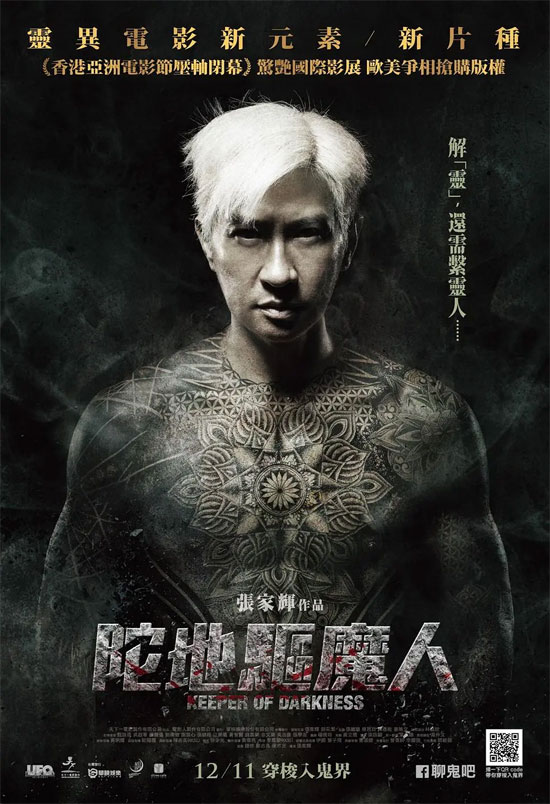
The rating on Douban isn’t high, only 6.4, but I personally think this movie deserves at least a 9.
After reading the reviews, the main points of dissatisfaction seem to be:
1. It’s not scary enough for a horror film.
(This level of horror is just right—it appeals to a wider audience. Plus, the overall visual style and effects are excellent. I really liked the eerie black smoke accompanying the ghosts. Also, while most horror films have ghosts moving on skateboards, this one uses a floating, constantly drifting effect—clearly a thoughtful production choice. Do people prefer horror films with only terrifying plots but weak storytelling, or horror films with richer narratives?)
2. The romance subplot feels forced.
(The romance serves to develop the male lead more deeply and nuancedly—I’ll elaborate below on how astonishingly intricate this film’s portrayal is.)
3. Several plot threads (like the tattoos and the mother) remain unresolved.
(Given the film’s runtime constraints, it delivers a relatively complete story packed with intricate details—a testament to its conscientious production. Unresolved elements could serve as setup for a potential sequel, or even without one, they leave room for open-ended interpretation and audience imagination.)
Now, as a detail-obsessed viewer, let me dissect the film’s nuances.
(Warning: The following contains major spoilers—and they’re poorly handled…) .)
Fa-chai, portrayed by Nick Cheung, is a kind-hearted, innocent yet “fierce” individual (a fierceness cultivated by the young Fa-chai to outdo ghosts). He repeatedly risks his life to save strangers, even covering the black marks left after each exorcism with tattoos—so many that his body can no longer accommodate them—yet he never backs down. For years, he has consistently helped anyone in need. (Later, it’s revealed this stems from witnessing his mother jump to her death as a child and being powerless to save her. But his inherent kindness shines through in countless moments.)
Yet this deeply compassionate man treats Xue, the female ghost who cares for and loves him, with repeated coldness. During their warm daily chats, whenever Xue asks if he likes her or if he’d cry after she leaves, he simply shakes his head and ends the conversation. I too once believed their bond was purely friendship, or that Fa Zi’s feelings for Xue were familial (replacing his deceased mother). Yet he harbors some affection for her, though his rationality—knowing humans and ghosts are worlds apart—compels him to draw boundaries, denying her any chance. (When Fa Zi finally confesses, he mentions Xue had asked this very question countless times before—details, oh details! Her look of disappointment reveals it wasn’t just the three times shown in the film, but countless times!)
By the end, when Fa Zi took Xue—now inhabiting the body of the female lead—out on a day-long date, I still harbored doubts. Was this merely a “friendship date” where Fa Zi, as her longtime friend, accompanied Xue through her final day in the sunlight? But when I saw him laugh so joyfully—a laugh uncharacteristic of his age, childlike in its pure, radiant brightness—I knew. He loved Xue.
This is where the film’s characterization shines with nuance. Though Fa Zai is in his forties, he retains a childlike innocence and purity—you can feel his childlike heart. When Xue asks him why he doesn’t make more friends, his reply, “Don’t you think people are far more complicated than ghosts?” reveals this depth. His long-suppressed feelings for Xue mirror this vulnerability. His heart remains that of the wounded boy he once was, making it difficult for him to express love—for fear of being hurt again.
In everyday flashbacks, Fa Zi often takes the initiative: hunching over to scare Xue, wearing a ghost mask to make her laugh, or starting the bare-handed ping pong game. This contrasts sharply with his earlier coldness toward Xue in the film, making the transformation all the more poignant.
In the final moments, when Fa-zai chases Xue to the ghost realm to confess his feelings, he adjusts his collar before speaking (a detail that utterly captivates me):
You keep asking me if you matter in my life. I say no, because you matter more than my life itself.
You ask if I’ll cry when you leave. I shake my head and say no, because I already wish I were dead.
Your silliest question is whether I like you, if I still like you? Because I love you.
Throughout the entire film, did you ever feel that Fa Zai was already in his forties? If not, that’s the film’s triumph—the success of director and lead actor Nick Cheung. Don’t view this romance through horror-film lenses; examine it through character development. Then this love story feels neither forced nor jarring, but rather plays a vital role in shaping the characters. It’s precisely this romance, these cheesy moments from Fa-zi’s youth, that reveal him not just as a cold-hearted exorcist, but as a big kid with a childlike heart.
Fa-zi’s mother often scolds and hits him, yet during meals, they sit in silence. She silently passes him the last piece of vegetable, then slaps his hand for improper chopstick use. Afterward, she quietly pours the remaining soup over her plain rice. This brief, simple scene masterfully conveys the mother’s complex emotions, showcasing the director’s meticulous care.
Perhaps because he both directed and starred in the film, Zhang Jiayi was able to portray Fa Zai with even greater depth and nuance. His performance is truly remarkable, and I sincerely hope everyone can see the dedication and artistry he poured into this role.
My early impression of Zhang Jiayi was rooted in comedy—he seemed to play mostly comedic, minor characters and wasn’t particularly well-known. It wasn’t until his lead role in Unbeatable a few years ago that I sensed his shift toward playing muscular tough guys. He subsequently starred in numerous Hong Kong cop thrillers, but the downside of such roles is that they rarely showcase acting beyond action sequences. This film, The Devil’s Advocate, revealed his nuanced acting skills, allowing me to see extraordinary charisma beneath his unassuming appearance. I truly never imagined his acting could reach such heights.
What makes this even more remarkable is that he also directed it. I usually seek out directors’ backgrounds and explore their other works after seeing a great film, because crafting a truly exceptional directorial piece is incredibly rare. Take some big-name directors today—they may have fame, but what about their work? After watching their films without knowing who directed them, you wouldn’t even think to look up the director. The experience leaves little to savor afterward, let alone inspire reflections or reviews—at most, you might jot down a brief complaint.
A masterpiece like this demands your full attention. Once you start watching, settle in and give it your undivided focus. Even if it has minor flaws, they pale in comparison to its brilliance. Don’t let it go to waste.
Please specify:Anime Phone Cases » Keeper of Darkness 2015 Film Review: A masterpiece that absolutely scores full marks in detail and character portrayal.