Film Name: 三更2 / Dumplings – Three… Extremes
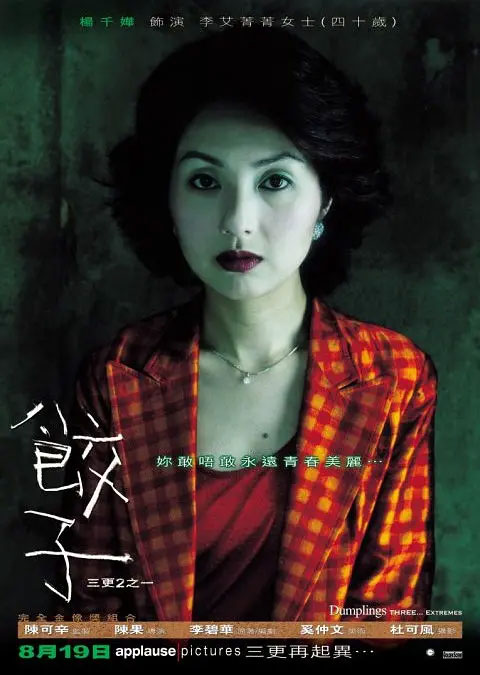
The entire film unfolds like a fragmented dream. The narrative is woven together by disjointed dream sequences. Directed by Miike Takashi, it’s hard to imagine this filmmaker—known for his penchant for gore and violence—crafting such an aesthetically eerie, vividly colorful work.
All tragedy stems from human nature—jealousy. Kyoko, consumed by envy over the circus master’s affection for her sister, locks her sister in a box and accidentally burns both her and the master to death. As the young Kyoko watches the circus engulfed in flames, whether she feels terror or sorrow, confusion or despair, is impossible to say. This was never her intention. She merely wished to confine her sister for one night, then take her place in the ringmaster’s embrace to experience happiness. Yet it all culminated in the utter destruction of everything.
Watanabe portrays two roles in this film: the ringmaster and the editor. As an adult, Kyoko becomes a writer. Upon first encountering the editor, who bears a striking resemblance to the ringmaster, she feels an irresistible urge to touch him. As the editor departed, he gifted Kyoko a music box. The melody inside was the very one she and her sister had performed to in childhood. That music drew Kyoko back into a dream. Standing on this side of time, she watched her past self on the other side—witnessing how the Troupe Leader doted on her sister, placing a reward necklace around her neck. She witnessed how pitifully she had spied on the troupe leader’s affection for her sister, how jealousy had driven her to accidentally burn her sister to death.
In one scene, Kyoko stood alone in a vast snowy landscape, her face heavily made up, half-concealed by a clown mask. The editor approached and asked, “What are you looking for?” “Someone,” she replied. “Could that person be me?” the editor probed. “You do bear a striking resemblance to him.” Kyoko gave a cold laugh, then walked alone back into the icy wilderness. She was likely searching for the ringmaster. The tears hanging from the clown mask on her face probably symbolized the love deep within her heart that could never be fulfilled.
The film’s climax is the scene where Kyoko enters the circus for the last time. Gazing at the box containing her sister, she murmured mournfully, “Sister, do you know… you were the one I loved most?” The circus master entered, still wearing the mask Kyoko recognized. When he tore it off, revealing a bloody scar on his forehead, Kyoko shuddered in terror. That scar was from when she had injured him as a child. The ringmaster roughly pried open Kyoko’s eyes, forcing her to look at her sister inside the box. Kyoko wept bitterly, repeating only, “I’m sorry.” The ringmaster then softened, placing a necklace around Kyoko’s neck and saying, “You thought I only loved your sister, but actually… I prepared a necklace for you too.” He then kissed Kyoko gently. In that moment, Kyoko finally exposed the desire that had been pent up inside her for years. She had always loved him. Perhaps it was precisely this love, tinged with paternal affection, that had driven her to mistakenly kill her sister. Kyoko began kissing the leader. Even as his demeanor remained distant, she persisted. Finally, he responded—passionately, fully immersed. Just as their emotions reached their peak, the leader suddenly pulled a plastic bag over Kyoko’s head. His voice twisted with anguish: I don’t know which is more beautiful—you now or her back then. You two are the perfect union. How could only one of you live?” The leader rolled Kyoko’s body into a bundle like a doll, stuffed her into the box containing her sister, and buried it deep within the endless snow. Struggling, struggling, Kyoko awoke. It was that dream again. Only this time, upon waking, her sister lay beside her.
One of the most haunting scenes in the film is that of Kyoko, conjoined with her younger sister, standing on the balcony. The crisp winter morning light bathes the deformed conjoined twins in a warm, radiant glow. Their gazes are fixed ahead, endlessly vacant. That sense of hopelessness beneath the illusion of hope sends a chill down the spine.
Many viewers interpret the entire story as the delusion of a conjoined writer. The editor, bearing an uncanny resemblance to the cult leader, is merely a lonely, deformed individual craving love—a projection of romantic and sexual fantasies. Yet I prefer to believe this cruel, horrific childhood memory is real. What was conjoined to Kyoko was not her physical sister, but her own inescapable guilt toward her. Thus, the figure depicted as conjoined with Kyoko is her younger sister.
Some dreams aren’t impossible to awaken from; rather, the dreamer refuses to wake. That memory, haunting her for a lifetime, transformed into a dream that twists and entangles within Kyoko’s existence. Even when she awakens drenched in sweat each time, she clings tightly to the dream. For without that dream, she would have nothing left. Within that dream dwell the two she cherished most: her sister and the Troupe Leader. That is why, when the editor asked, “Could it be me?”, she could not give him an answer. Some people, some things, are simply irreplaceable.
Hearing Kyoko say, “My sister and I have never parted,” brought an inexplicable warmth to my heart. When we have nothing left, is there not another self deep within us, one that will never leave us?
Please specify:Anime Phone Cases » Dumplings – Three… Extremes 2004 Film Review: The Buried Dream’s “Coffin”