Film Name: 旺角黑夜 / One Nite in Mongkok
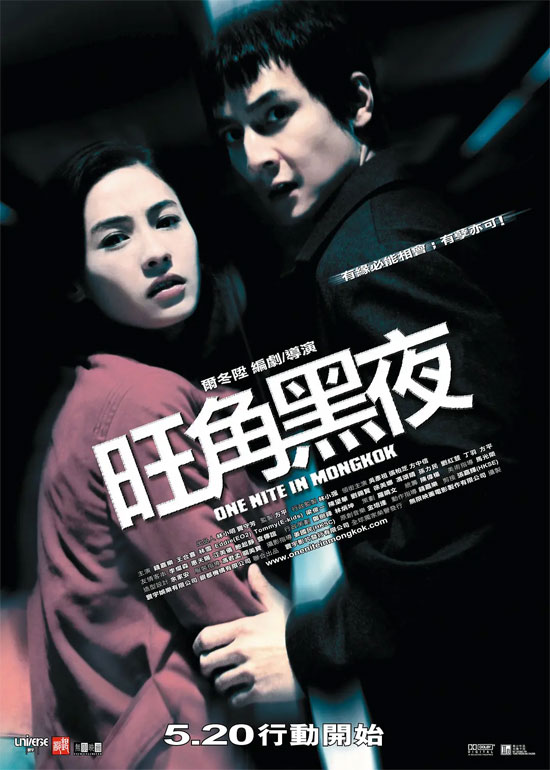
Since the turn of the century, Hong Kong cinema has exhibited a significant shift compared to the frenetic boom of its golden age: the emergence of numerous meticulously crafted, rigorously structured scripts that prioritize narrative integration and character depth. The pinnacle of this trend is represented by “Infernal Affairs,” while many works from the Milky Way Image team also showcase dazzling scriptwriting prowess. Occasionally, unexpected gems also surface. Eddie Rui Xing, long adept at social realism, wrote and directed “One Nite in Mongkok” in 2004. Though it won the Hong Kong Film Award for Best Screenplay that year, it remains an underrated gem. Looking at this century, aside from “Infernal Affairs,” it’s hard to find another Hong Kong film script that can match “One Nite in Mongkok” in terms of character depth and plot construction.
The outsider’s perspective, gangster prostitutes, urban crime, good and bad people yearning for self-redemption, inescapable dark absurd fate, “One Nite in Mongkok” is rooted in film noir, setting it apart from other Hong Kong Mongkok crime films like “As Tears Go By,” “Man Wanted,” “Once Upon a Time in Triad Society,” and “To Live and Die in Mongkok.” As Bordwell once noted, a key feature of “Infernal Affairs” was its absorption of Hollywood screenwriting strengths to create a highly symmetrical dual-plot confrontation structure unprecedented in Hong Kong cinema. “One Nite in Mongkok” both continues and reinvents this trait. The traditional Hong Kong film approach of collective brainstorming and collaborative plot-building is entirely discarded, while character development breaks free from highly typified, caricatured patterns. Regarding script symmetry and balance, “One Nite in Mongkok” delves deeper and more subtly than “Infernal Affairs,” operating on a more nuanced, pervasive level. The script’s structure features subtle echoes throughout, resonating with the dark, fateful theme.
The film’s timeline follows a present-flashback-present structure, with the main story unfolding on the evening of December 24th, Christmas Eve. The title “Peaceful Night” carries inherent irony from the outset. The choice of the present moment as the narrative entry point is also deliberate. Sir Miu (Fong Chung-Tung) and Ghost Brother (Chin Ka-lok) sit on the steps, sighing helplessly: “If it’s meant to be, we’ll bump into each other,” “Or maybe it’s karma.” This directly introduces the dark fatalism theme. The flashbacks primarily establish the origins of the conflict. Two gangs fighting over mainland tourists in Mong Kok, with a coin dropping into a gutter—this visual sequence (like a pebble creating ripples) swiftly hints at and outlines the narrative structure’s progression. These are exceptionally fluid, concise, and seasoned storytelling techniques, commonplace in Hollywood films but rarely seen in traditional Hong Kong cinema.

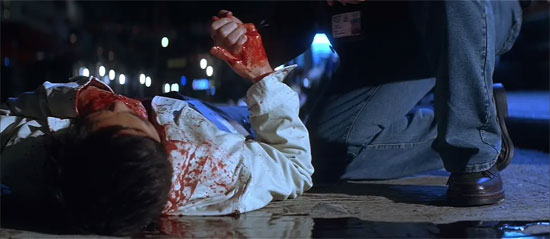
The screenplay invests significant effort in its symmetrical structure, a crucial yet easily overlooked feature of the film. The initial conflict is sparked by the respective underlings of Ah Tin and Nine’s fellow gang brothers: Ah Tin’s son Tiger on one side, and Nine’s subordinate Liang Fai (played by Lee Chan-sum) on the other. This forms the first layer of symmetry. Subsequently, this conflict intertwines with the second layer of symmetry involving the police and Lai Fook (played by Daniel Wu). Within the police force, both Sir Miao and Binzi are accidental killers yearning for redemption, forming another layer of symmetry. The fourth layer emerges between Lai Fu and Dan Dan (Cecilia Cheung) as fellow mainlanders in Hong Kong, Hunan natives, and struggling members of society’s underclass. Even the perpetually clashing couple Lao Liu (Ray Lam) and Su’er, alongside Su’er and Dan Dan, create symmetrical dynamics. Crucially, Lai Fu and Bin Zai share a vital symmetry. Both enter new environments as outsiders. Bin Zai accidentally kills a drug dealer, only to be accidentally killed by Lai Fu himself. Within the overarching conflict structure, Lai Fu is indirectly ordered by Ah Tin to kill Nine Brother, yet the Su Er he truly seeks is precisely Ah Tin’s daughter-in-law. Symmetry also emerges in events and character circumstances. Lai Fook wields violence by headbutting, and the violence inflicted upon him culminates in the climactic scene—also involving headbutting. Lai Fook discards his gun, attempting to escape the trap, only to retrieve it in the end. Bin Zai cannot evade his fate of being shot. Sir Miao, burdened by guilt after killing a prisoner, ultimately finds closure by legally shooting a criminal. In the climactic scene, as Bin-zai lies dying, Ghost Brother grips his struggling hand. The dying Lai-fook also extends his hand, yearning to be held. Just as Sir Miao hesitates to grasp it, Lai-fook’s hand falls limp. This multi-layered, nested topological symmetry—a looping, interconnected structure—serves as a powerful engine driving the film’s tension. Symmetry, of course, also serves as a metaphor for the theme of karmic retribution.
Another constant source of tension stems from the meticulous design of the characters’ predicaments. While ensemble Hong Kong films abound, few achieve this level of depth where characters shine not through overtly flashy traits (so-called caricatures), but through the ingenuity of their situations. Every character in the film is trapped in a predicament of awkwardness, helplessness, and impossible choices. Regardless of their moral standing, they all struggle in their respective corners of the city. Inspector Miao, burdened by the immense psychological weight of killing a prisoner, faces his wife’s departure. During this manhunt, he must not only find the rat (Lai Fook) but also outmaneuver the relevant authorities. New recruit Bin-chai desperately wants to catch Wu Shu but accidentally kills a drug dealer instead. He struggles to accept Sir Miu and Ghost’s methods of covering up and falsifying evidence, nor can he endorse Ghost’s cynical approach to survival—yet they do these things to save him. Lao Liu finds himself caught between the police and Ah Tin. He must fulfill Ah Tin’s order to hire a hitman while avoiding provoking the police, leaving him no choice but to betray Lai Fu. Dan Dan, facing an expired visa, desperately wants to leave Hong Kong. Yet she feels conflicted about betraying Lai Fu, while the lure of money proves irresistible.
The film’s screenplay is meticulously crafted, with no scene being superfluous. When police raid the Evergreen Inn searching for Lai Fu, the door-busting technique is commonplace—yet one officer dislocates his shoulder in the process. This detail alone delivers stark social realism. Reality rarely unfolds as predictably as in mainstream dramas. Lao Liu dials a fake number, informing police that Lai Fu is at the Evergreen Inn—a minuscule yet crucial detail. This action proves he didn’t recruit Wu Shu himself, but obtained the criminal’s address through his own investigation.
It must be emphasized that Daniel Wu’s portrayal of Lai Fu stands as one of his most accomplished roles to date, and represents one of Hong Kong cinema’s most distinctive depictions of a mainland criminal. The character’s success owes much to Wu’s innate talent, but the script’s unique construction provided an exceptional platform for him to deliver an unexpectedly compelling performance, breaking through cultural barriers to convincingly embody a mainland criminal.
Character development hinges not only on external construction and internal psychological exploration but also on the careful building and navigation of relationships. Though not appearing until 15 minutes in, Lai Fook is the central figure of One Nite in Mongkok. He is interconnected with all other characters—Ah Tin, Ah Kau, Old Liu, the police, and Dan Dan—forming a pivotal point where a single move affects the entire system. Under the gaze of these diverse characters, Lai Fook’s image naturally becomes multifaceted. Take earlier films like “Long Arm of the Law” or the more recent “Trivisa” as examples: mainland criminals committing crimes in Hong Kong were portrayed in a very one-dimensional manner in Hong Kong cinema. They were all desperate, violent thugs, reckless and fearless in the face of death, notorious for their wickedness. The character of Lai Fook breaks through this stereotype significantly. While he embodies the desperate, all-or-nothing gambler, Lai Fuk is not inherently evil. True to his name, he appears simple on the surface yet possesses sharp survival instincts. On his first day in Hong Kong, he immediately suspects Old Six of being untrustworthy after discovering the gun had been used—a clue that leads police to raid the hotel only to find no one there. Bravery, ruthlessness, foolishness, and wickedness coexist within Lai Fu, alongside kindness, intelligence, and vulnerability. This complexity defines the character. Consequently, even though Daniel Wu’s physical demeanor and accent differ markedly from mainland Chinese actors, the character’s inherent depth transcends cultural barriers, greatly enhancing audience identification.
At the level of overall narrative progression, a key feature is characters being swept into a vortex of plot twists. Another hallmark is the layered unfolding of the dark, absurd, fatalistic theme. While relying on coincidence for major plot twists is a major no-no in screenwriting, when coincidences multiply and reveal layers of inevitability within them, that becomes fate. The film’s origin conflict stems from a ten-dollar dispute—a small stone dropped into the river. Yet in Mong Kok, a place of such high population density, immense survival pressure, and rampant gang crime, a single pebble is enough to set the entire lake into turmoil.
Let’s examine some key scenes in greater detail. The police operation, the accidental killing of a guest at Bin Zai Hotel, and the subsequent discovery that the guest was a drug dealer. This sequence masterfully employs dramatic structure—building tension through quiet moments before erupting into chaos, culminating in the accidental killing amid the confusion. The emotional intensity plunges to its lowest negative point. Yet a turning point emerges almost immediately. Emotions immediately rebound. Yet this isn’t a simple quantitative rise and fall. Though they caught the criminal red-handed, the fact of shooting him dead cannot be so easily dismissed. Colleagues who were earlier full of resentment come over to congratulate them afterward, elevating the scene’s absurdity to its peak. Crucially, the scene’s focus lies in amplifying the characters’ psychological complexity through mounting external pressure.
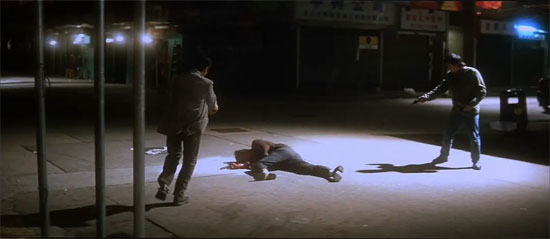
The climactic encounter between Lai Fook and the police officer represents the zenith of absurd fate. For Lai Fook, it’s the ultimate explosion after pressure reached its peak; for the officer, it’s a sudden, unprepared clash following a moment of false ease. Two emotional forces—one ascending, one descending—collide unexpectedly. Seemingly accidental, yet inevitably destined. As Sir Miu and Ghost Brother put it, it is both fate and karma. Throughout the film, lighting had blended black and warm yellow hues, offering faint hope within the darkness. In this scene, Lai Fook’s death and Bin Zai’s death are bathed only in a harsh, pallid light—the irrevocable glow of death.
Like “Infernal Affairs,” “One Nite in Mongkok” proves a crucial point: even when abandoning traditional working models, Hong Kong cinema can still produce high-quality genre films when given platform control and creative freedom.
Notes:
(1) David Bordwell. Planet Hong Kong: Popular Cinema and the Art of Entertainment, Second Edition. Irvington Way Institute Press, 2011, p. 205.
(2) Lai Fook’s character shares similarities with the “big circle boys” archetype in earlier Hong Kong films. However, “big circle boys” specifically referred to immigrants from Guangzhou, whereas Lai Fook hails from Hunan, creating a slight distinction. Therefore, the text avoids labeling him as a “big circle boy.”
Please specify:Anime Phone Cases » One Nite in Mongkok 2004 Film Review: Still an Underrated Masterpiece of Screenwriting