Film Name: 你的名字。 / Your Name / Kimi no na wa./ 君の名は。
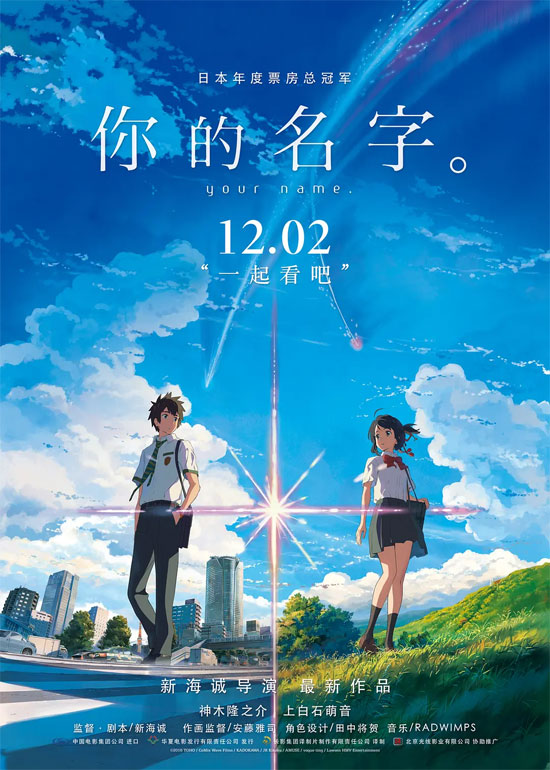
First, let me applaud Director Shinkai for this work brimming with sincerity—as an audience member, I truly felt your heartfelt intentions. As a gamble of a lifetime, one you couldn’t afford to lose, you bet right and won big. In my eyes, you’re not merely a genius animation director, but someone who has always strived relentlessly—constantly reinventing yourself, evolving with unwavering dedication. So while this gamble may not have been a simple case of things falling into place, it ultimately carries an aura of destiny.
Now, let’s talk about the experience.
Shattering the dazzling romantic comet everyone saw, revealing reality’s cruelest face—when Taki realized Shikishima Town no longer existed, that plot twist plunged the film’s emotion into its deepest abyss. It was the most profound stroke in the entire work. The director meticulously guards this secret, laying groundwork throughout, only to reveal it with a devastating, unprepared shock—the tension is immense.
Plot-wise, it reveals that the protagonists’ role reversal transcends mere geography—it spans time and even life and death. Emotionally, it delivers a jarringly realistic jolt about the flip side of “beautiful” things. Such brutal shattering of idealism is rare in animation.
Upon reflection, the motif of “stars” consistently appears in Makoto Shinkai’s films. Whether in Voices of a Distant Star or Children Who Chase Lost Voices from Deep Below, even in Your Name—which could have been a purely modern-day drama—elements like comets and shooting stars are inexplicably woven in. Just as some directors are inherently drawn to celebrating the sea or the forest, Makoto Shinkai is inherently drawn to celebrating the stars. Even when they are so cruel, they remain an incomparable force of nature, and the director still holds them in awe.
“Kizuna” (bonds) is another crucial motif in the film. The protagonists are bound together by these ties; as a shrine maiden, the female lead Mitsuha weaves traditional textiles daily, essentially maintaining her own ‘kizuna’ with tradition. The very name “Kizumori Town” signifies a village dedicated to safeguarding these bonds. Mitsuha’s father abandoned his family—but in another sense, wasn’t he also protecting the “knot” that bound him to his one true love? This cause of “guarding the knot” ultimately bore fruit: it enabled Mitsuha to forge a surreal bond with Taki through the power of “knot-tying.”
Actually, I’ve always wondered why the film’s title deliberately adds a period after “Your Name.” If it were simply “Your Name,” ‘君の名’ would suffice. “君の名は” is clearly an unfinished sentence—a question the protagonist keeps asking throughout the film—so why emphasize it with a period that signals completion? Perhaps the period can be interpreted as a “knot.” By the film’s end, when the protagonists reunite, the fated bond between them transforms the original question into an affirmative answer. What the title omits isn’t the question mark, but precisely their names themselves.
The film relentlessly explores the concept that “all things have their end”—between lovers, family, the living and the departed. Thus, why the body swaps occur without hesitation, why they instantly adapt to each other’s lives—such logic becomes utterly irrelevant. The film isn’t about how people swap bodies, but about the mysterious, fated bonds that connect them.
I particularly cherish the feeling of Taki and Mitsuha running—protecting those they hold dear, pursuing their own “kizuna.” Though seemingly impossible, they fight relentlessly until the very end. Whether searching for each other or rescuing villagers, this is the authentic essence of people living simply yet genuinely. Are we, too, living this way?
The film also meticulously portrays the contrasting environments of Japanese cities and countryside. The village is simple, pure, and traditional, yet the politics of the city seep into its soil. Villagers yearn for the city. City dwellers, however, live exhausting lives—cramped in small apartments, their routines mechanically rigid. Yet deep down, they too admire the comet’s beauty, revealing an unspoken longing for nature. The city and countryside are connected by the modern transportation of the train, which itself represents a kind of “knot.” The bond between a traditional country girl and a handsome city boy—isn’t that also a “knot” between Japan’s countryside and its cities?
Please specify:Anime Phone Cases » Your Name 2016 Animation Film Review:Guard the “knot”