Film Name: 买凶拍人 / You Shoot, I Shoot / 買兇拍人
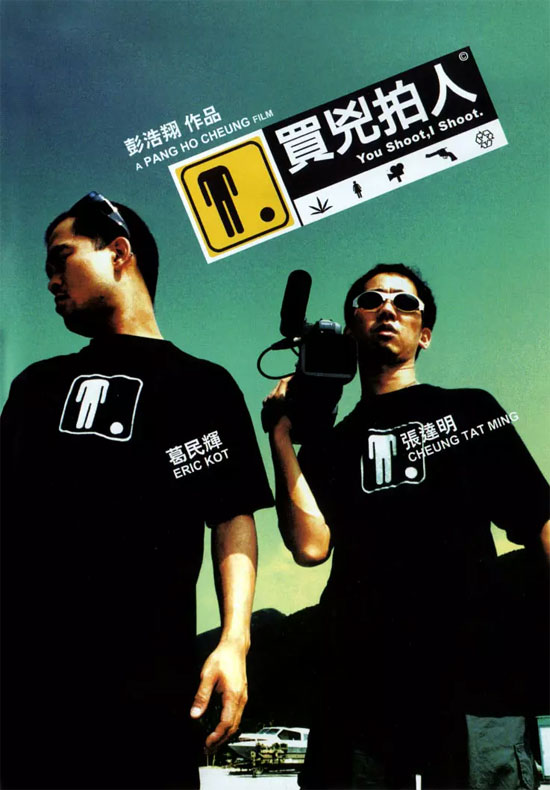
You Shoot, I Shoot. The English title is You Shoot, I Shoot. “Shoot” has two meanings: to fire a weapon and to take a photograph. Combined, it means you kill, I film.
Such an oddball English title might raise suspicions of being a mere gimmick, but the film genuinely delivers on its bizarre premise. Consider this synopsis: Professional hitman Bart (played by Gordon Lam) possesses exceptional killing skills, securing numerous employers and substantial income. He lives with his wife Ling (played by Fang Zixuan) in an upscale residential area, enjoying a very comfortable life. Unfortunately, this idyllic life is short-lived. After a financial crisis, business becomes increasingly difficult. Driven by necessity, Bart begins serving wealthy wives, killing on their behalf.
Unexpectedly, these wealthy wives have numerous demands. They require him not only to kill but also to film the entire process, allowing them to vent their hatred. Understanding that the customer is always right, Bart decided to find a partner. By chance, he met assistant director Quan (played by Cheung Tat-ming) in a bar. The two hit it off immediately, forming the “Killer-Director Duo.” Their business boomed overnight, and a series of “hired killings with filming” operations soon unfolded…
Murder is clearly a dangerous business, but the wealthy ladies insist, “Anyone can kill,” adding, “The key is seeing our enemies die to truly vent our anger.” Thus, the struggling hitman Bart and down-on-his-luck assistant director Chuen form the dream team “You Shoot, I Shoot”—one handles the killing, the other the filming and post-production. At this point, audiences might find it absurd—why would anyone kill openly and leave video evidence? Don’t the clients and killers fear this becoming incriminating proof someday? Well, that absurdity is precisely the point. It allows Pang Ho-cheung to unleash his imagination freely, making the film more enjoyable for viewers. Driven by money and the dream of making his own film, Ah Bart and Ah Chuen form a perfect partnership, constantly coming up with ingenious ideas. Their climactic mission to kill the gangster “Double Gun Hero” unfolds like a musical flourish, with a dazzling array of characters taking center stage and propelling the film to its climax. The climactic scenes carry a carnivalesque energy. Killing “Double Gun Hero” becomes secondary; each character’s will takes center stage. Thus, when Brother Biao attempts murder, he mimics Chow Yun-fat’s “The Killer” by releasing white doves—only then does it feel “tragically beautiful.” Later, he demands filming his “personal execution” to achieve “true satisfaction.” Other characters follow suit. The stunt double for “Double Gun Hero” has artistic pretensions, endlessly pontificating on set. This interplay between on-screen and off-screen absurdity feels oddly familiar.
Murder becoming such an “entertainment-oriented” profession seems ‘absurd’ at first glance, but upon reflection, it aligns with the principles of a market economy—where “the customer is king.” Who says those hiring assassins can’t have such demands? Given such requests, the emergence of “hiring assassins for filming” feels entirely natural. While the premise seems bizarre, its core is grounded in reality. Through this theme, Pang Ho-cheung channels a “fin-de-siècle” vibe: Abart’s mother-in-law sends him on a revenge killing after losing at mahjong (with his wife egging him on), while his father-in-law asks him to eliminate his mother-in-law because his mistress in Shenzhen is coming to beg for mercy. Human nature is unpredictable, and family dynamics are no exception. The closing theme song “You Shoot, I Shoot” captures this very spirit of end-of-the-century revelry.
This alone clearly underestimates Pang Ho-cheung. He also uses his most familiar persona—assistant director Ah Chuen (who bears some autobiographical traits)—to portray Hong Kong’s post-1997 decline and the precarious nature of a director’s career. He possesses a genuine passion for his craft, yet finds himself forced to shoot “killing” scenes to realize his directorial ambitions. He maintains his moral integrity, yet when his final payment for a previous film arrives as marijuana, he is compelled to peddle it in bars. Through a series of twists, he unexpectedly becomes Ah Bart’s killing partner. He still believes in love, cherishing a vulnerable Japanese AV actress as his “leading lady,” keeping her “hidden in his heart,” and later stepping forward to protect her. His romance with the AV actress might represent a certain intellectualized, pure idealization of human connection amidst this chaotic era.
Abart (played by Ge Minghui) possesses a comedic face, perfectly suited to the film’s absurdity and carnivalesque spirit. Seeing him, I also felt this film carries on the legacy of 80s and 90s Hong Kong cinema—partly that “nonsensical” humor, deeply rooted in the everyday lives of ordinary people, that Hong Kong “street-smart wisdom.” But it’s more than that; it also possesses the joyful/carnivalesque style of the Daming Yip faction (though I can’t quite put my finger on it). What kind of aesthetic style is this? I’ll leave that for the experts to define.
Please specify:Anime Phone Cases » You Shoot, I Shoot 2001 Film Review: A bizarre carnival