Film Name: 侧耳倾听 / Whisper of the Heart / Mimi wo sumaseba / 耳をすませば
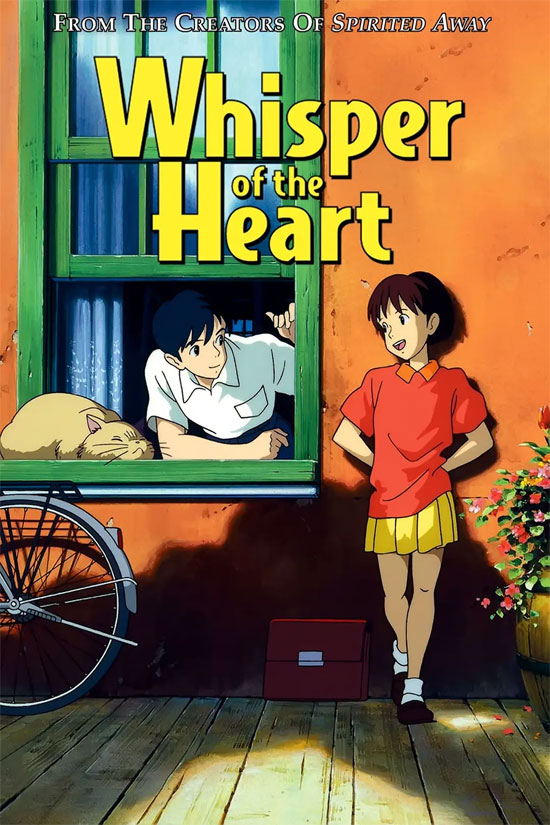
I don’t know how many people found their life’s direction after watching “Whisper of the Heart,” or at least discovered what it means to truly live—but I was certainly one of them. Twenty years on, this film lingers like the haunting melody of “Country Road,” refusing to fade from memory.
This film is fundamentally a story about “the road.” It features numerous depictions of the protagonist walking, and significant screen time is devoted to paths. From the opening night scene in Tama City, with its bustling pedestrians and the protagonist’s journey through the darkness, to the final frame frozen on a concrete bridge, from the protagonist’s repetitive daily commute to and from school, to the hidden path revealed by a cat, from the sunny road of carefree ease and smooth sailing, to the stormy path of emotional confusion and creative block, from the uphill climb where anticipation mingles with toil, to the exhilarating descent of release; from the solitary path of personal growth, to the shared journey of mutual progress; from the tangible road to the road of life… all set to the song “Country Road,” deepening the resonance of the theme of the road.
A lifetime is spent walking—treading the same paths, diverging trails, parting ways, and converging paths. As Yue Daowen and the male lead, Tian Ze Shengji, repeatedly part and reunite at the road’s ends, their serendipitous encounters and “dropping off here” moments alter each other’s life trajectories.
I wonder if this feeling is a kind of shared empathy—this intense longing for the protagonists to meet, their every encounter sending waves of emotion through me. It’s not a grand, earth-shattering romance, yet it feels like the purest, most beautiful thing in the world.
This is likely why so many cherish “Whisper of the Heart.” It lacks grand, fantastical worlds, battles between superpowered heroes and ambitious villains, or even formidable adversaries. The protagonists simply strive to become better versions of themselves each day—more diligent, more passionate about life, more appreciative of each other, and ultimately, better people. It’s unadorned, yet profoundly moving. This is the voice of life itself—the one we truly need to listen to.
Though directed by Yoshifumi Kondō, the screenplay and storyboards were crafted by Hayao Miyazaki himself. This makes it a semi-Miyazaki work—a film not directed by Miyazaki but completed under his supervision, imbued with his distinctive essence. This is especially true of its portrayal of adolescent female sensibilities. Based on a shōjo manga about youthful romance, Miyazaki adapted and guided the story into a coming-of-age tale. It depicts how a young heroine encounters an idealized male figure who inspires and empowers her self-realization. Unlike the more assertive heroines in other Miyazaki works, Whisper of the Heart’s Shizuka Tsukishima begins as an unpolished gem—a raw, undeveloped character. Through her, Miyazaki encourages women in Japanese society to transcend the role of male appendage, to cultivate their own strengths, and to forge their own paths.
This film radiates pure, heartwarming positivity. From neighbors greeting each other on staircases to Tsukishima Wen proactively helping an elderly person with their chair, and countless other details showcasing similar courtesy and virtue, every moment leaves one impressed by the quality of Japanese citizens. The Tsukishima family, a simple working-class household, lives in a cramped yet joyful home. The father’s willingness to let his daughter explore her own educational ideas and his approach to communicating with his child are heartwarming. The film champions activities like reading and music that cultivate emotional and intellectual growth, encouraging young people to find what they love and pursue their dreams courageously. It also portrays love as a positive force that guides partners to support each other and grow together.
This overflowing positivity provides comfort to audiences while carrying a slight anesthetic effect. As a work grounded in reality, the film is actually quite unrealistic—it filters out nearly all the falsehood, evil, and ugliness of life, retaining only truth, goodness, and beauty. In this sense, the “real world” of Whisper of the Heart is more fantastical than any fantasy world created by Studio Ghibli.
The film celebrates the artisan spirit—the dedication to mastering a craft to perfection—a quintessential Japanese cultural trait. Seiji’s meticulous approach to violin-making inspires Tsukishima to pursue her own creative endeavors with equal diligence and perseverance. Even the filmmakers themselves approached their craft with unparalleled dedication—the pivotal scene where Seiji plays the violin and Tsukishima sings was meticulously choreographed to replicate authentic musical movements. As the film suggests, though Seiji and Tsukishima are still rough stones, their relentless pursuit will undoubtedly polish them into precious gems.
“Raw gemstone” is a pivotal term in the film. Seiji’s grandfather entrusting that unpolished stone to Tsukishima carries profound symbolism. His lengthy, didactic monologue sounds like Miyazaki himself addressing the youth. How much Miyazaki wishes every young Japanese person were such an unpolished gem—their futures brimming with limitless potential. Entrusting them with this gemstone is akin to entrusting them with Japan’s future. For these gems, Miyazaki would gladly make the real world a little more unrealistically beautiful, a little more fantastical, just to pass on this hope.
Now, about the Cat Baron. This prop is the film’s crowning touch. As a craftsmanship piece, it embodies the artisan spirit. As a keepsake, it stands as a testament to love. The pursuit of the craftsman’s ideal and the simple, beautiful love it represents are precisely the film’s two central themes. It carries a profound sense of legacy. A truly great work of art commands unwavering attention. From the moment Tsukishima Miko laid eyes on the Baron, it held her gaze. Most remarkably, it captivates the audience just as profoundly. The instant you see it, you become Tsukishima Miko—staring at it, gazing at it, yearning to understand it, to possess it, to claim the magical power it holds.
It’s been roughly twenty years since I last watched “Whisper of the Heart,” yet whenever I recall this work, the Baroness is the very first image that springs to mind. What I wish to convey here is this: while most plotlines and characters in life may fade from memory, certain images endure. The Cat Baron is one such unforgettable image. When you encounter such people or things, cherish them deeply, for they are the companions that will journey with you through life.
Please specify:Anime Phone Cases » Whisper of the Heart 1995 Animation Film Review: Listen to the resonance of the “road”