Film Name: 天气之子 / Weathering With You / Weather Child / Weather’s Child / Child of Weather / 天気の子
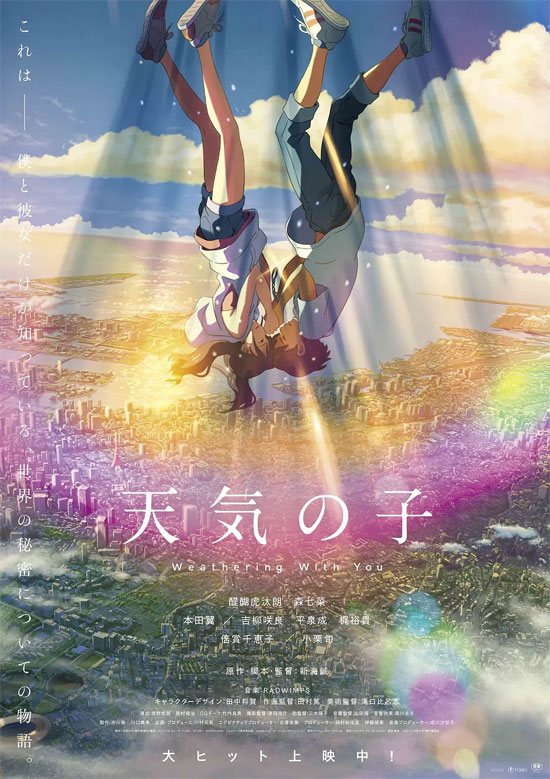
Stepping out of the theater, I couldn’t help but gaze at the long-missed sky and touch the long-missed weather, as if I truly felt something different. Perhaps this is the difference between a director and an ordinary person: the former discerns the unusual in everyday things and imbues them with new value, while the latter happily chews on these unusual elements and values as guided, following the former’s train of thought to continue imagining and discussing. At times, I even suspect that when audiences munch on popcorn during a film, it’s not driven by a physical urge to chew, but by a mental urge to digest. They transform the act of chewing the director’s worldview into the satisfying sensation of tearing into popcorn with their teeth.
Before Weathering With You, no major animation had used weather as its imaginative subject. Had Disney tackled it, they might have turned each element (wind, rain, snow, thunder) into a cartoon character, embodying the weather’s traits through color, costume, and symbolism, then endowing them with distinct personalities and superpowers—much like their fantastical interpretations of human emotions in BRAIN IT Amazing Adventure. But this film is directed by Makoto Shinkai, so we witness weather transformed into a prop serving young love. This is Shinkai’s way of imagining the world—everything exists to enhance that pure essence of youth and romance.
If Marvel has its own superhero universe, I’d say Shinkai is rapidly building his own universe of youthful romance. Couples traverse stars, cross time and space, journey to the edge of the clouds, and explore distant lands. They find themselves in the Garden of Words one moment and immersed in Tokyo’s bustling streets the next—all for the sake of encountering each other, meeting each other, and falling in love. These seemingly independent stories are intertwined, each containing elements of the other, much like how “Weathering With You” references characters from “Your Name.”
Yet precisely because it serves love, the film refrains from endowing the weather with any unique significance. Though the story unfolds from the everyday weather we all encounter, the imagination ultimately concludes that weather remains just weather—capable of being controlled by certain individuals, yet devoid of consciousness or humanity. This remains a story about people, not about people and the weather. Perhaps it’s not that Director Shinkai couldn’t conceive of this, but rather that he never considered exploring it in the first place.
Thus, one of the film’s most significant simplifications is how effortlessly the male protagonist, Hinao, crosses the torii gate—that magical archway perched atop an ordinary rooftop—which serves as the boundary between the human world and the realm of weather. His greatest challenge turns out to be evading the police, not his inability to cross the threshold like the female protagonist. Without that desperate, life-or-death struggle to breach the barrier, the protagonists’ reunion in the weather realm loses much of its emotional impact.
The film crafts a uniquely magical gateway between the human world and the weather realm, much like the gate before the oil house in Spirited Away. Its wonder lies in how such an extraordinary, otherworldly entrance can be so ordinary and grounded. Yet, regrettably, the film assigns this magical portal an unremarkable threshold that fails to match its significance. Can anyone simply walk through the torii gate to reach the other side of the Weather Realm? If the Weather Realm were merely a tourist attraction, the story would be rather dull.
Having high expectations for the “weather” theme, I was eager to see how Makoto Shinkai would animate it. After watching it impatiently, I still felt a slight disappointment. The film is too grounded, but not in weather—instead, it relies on conventional real-world themes like love and society. This makes the film’s greatest creative element, “weather,” feel somewhat detached and unrealistic. The female protagonist’s ethereal, weather-shaman-like aura clashed jarringly with the male protagonist’s gritty, gun-wielding reality. In this sense, the weather concept felt far less organically integrated than the meteor motif in Your Name.
Please specify:Anime Phone Cases » Weathering With You 2019 Animation Film Review: Let the weather be down-to-earth