Film Name: 爱宠大机密 / The Secret Life of Pets
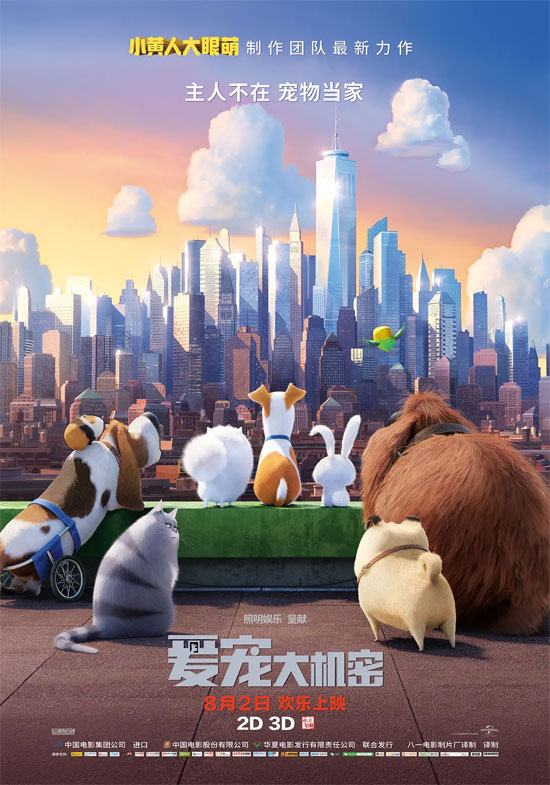
The Secret Life of Pets explores humans, fellow animals, and the world from the perspective of pets. The film not only vividly depicts the differences between pets of different species like cats and dogs, as well as the distinctions between male and female individuals, but also masterfully captures many relatable pet details. Examples include cats sneaking food from the refrigerator and dogs being tugged by retractable leashes. The scenes of pets running wild when their owners are absent are the film’s main gift to the audience’s imagination.
Indeed, the film’s two posters profoundly reveal the touching inner lives of beloved pets. Mike, watching at the door and gazing from the rooftop—the former shows his slightly upturned nose, indicating he’s looking up, longing for his owner’s return; the latter is level-eyed, for even the most dazzling, vast city cannot compare to his owner’s embrace in his eyes. Among all these homes, only one is yours. Only one person is your master.
“The Secret Life of Pets” was one of my most anticipated animated films this year, yet I left feeling slightly disappointed. This disappointment stems primarily from comparing it to “Toy Story” from two decades ago—beyond a group of pets causing a ruckus while their owners are away, it offers little additional emotional depth.
“Toy Story” not only explored the human world through toys’ eyes but also created a toy unaware of its own nature—Buzz Lightyear. This dramatic conflict’s wit and originality far surpasses the simplistic, crude struggle between pro-human and anti-human pet factions in “The Secret Life of Pets.” Woody views Buzz Lightyear as a rival for affection, much like Mike sees Stitch as a rival for attention. The crucial difference lies in their natures: Buzz is fundamentally non-confrontational, while Stitch harbors malicious intent.
In “Toy Story,” the conflict between a malicious entity and an innocent one explores not the confrontation itself, but the nature of confrontation. The villainous brat’s emergence merely provides a resolution to this contemplation: learning tolerance. In The Secret Life of Pets, the theme of the two rivals’ struggle is the conflict itself. The palace intrigue ultimately forces them to adapt to the reality of shared attention. The villainous rabbit’s appearance simply gives the two rivals a common enemy, compelling them to unite. The final outcome is learning to share.
In “Toy Story,” toys are lifeless in front of humans, passively receiving their affection. But in “The Secret Life of Pets,” pets actively perform cuteness and charm for humans. This performance makes the bond between humans and pets seem somewhat dim. Any film depicting human-pet relationships risks reducing pets to subservient roles if it fails to explore the stories unfolding between them and their owners.
Thus, the film’s excessive focus on pets vying for attention and engaging in factional struggles, coupled with its overemphasis on pets’ behavior when owners are absent, results in a severe scarcity of owner-pet interactions. This undermines the grand thematic contrast between pets’ reverence for their owners and their equal perspective on the world.
Please specify:Anime Phone Cases » The Secret Life of Pets 2016 Animation Film Review: Look up to the master and see the world eye to eye