Film Name: 奇门遁甲 / The Miracle Fighters / 奇門遁甲
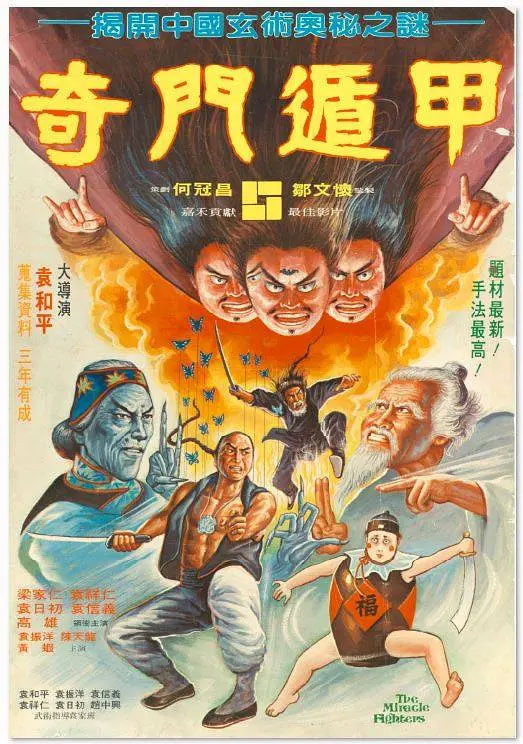
I’ve always wanted to watch “The Miracle Fighters.” Even before finding it online, just reading reviews and looking at the posters sparked my imagination with all sorts of bizarre and magical scenes, making me yearn to see it. Generally speaking, Hong Kong horror, weird, and fantasy films from the 70s and 80s—when done well—are genuinely captivating. They don’t leave you scared afterward, though there are always a few unforgettable shots or scenes. As a child, watching these films felt terrifying, but revisiting them as an adult brings a sense of familiarity. What draws me to them is their rare, precious quality—traditional and folk-inspired, with a uniquely evocative atmosphere. Like listening to a village elder tell tales, they can even evoke the feel of Ming and Qing dynasty supernatural fiction if you’re not too picky. Horror can be tediously dull at times, but I’m quite taken with cleverly crafted eeriness and simple, sincere lessons about reward and punishment.
“The Miracle Fighters” is a renowned title, and I expected it to be wildly supernatural. Instead, it revisits a theme overused in wuxia films of that era: a youth, drawn by fate—whether consciously or not—into an event. Through external forces and personal effort, he ultimately resolves the situation, achieves his goal, and undergoes profound personal growth. Thinking about it this way, the title “The Miracle Fighters” seems a bit grandiose. But then again, the concept of “Qimen Dunjia” (Mysterious Gates and Hidden Armor) permeates the film—even the two heroic magicians are named ‘Qimen’ and “Dunjia.” While the story itself is formulaic, the storytelling avoids clichés. At the very least, it lives up to the title and truly delivers on the audience’s expectations for what those four characters represent.
The plot may be familiar, but it maintains integrity. For instance, there’s no conventionally beautiful female lead—the only somewhat attractive woman dies upon her first appearance. Yet her simple attire and tear-filled, expressive eyes make her memorable, even as a minor character. She justifies the military instructor’s sacrifice of his later years, leaving a strong impression. The young prince held hostage by the instructor actually dies—no melodramatic coming-of-age saga decades later. The protagonist remains genuinely virtuous, resisting power’s allure to collaborate with the Bat Sorcerer and eschewing pretentious existential musings. Most commendably, the Bat Sorcerer avoids using palace beauties to seduce the youth for sensationalistic romance. Such unadorned integrity! The only slightly melodramatic element might be the grand twist at the end involving the “Dùn Jiǎ” technique, which genuinely deceived the audience—and did so with conviction. Yet plot holes become irrelevant here; the film’s true appeal lies in its unabashed, uplifting entertainment value. Even decades ago, entertainment films could be crafted with such earnestness and style.
Regarding the martial arts sequences, speed and power have been discussed ad nauseam—after all, this is the renowned “Yuen Woo-ping’s stunt team.” To call them simple and brutal is an oversimplification; direct and crisp captures the essence. The fight scenes appear minimally edited, showcasing intricate, agile, and explosive techniques in real time. This directness is far from simplistic. With no trace of clunky special effects, the sequences feel natural and deeply immersive. It delivers that visceral thrill of watching live theater, of witnessing martial prowess unfold before your eyes. Though I’m no film connoisseur, I sense that King Hu’s wuxia films embody the highest artistry. As a later-generation director, Tsui Hark leans toward fantastical modernity, while Yuen Woo-ping’s action films might seem comparatively crude—yet they feel deeply grounded. For today’s audience like me, who doesn’t dwell on technicalities, that very quality holds its own charm.
When it comes to visual impact and imagination, without even getting into aesthetics, it blows today’s films out of the water. The visuals in “The Miracle Fighters” are crisp and direct, much like the martial arts sequences within. Yet certain shots linger in the memory. Take the scene where the fake priest begs for rain: an emaciated, gaunt old man with matted hair, bare-chested and kneeling on the ground, pleading for rain. It’s a shot rich in visual impact and emotional resonance. Some claim “The Miracle Fighters” would be considered a bad film today, but I simply can’t agree. Viewed today, while its themes may seem dated and the plot—stripped of its magical battles—offers little substance, its brilliance lies precisely in its depiction of these battles and the martial prowess of the Yuan Family Team. The film’s true value is that its technical displays never devolve into mere showmanship; everything serves the narrative, creating a cohesive whole. Contemporary films are not lacking in grand themes or lofty ideas, yet in terms of substance, natural technique, dignified posture, imagination, and expressive power, they simply cannot compete with this “bad movie”! Suddenly, another “bad movie” comes to mind: The East Is Red. It’s a “bad movie” I adore immensely. Though it feels like a significant step down from the earlier Swordsman and Swordsman 2, Tsui Hark’s unapologetic dedication to thoroughly entertaining you, the film’s absurd tragic philosophy, and the goddess’s perfectly imposing presence all deeply moved me. In a word: the artistic conception is superb!
What “The Miracle Fighters” is most celebrated for is undoubtedly its imagination. One can only imagine that the “Yuen Team” must have spent years honing their craft in the real martial world. The attention to detail in the film is something an armchair academic could never conceive. It’s too grassroots, too legendary, and too full of life! This quality is truly precious. Though the times have changed vastly, the spirit and innate qualities of people remain strikingly similar. Their era was closer to legends and closer to the martial world. This is akin to opera—thus, when today’s performances lack appeal, it seems unfair to blame the performers alone. Sometimes, individual effort alone may not make much difference.
The film features a dazzling array of fantastical and bizarre combat techniques, both eye-opening and entertaining. Those legendary marvels—mysterious earth spirits, shape-shifting, remote acupuncture, shadow-pinning, flying spinning tops and swords, seven-star wooden dummies—all vanished from the silver screen long ago. Yet “The Miracle Fighters” thoughtfully collects them. Take the “ghost doll” in the jar, for instance. It’s eerie, comical, and undeniably charming. While the plot might not strictly require such a “ghost doll,” its expressive presence undeniably elevates the film. With its pallid limbs and face, two patches of red on its cheeks, a single red dot on its lips, and a body shaped like a clumsy, oversized jar… At any moment, this giant jar could roll toward you, suddenly extending its bizarre head to stare intently, erupting into a child’s clear laughter. Before the chill could reach your spine, it shifts into another pose—and you breathe a sigh of relief, realizing this adult-played ghost is actually quite adorable. Take, for instance, the mysterious spells of those peculiar yet righteous old masters, “Qimen” and “Dunjia.” When a youth stumbled into their courtyard, the waterfall in the landscape painting on the wall actually sprayed him with water. A strangely gaunt old woman craned her neck, smiling and calling out to the youth: “Come here, come here~~~” yet her body remained several meters away. Terrified, the boy turns and runs, nearly dashing out the door—only to mysteriously enter another doorway the instant he exits. A crooked-faced old man holds a painting of a rooster, cuts it into strips, and declares he’ll cook chicken noodle soup for the boy. Sure enough, he boils a bowl of noodles and forces the boy to eat it. Then there was the old barber woman speaking in Yangzhou dialect, whose technique of wielding red thread while shaving blended seamlessly with combat—truly deft and skilled, beyond the capabilities of modern practitioners. The actor playing both the little ghost and the barber woman seemed to be the same person, Yuan Zhenyang. Truly, one must praise: What a talented performer! Then there’s the painting where figures move—not unusual in itself—but astonishingly, they can be summoned forth, culminating in an unexpected twist at the end. Take that peculiar old woman called “Dunjia,” played by a man. Yet he performed on stilts, and with Mandarin dubbing, he convincingly embodied a bound-foot grandmother. Consider the Taoist ceremony in Fengdu Ghost City: when priests infiltrate the underworld to seize a token, we witness not only Mao Shan rituals like retrieving objects from boiling oil, crossing paper bridges, and navigating Bagua formations, but also a performance of Zhong Kui leaping—a classic opera sequence.
In terms of the expressive power forged by imagination and acting prowess, what resonates is not merely the extraordinary talent of each member of the Yuan Family Troupe, but rather the sense that behind every performer lies a story and a world of their own. A film like this—seemingly crafted for simple amusement yet imbued with folk wisdom and reflecting the grassroots perspective on the world—could only emerge from those with extensive experience and profound life insights. Their performances may appear exaggerated, yet their theatrical training shines through in their eyes. While classified as entertainment films, their work withstands the test of time. Among fantasy films, theirs possess greater substance and depth—achieving a level of wonder and eeriness that modern cinema, reliant on special effects, struggles to match. What truly inspires awe is how they infuse their films with China’s authentic folk traditions and ethnic distinctiveness. Their boundless imagination and rich spiritual depth should make today’s filmmakers—who blindly imitate Japan, Korea, or Hollywood, producing hollow, grandiose spectacles—blush with shame.
Please specify:Anime Phone Cases » The Miracle Fighters 1982 Film Review: It’s a very cute movie.