Film Name: 全职高手之巅峰荣耀 / The King’s Avatar: For the Glory
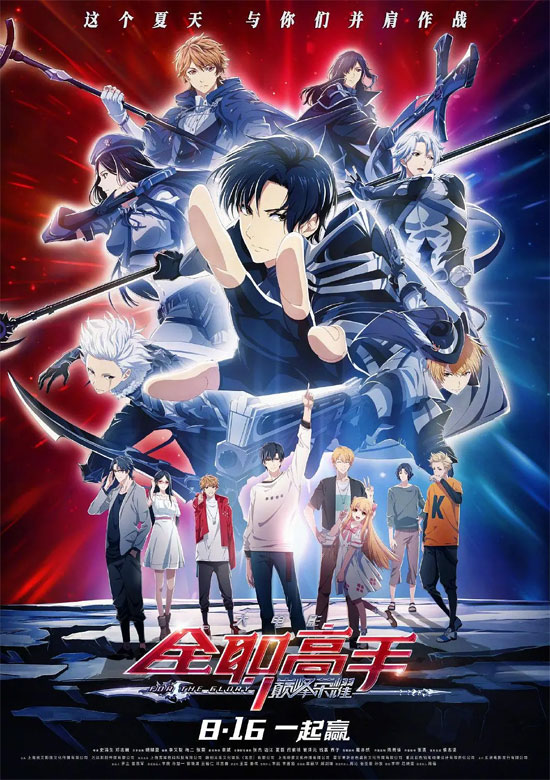
As a fan of The King’s Avatar who hasn’t read the original novel, I was still looking forward to this movie’s release. After all, I’ve rewatched its 12-episode animated series three or four times. I genuinely believe its web animation is a standout domestic work—not only is the production quality solid, but crucially, the characters feel real, fleshed out, and driven by dreams. Before watching the film, I had a vague sense from online reviews that I might be disappointed—and sure enough, I was.
Let me start with one positive point. I think the “The King’s Avatar” IP has been developed with a cohesive vision across its adaptations. They strategically planned when to release the web animation, when to produce the TV series, and when to launch the animated film—all while ensuring narrative complementarity between the film and web series. What’s particularly commendable is that the same voice actors portray the same characters across the web animation, TV series, and animated film. After getting used to Ye Xiu’s smooth-talking and Huang Shaotian’s trash-talk in the web animation, hearing the same voices in the TV series felt instantly familiar and comforting. This shows respect for IP development—not just in visual design and consistency, but also in vocal design and continuity. Many of our IP adaptations across different media have historically overlooked this crucial aspect.
Having not read the original work, I naturally missed out on the online debates about the characters’ past lives and present incarnations. Yet even when viewed purely as a sports-themed film, the movie falls short. In a word, it lacks soul and vision.
The film roughly divides into three parts. The first part focuses on forming the team. This section is saturated with dogmatic assertions that esports is not gaming, as if the film isn’t intended for nostalgic fans but rather for uninformed parents. The second part deals with the death of a comrade-in-arms. This event fundamentally alters the lives of Ye Xiu and Su Mu Cheng. Unfortunately, the film treats the sequence of events like a mundane chronicle, neglecting to explore the consequences—specifically, how the loss of a comrade and the departure of an elder brother reshape the protagonist’s psyche, consciousness, and character. Clearly, the latter is precisely what audiences most want to see. The third part focuses on winning the league championship. It primarily explores the journey of one team member, though the protagonist’s team actually consists of six players plus a manager. The film highlights two key matches, yet securing the league title requires winning at least a dozen games.
The best thing about Glory of the Game is its name—it lets every player find their own brilliance, their own life story, their own glory. So “The King’s Avatar” aims to blend the glory of gaming and winning championships with the glory of discovering life’s purpose. Striving for dreams, overcoming hardships—even starting from scratch or beginning anew—is sustained by the conviction of glory. I believe this is the core and soul of “The King’s Avatar.” Yet the film fails to capture this profound glory, settling instead for the superficial triumph of lifting a trophy or fulfilling a comrade’s dying wish. This reduces ultimate moves like the Seventh-Tier Will to hollow, powerless gestures. Ye Xiu’s ability to execute this move stems not from his technical prowess, but from his unmatched will to pursue the glory of his dreams.
If I were writing this story, I’d focus on the main thread of Ye Xiu and Su Muqiu’s journey as best friends—from their meeting, to understanding each other, to supporting one another, to parting ways, and finally to Ye Xiu carrying his comrade’s legacy onto the battlefield. This thread captures Ye Xiu’s original passion for Glory, his naive youth, his unwavering dreams, and his tenacious will. I would depict the hardships of Ye Xiu’s transformation from amateur player to professional, his unwavering persistence. I would portray the protagonist’s heartache and toil as he leaves home to forge his own path—a journey marked by resolve and without regret. I would show how Ye Xiu’s relentless pursuit of his dream influenced Su Muqiu, how it shaped Su Mucheng, how it impacted his future teammates, and even how it affected his twin brother.
Particularly after Su Muqiu’s passing, I’ll explore how Ye Xiu overcame this profound grief, transforming sorrow into strength. This was far from merely standing solemnly before a tombstone for a few seconds. Put yourself in his shoes to grasp the magnitude, the agony, the depth of that blow. How could anyone carry on with life and competition as if nothing happened? There must be a process, a key to unlock the heart’s chains and move forward. This is the film’s most profound emotional core—no amount of portrayal is excessive, and it absolutely should not be simplified. Yet the film simplifies it.
In sports narratives, competitive skill is secondary—the crucial element is having a dream. With a dream, even the weakest become inspiring; without one, even the strongest become mere show-offs. Esports isn’t a game, and filmmaking certainly isn’t a game either. Please approach filmmaking with the same dream-driven passion Ye Xiu brought to playing Glory.
Please specify:Anime Phone Cases » The King’s Avatar: For the Glory 2019 Animation Film Review: Esports is not gaming, and movies certainly aren’t gaming either.