Film Name: 消失的子弹 / The Bullet Vanishes / Ghost Bullets
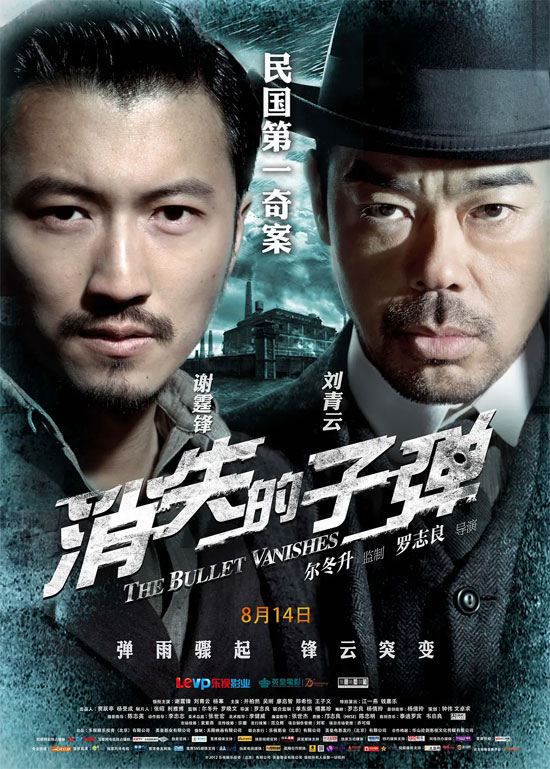
For many years now, Chinese-language detective thrillers have failed to deliver surprises for film fans. We pay to see Western suspense thrillers, bloody violence, wildly imaginative plots, and dazzling visual spectacles, yet rarely praise domestic suspense films—because let’s face it, there’s no shortage of trashy productions that lack originality, fail to shine, and are so melodramatic they insult our intelligence. I assumed that “The Bullet Vanishes,” despite its star-studded cast, would be nothing special. To my surprise, it turned out to be a pleasant surprise.
While anyone who watches “The Bullet Vanishes” and has seen Sherlock Holmes will inevitably compare the two, who among us didn’t copy passages from model essays in our childhood compositions? In the process of progress, if you can avoid direct plagiarism and even add your own embellishments, that deserves applause. So for us fans of American and British TV, movie buffs who’ve seen it all in Western culture, diving into the bizarre cases of Republican-era China offers a refreshing change of pace. This blend of dark, quirky charm with light, retro-inspired artistry is well worth the ticket price. Some might say one ticket delivers the value of multiple films, spotting imitations here and there. Well, let’s sharpen our eyes and enjoy the game of spotting similarities—after all, they’re just shadows. The story itself is fresh and quite compelling.
At the advance screening meet-and-greet, the host revealed that producer Edward Yang guessed the ending ten times without getting it right. I didn’t attempt ten guesses myself, but this hint alone made me dismiss all the obvious clues laid out before the climax. Until Lau Ching-wan’s prophetic words, this ultimate villain truly remained hidden in plain sight.
“There’s no such thing as a perfect crime,” and rarely a perfect thriller either. Unlike Lao Song, we don’t have the chance to recklessly test “poison” firsthand, so we’ll never know if bone bullets can kill cleanly or how many other murder details would play out in reality. If not for plot convenience, we’d struggle to accept minor details like a gold ring snapping at the slightest tap, or Guo Zhui spotting its gleam instantly amidst a trash-heap incineration site. Truthfully, we needn’t be so critical. We can simply attribute these improbable events to “plot requirements.” After all, we’re just here to enjoy the story—seeking thrills and entertainment.
Of course, if you have a soft spot for the Republican era, or are a fan of Feng Xiaogang, Liu Qingyun, Jing Boran, or an admirer of Uncle Zhi, I still highly recommend heading to the theater. You’ll get to enjoy the wide, ultra-clear screen, the perfectly recreated Republican-era atmosphere, and watch handsome actors play cool while award-winning actors show their adorable sides.
Alright, let’s talk about something serious. Why I’d still say it’s good even if you call it trash.
(If you decide to watch this movie, friendly heads up: stop reading now. I know—suspense films hate major spoilers.)
【On Friendship】
Films featuring dynamic duos inevitably lean toward bromance territory—heroes drawn to each other, partners bound by deep brotherhood. When conflicts intertwine with affection, the journey becomes anything but simple, tangled beyond untangling.
One excels with intellect, the other with physical prowess—a seemingly perfect pairing. Imagine if Sherlock Holmes’s partner, Watson, were as brilliant as Holmes himself and possessed sharpshooting skills. Wouldn’t that be an even more box-office-friendly and critically acclaimed duo? A sidekick is essential too—a young, inexperienced actor fits the role perfectly. He must be far more naive than Watson, adept at charming audiences with his innocence, evoking profound sorrow when his demise approaches.
From the moment Lao Song laid eyes on Guo Zhui, he knew this was a formidable opponent. As a high-IQ detective who thrives on challenges, he wouldn’t pass up this opportunity. You could even call it love at first sight—mutual understanding and equal intellect are prerequisites for effective communication, making it nearly impossible to kill someone you share such rapport with, especially when pitted against each other.
We all knew Lao Song wouldn’t pull the trigger, just as we knew Guo Zhui would reach out and stop him at the critical moment.
【On Love】
Most films invite us to anticipate romance. Unless it’s purely masculine fare devoid of female presence, sparks are bound to fly. Well-crafted love stories always add a beautiful flourish.
The romance between female prisoner Fu Yuan and Lao Song has no explicit beginning. We only know she personally wrapped a scarf around his neck, that the words “take care” were what he wanted to say to her, and that they exchanged letters. Love between intelligent people is merely a contest of subtlety—unspoken yet deeply ambiguous, filled with mutual understanding and admiration. Few words are spoken, but each hits the mark. Jiang Yiyan is an actor with immense presence, radiating charisma even without makeup—capable of both innocence and allure. Liu Qingyun needs no introduction.
Guo Zhui and Little Lark’s relationship felt abrupt—we assumed mere acquaintance, yet suddenly witnessed a small-scale prelude of physical commitment. Only at the very end did we realize their love had long been profound. Revisiting that bedroom scene afterward, it no longer felt so impulsive. Some women love blindly, like Little Lark—asking no questions, accepting whatever is asked of her, determined to fulfill her duty solely to stay by his side forever. Some men, though seemingly cynical, truly mean what they say when they vow to protect her for life. They keep their word.
【On Justice】
Sometimes, speaking of justice and righteousness requires choosing the right moment. In certain situations, you might even admire someone who actively schemes to bring down villains and seize power—just to see evil punished and justice served. Like me, you might wish Guo Zhui hadn’t taken his own life, hoping he and Little Lark could live happily ever after. Even without becoming police chief, they could find joy in a place where spring blossoms forever. Because we know who is truly evil. Even when someone violates justice, we refuse to label them a “good person gone bad.” In such moments, we all become like Old Pine. Even when we don’t decide their fate, we wrestle internally—like Old Pine—when exposing them privately, where only heaven, earth, you, and I know.
Truthfully, I wish there were more people like this. Of course, they mustn’t truly “go bad” once they rise to power.
Well, I hope by the time you finish reading this, you’ve already seen the film.
Please specify:Anime Phone Cases » The Bullet Vanishes 2012 Film Review: We’re all good people gone bad.