Film Name: 白发魔女传 / The Bride with White Hair / 白髮魔女傳
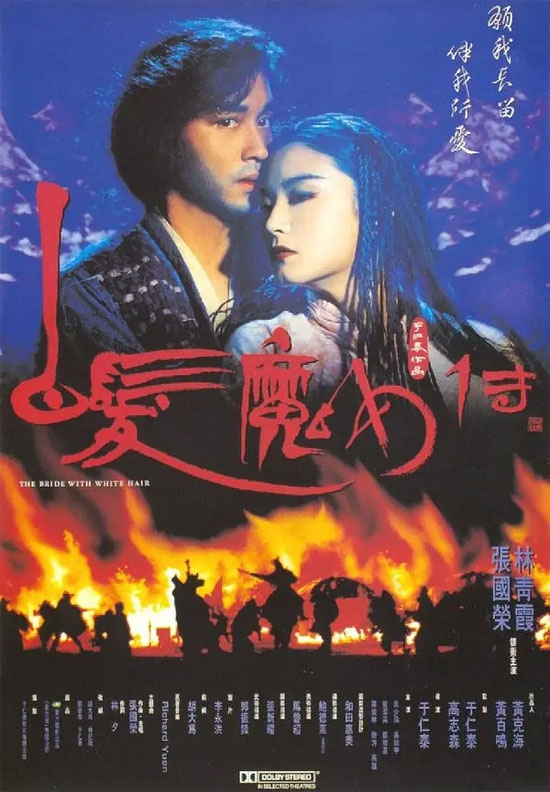
The main focus of the story, in my view, rests entirely on Wu Zhenyu. The character he plays is Jin Wushuang. When he first appears, he seems like a hermaphrodite, speaking in a hoarse voice. Someone coughs, and he endures it, continuing to speak. Hearing another cough, he finally strikes and kills the person. Everything unfolds in a terrifying manner. Then he approaches Lin and asks, “Why are you unhappy?” Suddenly, he seems to transform into a woman. I initially thought he’d mastered some esoteric martial arts technique, but that’s not the case—it’s more like he’s become a demon.
Then Lin and Zhuo Yihang began their romance, causing Jin immense pain. Finally, two figures lying side by side began speaking, and I realized they were siblings. The actress playing the sister—I think it was Lam Kit-ying—kept laughing maniacally. The two seemed connected, almost telepathic. As the sister touched her brother’s body, she suddenly declared, “No woman will ever love you.” Then the blanket suddenly flew into the air, revealing their naked bodies. Wu’s voice shrieked sharply and painfully, while the sister’s maniacal laughter echoed. They were two naked bodies fused together.
Before the blanket flew away, I actually thought it would never be removed—showing nudity like that would be too bold. I even imagined Wu’s body couldn’t be considered male, wondering if he might have female breasts… Perhaps it was precisely these imaginings that made the sight of their joined bodies suddenly shock me with disgust. But it wasn’t just that. The two people, joined together, curled up like butterflies with wings growing from their bodies, each striving to fly in opposite directions.
Later, Jin finally married Lin, exchanging freedom for her release. Wu Zhenyu carried her sister on his back while drawing close to Lin, who cackled wildly, “Look! Does she show even a shred of feminine reaction?” It felt deeply unsettling. In the final fight scene, Wu rolled in—back-to-back, worse than crabs, they could only advance by tumbling. After Zhuo Yihang’s sword severed them, the sister’s words were inaudible, but Wu sighed softly—apparently sleeping like that felt incredibly comfortable. In the end, the siblings’ hands touched.
For some reason, watching this film still leaves me deeply saddened. Though such conjoined twins seem terrifying, I can’t forget them. After all, they are human too—they have thoughts and yearn for love.
When my sister recited the line, “Look at your body—no woman would ever love you,” I couldn’t help but wonder how many times she’d silently repeated to herself, “Look at your body—no man would ever love you.” Or perhaps, deep down, she believed she could only love her brother—a choice born of necessity. Though their bodies were joined, their hearts remained apart. Despite their physical deformity, they possessed the desires of ordinary people. Thinking of their severed bodies, one wonders if all men yearn to break free from women’s bonds. Such thoughts might seem amusing, for the symbolic meaning is too potent. Recalling a novel I once read, Wei Wuyi (the Rat Leader from “Handsome Siblings,” who loved the Mistress of Yihua Palace). For people like them, perhaps ordinary lives would have been better. Yet despite their physical disabilities, they possessed intellects and minds unmatched by most in this world, becoming masters beyond compare. The mediocre always looked down on them, and those they disdained would never love them in return—that was the true tragedy. Love, when viewed as a personal matter, often involves courage. But when it comes to actually choosing someone to be with, it frequently boils down to a matter of letting go.
One can control their own courage, but humans aren’t gods—they can only control their own courage.
Jin asked the witch, “What did he give you?”
The witch replied to Jin, “He gave me a name. Every person should have a name from the moment they are born.”
Jin suddenly understood, “So you just wanted to be an ordinary person.”
It wasn’t that Jin couldn’t express himself. What he expressed, broadly speaking, was his own love—their own way of loving. For Jin, it wasn’t that he didn’t see the witch as human. It was that he didn’t even see himself as human. In his heart and in his anguish, he sometimes thought being ordinary was a good thing. But it was also his pain, because he could never be ordinary, nor could he give his woman “ordinariness.”
To love someone, to think of someone—anyone who has loved understands this. But understanding doesn’t mean acceptance. Understanding doesn’t mean love. Most of the world’s sorrows are like this. If someone treats you with tender care, showers you with affection, yet some kindness fails to stir even a flicker of emotion—the witch was like this, and some women are too. It always comes down to this: both are stubborn souls who refuse to let go.
Please specify:Anime Phone Cases » The Bride with White Hair 1993 Film Review: An Extraordinary Love