Film Name: 你想活出怎样的人生 / The Boy and the Heron / 君たちはどう生きろか
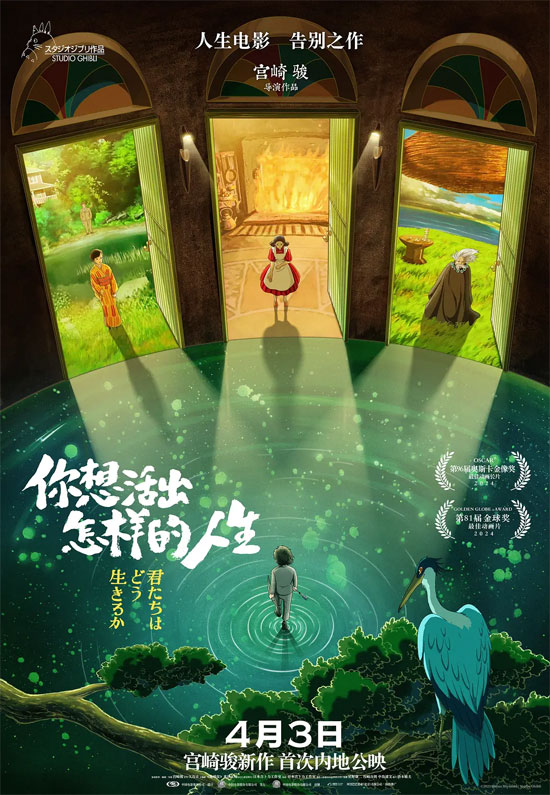
By all accounts, “The Boy and the Heron” is an ill-suited title for an animated film. It’s too profound, too philosophical—it would alienate many viewers. Yet Hayao Miyazaki chose this name for his film. For any other animation director, this would likely spell disaster. But for the 80-year-old Hayao Miyazaki—the one and only Hayao Miyazaki in the world—all conventional market rules for animation cease to apply. The “logic” behind “in theory” holds no sway over him. He possesses a “customization” function for the possibilities of animation.
“The Boy and the Heron,” a rare autobiographical animated film, won the Academy Award for Best Animated Feature. Before its Chinese release, it had already grossed $170 million worldwide. On April 3rd, its opening day in mainland China, it earned over 100 million yuan at the box office. This demonstrates the profound global affection for Hayao Miyazaki and the willingness to listen to his musings on life’s profound questions—questions open to interpretation by the wise and the discerning.
“The Boy and the Heron” is a Japanese novel Miyazaki read in his youth, which profoundly influenced him. However, this novel bears little relation to the film. In fact, the film’s creators hadn’t settled on a title during development and only later adopted the novel’s name.
The film’s true source material is Irish author John Connolly’s “The Book of Lost Things.” How similar are the two? David, the protagonist of that book, also lost his mother. He too moved to the countryside with his father, and his stepmother was also pregnant. David similarly struggled to accept this, retreating to the study—meaning books served as a similar medium. His uncle, a close relative, also vanished. A con artist similarly appeared, similarly taking the protagonist to another world to embark on a similar quest for discovery. When Miyazaki encountered this book, it stirred within him feelings of lingering attachment, nostalgia, and regret. This experience ultimately inspired him to create a film based on his own story.
Many discuss Miyazaki’s longing for his mother and the transformation in his relationship with his stepmother within the film. Yet what I wish to emphasize is the hidden sense of regret Miyazaki harbors toward his father.
In previous Miyazaki films, the father figure was either absent or lacking in affection for his children. The fathers of the two girls in “My Neighbor Totoro” showed little sense of responsibility toward their family. The father in “Spirited Away” was even transformed into a pig from the very beginning. These portrayals stem from Miyazaki’s childhood experiences and his own unresolved feelings toward his father.
Hayao Miyazaki’s family was actually quite wealthy; his father ran an arms factory. This is evident in the film, which depicts not only a large estate but also numerous servants in the household. Yet Miyazaki felt little paternal affection, perhaps because his father devoted most of his energy to work, or perhaps because his father remarried. One could say Miyazaki’s critique of the adult world originated within his own home.
From the very beginning of the film, Makoto Maki shows clear rejection toward his father. He feels his father didn’t do everything possible to save his mother, instead prioritizing his munitions factory. Moreover, within a short time, his father remarried—to his own aunt. How could he accept that? Yet he forgets that his father also has the right to choose his own path in life. His prejudice against his aunt also causes him to overlook the profound maternal love embodied by this woman.
When Makoto opens the portal and sees his father leading a group to find him, he realizes his mistake. The film deliberately portrays numerous instances of paternal love that others might instantly recognize, yet often go unnoticed by the characters themselves. Examples include the father standing up for his child, the anxious expression on his face during the search, and his fearless use of weapons against the parrot. This may represent the everyday details of life that Miyazaki gradually recalled later—details of his loved ones he had overlooked for most of his life. Thus, through the film, he expressed profound longing, understanding, and apology toward his father.
“The Boy and the Heron” thus provided Miyazaki with an opportunity for self-reflection. Unconsciously, he had already accepted his stepmother—though he refused to acknowledge it. Love is reciprocal. When he sensed his stepmother’s care and kindness, he found it hard not to reciprocate emotionally. Yet his fixation on his mother prevented him from doing so—from simply accepting a new family member.
His relationship with longtime collaborator Toshio Suzuki naturally fell under this introspection. As an artist, Miyazaki is stubborn, and at this juncture, he needed someone like Suzuki Toshio—someone who could tolerate and support him. Because Suzuki was so intimately close, Miyazaki sometimes forgot Suzuki’s feelings and needs, unilaterally enjoying his concessions without realizing the deep, inseparable dependence he had already developed on him.
The heron, representing Suzuki Toshio, evolves in the film from Makoto’s adversary to his ally. Their diametrically opposed responses to a question during a meal mirror real-life exchanges between Miyazaki and Suzuki. One can almost picture the two clashing fiercely over a particular issue. Yet Suzuki invariably made the greatest concessions, helping Miyazaki achieve his vision.
When the heron collapses on the ground, exhausted, uttering “I can’t go on,” I believe Miyazaki was expressing his gratitude for Suzuki’s steadfast companionship through over four decades of hardship. And when the heron finally says, “Goodbye, my friend,” I teared up. Suzuki and Miyazaki would one day have to part ways. How much reluctance, dependence, and mutual admiration is contained in that line! What kind of life do you want to live? It’s not just about finding your purpose and value. Finding a lifelong confidant like this truly makes life worthwhile.
Whether it’s Miyazaki’s prejudice toward his stepmother, his emotions toward his father, or his hostility toward the heron, the film labels all these as “malice.” In the otherworld, this malice is gradually cleansed away. Miyazaki tells us that carrying malice makes it impossible to embrace a new life. To live a life true to yourself, you must shed this malice. In the film, Miyazaki bids farewell to his own past “malice.”
Professionally, Miyazaki also reflects. “Those who imitate me will die” serves both as a tribute to Isao Takahata and a warning to Japan’s young animators. While The Book of Lost Things’ otherworldly realm draws from globally renowned stories, The Boy and the Heron’s otherworld is built from Miyazaki’s own creations. Its creator, Makoto’s great-uncle, is essentially Miyazaki himself in his later years.
This world is composed of thirteen untainted building blocks. The great-uncle wishes Makoto to inherit these blocks, constructing one every three days. In reality, since directing “Lupin III: The Castle of Cagliostro” in 1979, Miyazaki has helmed thirteen animated works—twelve feature films and one series, “Mirai Shōnen Konan”—averaging one every three years. These works function as cornerstones, building up Miyazaki’s meta-universe.
The elderly great-uncle hoped Makoto would retrace this path and continue assembling the blocks. But Makoto refused to remain in that alternate world, choosing instead to return to reality and forge his own new path. Miyazaki’s meta-universe collapsed, yet a new world brimming with possibilities may be dawning.
A consistent theme in Miyazaki’s work is children’s inherent moral qualities and resolve to make the world better. While he critiques the adult world—war, the conflict between humanity and nature—he never loses hope in children, instead holding profound expectations for them. Makoto’s choice to return to reality similarly demonstrates that young people have the power to find a better path. They need not follow predetermined routes; they can forge entirely new lives.
As the alternate world disintegrates, Miyazaki finds liberation. He is no longer bound by his previous 13 films, no longer burdened by the need to surpass or innovate. In bidding farewell to the past, he becomes a new person—a young man like Makoto, able to start anew.
This is why, in the final moment of the credits, when director Hayao Miyazaki’s name appears, the character “崎” is written as “﨑.” Though both characters share the same pronunciation, Miyazaki clearly uses this change to tell us that through this film, he has become a new person. In other words, through “The Boy and the Heron,” Hayao Miyazaki has been reborn.
Please specify:Anime Phone Cases » The Boy and the Heron 2023 Animation Film Review: Hayao Miyazaki’s New Beginnings