Film Name: 阿唐奇遇 / Tea Pets
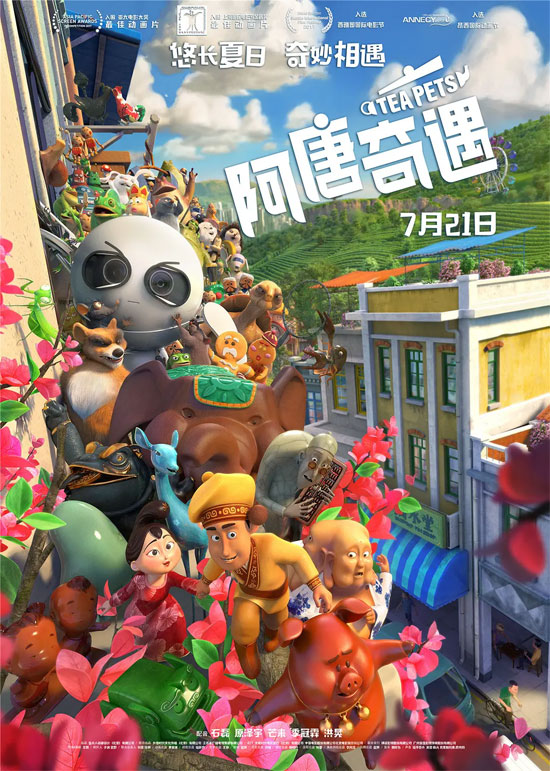
Just as I had already lavished praise on this film’s concept in the “Movie Talk” column before even watching it, I feel that even the critically acclaimed Monkey King: Hero Is Back didn’t deliver the same cultural impact as Tea Pets did when I finally saw it. This surge of interest, as if coursing through my very blood, carries the familiar and unfamiliar flavors of everyday life—a taste I haven’t encountered in Chinese animation for years.
“Tea Pets” may well be China’s first animated film centered on tea culture. It might even be the world’s first animated exploration of “tea pets,” those quintessentially Chinese scholar’s toys steeped in traditional culture. The choice of subject deserves immense praise, as it delves into the very fabric of our daily lives, drawing nourishment from our experiences. The opening ten minutes, filled with tea pet lore and scenes where these creatures come alive like characters from Toy Story—bickering, competing over who gets poured tea most often—are utterly captivating.
However, one aspect I find particularly baffling and must criticize without reservation is how the introduction of the robot Xiaolai completely shatters the film’s cultural authenticity. What was poised to unfold as a modern interpretation of traditional culture is abruptly transformed into a jarringly incongruous sci-fi narrative. The core relationships—between tea pets themselves, between tea pets and tea water, between tea pets and tea brewers, between tea pets and their creators—all become mere subplots.
What possible connection could a story about a tea pet seeking self-worth have with a robot? Conversely, what relevance does a narrative about a robot rebelling against control hold for the concept of a tea pet? The forced juxtaposition of these two elements not only fails to elevate either theme but actually dilutes their core motifs. Far from being a brilliant mashup, it doesn’t even qualify as a humorous clash of incongruous elements. The emotional bond between them—somewhere between friendship and human-pet attachment—is touching, yet pales in significance compared to the film’s brilliant premise and concept. This is a textbook case of two themes, two protagonists, and two films being forced together.
So is there truly no place for robots in the world of tea pets? Not necessarily, but it must happen in a sequel—after the core story of the tea pets themselves has been properly established. The worldview of the first film shouldn’t be so chaotic. Consider this simple principle: Would the first Toy Story have centered on toys and aliens? Absolutely not. It inevitably focused on toys interacting with each other and with their owner. Would the first Finding Nemo have centered on fish and robots? Absolutely not. It was about fish and fish, fish and humans. The same fundamental principle applies to tea pets.
What I truly longed for was a narrative arc depicting Tang and Xiang’s journey—from their initial separation to their eventual reunion, from forgetting each other to rekindling their love. Because Ah Tang and Xiao Xiang are the master’s final creations, and the ultimate testament to the master and his wife’s love. The opening scene, where the master’s wife holds Xiao Xiang with a satisfied smile before passing away, is a setting rich with dramatic tension and future potential. We could fully reflect the master and his wife’s younger selves through Ah Tang and Xiao Xiang’s love, thereby proving a truth: every tea pet has life, each a continuation of the artisan’s soul.
The film scarcely touches upon profound questions: What exactly is a tea pet? What significance lies in its color-changing ability? What defines a good tea pet? Instead, it introduces distractions like the AI robot Xiaolai and the “confessional” search engine—elements that seem profound but ultimately feel like noise. Who is the enemy of tea pets? If we truly put ourselves in their shoes, it might be jealous peers or fickle humans craving novelty—but it certainly isn’t mice. This conflict is pure fabrication. Does the tea pet’s value lie in the master’s engraved characters, or in the energy and emotion he poured into its very being? Do tea pets crafted by unknown artisans feel inferior? How do they find their own purpose? These are the questions the film should focus on exploring.
Could the film tell the story of the security guard’s hidden talents and aspirations? Yes, but only as a very light subplot, serving purely as comic relief without any dialogue. It would satirize how we often overlook truly talented ordinary people in daily life, while also echoing the film’s main theme of portraying the craftsmanship of tea pet masters—a third layer of artisan spirit.
Could the film include a Ferris wheel scene or prop? Yes, Atang and Xiaoxiang could meet at the Ferris wheel. This symbol carries fixed meaning in animation—it represents love, not a random choice. We never employ the Ferris wheel as a symbol for friendship. The film is saturated with scenes of robot Xiaolai and Atang’s Ferris wheel journey, culminating in Xiaolai treasuring a glass sphere from the ride—a moment so saccharine it gives one goosebumps.
Overall, “Tea Pets” succeeds in its opening yet falters in its execution; it excels in its concept but fails in its execution. The only truly heartfelt, tea-pet-centric imagination lies in their counting of how many times each has been watered—a pitifully sparse moment. The jarring intrusion of sci-fi elements distracts us from focusing on the tea pets themselves, or even the tea-pet culture. No matter how you look at it, the friendship between a tea pet and a robot isn’t exactly something we’re dying to know about.
Please specify:Anime Phone Cases » Tea Pets 2017 Animation Film Review: When Sci-Fi Meets Traditional Culture