Film Name: 千与千寻 / Spirited Away / A Voyage of Chihiro / Sen to Chihiro no kamikakushi / 千と千尋の神隠し
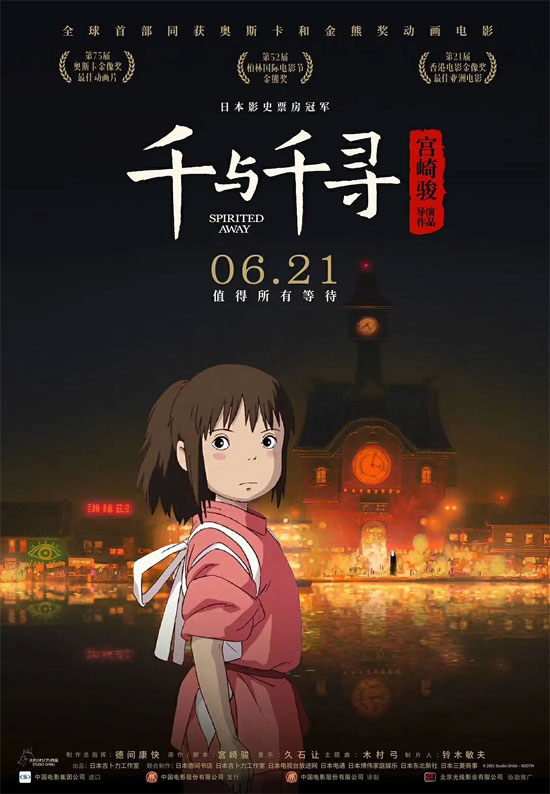
Reviewing “Spirited Away” could probably fill 100,000 words and still not cover it all. Ha ha. It truly is a work that leaves so much room for interpretation.
My good friend Wang Shuang always says that the work that influenced him most was “The Lion King,” which made him feel the weight of a father’s responsibility. So I often reflect: if there’s one animated film that had the greatest impact on me, what would it be? Hmm, it would probably be “Spirited Away,” which I saw when I was 18. Subconsciously, perhaps it was precisely because I watched “Spirited Away” that I developed the desire—and even the courage—to pursue a career in animation.
It was this very work that planted the concept of “Miyazaki Time” in my mind. Later, this hazy impression, honed over five years, crystallized into my sole graduate thesis on animation ontology: “Interpreting Miyazaki Time.” This paper won an award at the inaugural China Communication University Student Animation Festival. When analyzing Miyazaki’s animations, one cannot always approach them from a narrative perspective. If animation is an art of imagination, American animation tends to shape imaginary spaces, while Miyazaki creates imaginary time—this is precisely where he stands apart from other animators.
So when Spirited Away finally premiered in China 18 years later, I found myself alone in a corner of the theater, watching it with reverence and a profound sense of guardianship.
The unparalleled effort Miyazaki poured into this work is immediately apparent, though it’s not evenly distributed. I’ve long held a view that many might disagree with: after the film’s greatest moment—Chihiro and No-Face sitting side by side on the ghost train—Miyazaki’s imagination began to run dry. I’m not just talking about this film, but about Miyazaki’s entire animation career. One could say the Ghost Train is the climax of Spirited Away, and also the pinnacle of Miyazaki’s entire animation career.
After hitting creative exhaustion, Miyazaki could only rely on a “jumping lamp” to bridge the entire journey from the train’s sixth station to Yubaba’s residence, then hastily conclude with the superficially dazzling scene of Haku and Chihiro flying while regaining their names and memories. As sisters, Yubaba and Haku receive entirely different levels of attention in the film. Yubaba possesses the Oil House, servants, and children, while Zeniba resides in a plain village cottage adorned only with a “jumping lamp.” This contrast transcends mere simplicity or deliberate juxtaposition.
At the outset, I mentioned the concept of “space.” The film’s most expansive “space” may well be the character of No-Face. Truly, this is an iconic figure etched into memory for a lifetime. Ten thousand people could offer ten thousand interpretations, each seeing something distinct within him. Much like traditional Chinese painting uses negative space to invite imagination, No-Face serves as the negative space of Spirited Away. Indeed, many plot points and symbols in the film are deliberately left ambiguous, granting viewers room for interpretation and transforming the entire work into a vast experimental field of consciousness.
The visuals are utterly fantastical, yet they constantly reveal the harsh realities of life. This is another profound impression I have of “Spirited Away.” From the cunning schemes of the Soot Sprites to the sycophantic behavior of the social service providers, from the River God polluted by garbage to the spoiled giant baby, every wild imagination in the film mirrors the human heart and nature within society.
Of course, a special place in my heart will always belong to Chihiro, this brave and kind little girl. She may be the most vivid female character in Miyazaki’s works—one who cries, worries, understands etiquette, isn’t greedy, is warm-hearted, and keeps her promises. From struggling to clean a floorboard to fearlessly journeying far for a friend, Chihiro moved many souls in the Oil House. That’s why her triumph earned such heartfelt applause. Her humble yet unbowed work ethic touched countless viewers, revealing in a child the potential future of society.
Miyazaki’s improvisational approach to creation means his stories aren’t always perfectly polished. Yet even so, it doesn’t diminish the extraordinary impact of Spirited Away, a masterpiece that stands forever in animation history. Perhaps many, like me, truly discovered and fell deeply in love with animation because of Chihiro. Perhaps many symbolic metaphors will forever elude us. Yet we should all draw strength for life from Chihiro’s kindness and self-rescue.
Please specify:Anime Phone Cases » Spirited Away 2001 Animation Film Review: My Personal “Spirited Away”