Film Name: 客途秋恨 / Song of the Exile
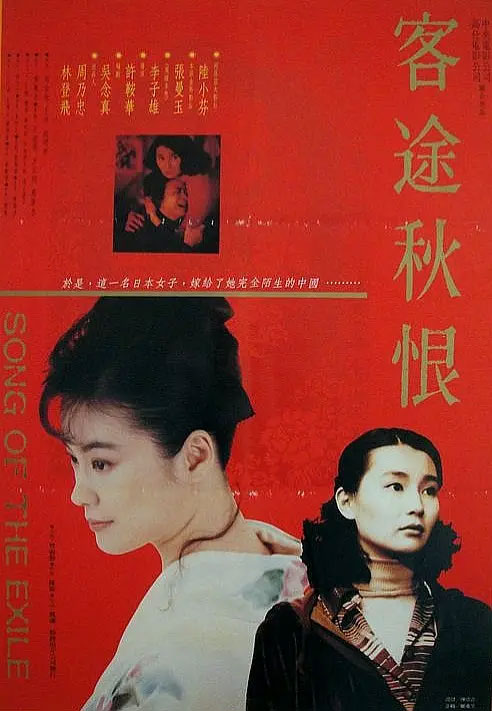
In the flyleaf of the book “Xu An Hua Shuo Xu An Hua,” I found this biographical sketch of director Ann Hui: Born in Anshan, Liaoning Province, in 1947 in Northeast China. Her mother was Japanese. She spent her childhood in Macau and attended primary and secondary school in Hong Kong. In 1972, she graduated from the University of Hong Kong with a Master’s degree in English and Comparative Literature, then went to London Film School to study film. She returned to Hong Kong in 1975 and has worked in film and television ever since. Reading this, I found her life journey truly extraordinary. How did Ann Hui become Ann Hui? It struck me that those born in Hong Kong during the 1940s and 1950s are microcosms of modern Chinese history. Later, I learned she had already turned these experiences into a film, “Song of the Exile.” Even more unexpectedly, I discovered that the screenplay—adapted from her own life—was written by Wu Nien-jen.
This is a personal chronicle of mother-daughter reconciliation, where misunderstandings stem from the era’s cruelties. The film weaves between present and past to narrate Ann Hui’s early life—spanning England, Hong Kong, Macau, Japan, Manchuria, and Guangzhou—a tapestry of shifting times and places. The opening scene shows her cycling through London streets with university friends, embodying freedom, joy, and unburdened spirit. This was her final year in London. She had no desire to return to Hong Kong, feeling that the home there was not truly hers. Only when her younger sister was about to marry far away in Canada did she hastily return for the wedding. Back in Hong Kong, everything felt so unfamiliar. Her mother had become domineering and authoritarian, making communication increasingly difficult and arguments constant. She felt her mother wasn’t always like this. But how much did she truly understand? At fifteen, she had already moved out to live on her own.
The scene flashes back to 1950s Macau, revealing her childhood memories of the city—like a dream—her mother’s daily silence and her grandmother’s doting affection. Her grandmother disliked her mother, constantly picking on her. With her father working in Hong Kong, her mother lived in misery with no one to confide in. Unable to integrate into this family, she wore a perpetually sour expression, her depression manifesting in harshness toward her daughter. Her grandmother, ever protective, only fueled the conflict further. Eventually, she moved back to Hong Kong with her father. Grandparents returned to Guangzhou, leaving her to attend school in Hong Kong with her parents. In daily life, Dad constantly accommodated Mom, fueling her rebelliousness and confusion, leading to constant arguments. It wasn’t until she was fifteen and about to leave home that Dad revealed Mom was Japanese. One can imagine the challenges: a foreign land, language barriers, unfamiliar surroundings. After the liberation, Mom followed Dad back to Macau, where she knew no one. Grandma’s deep-seated hatred for Japanese people was projected onto Mom, leaving no room for acceptance. Perhaps her father’s unconditional indulgence was his way of compensating her mother. Yet even so, unconsciously, despite her mother’s persistent longing for Japan, the environment had transformed her. Still, at this point, she did not understand her mother.
It wasn’t until she accompanied her mother back to Japan—a place her mother had always longed for—that she truly understood her mother’s feelings over the years, making reconciliation possible. Arriving in Japan felt like her mother’s first days in Macau: the unfamiliar language and completely different lifestyle made her feel utterly uncomfortable. Her mother couldn’t recapture the feeling of home either, even when seeing familiar places and people. Yet by this point, her mother had been assimilated into Hong Kong without realizing it. Returning to Japan only brought renewed discomfort, constant arguments with relatives, and deep-seated misunderstandings and barriers. What is homeland? What is identity? “Is so-called nostalgia merely a denial of reality?” In the end, both she and her mother were Hong Kongers. Her mother always felt she wasn’t like her. Was she really so different? Back then, her mother had chosen to stay in China with her father after the war ended, refusing to return to Japan. That resolve mirrored her own decision at fifteen to leave her boarding school. Their conflicts and unresolved issues stemmed not from dissimilarity, but from being too alike. The dissimilarity wasn’t in the superficial changes of their times, but in how perfectly they had inherited each other’s strengths and weaknesses deep down.
Reconciliation also came between her mother and grandmother. Upon learning that her grandfather had suffered a stroke and was bedridden, her mother urged her to return to Guangzhou for a visit. At this moment, Guangzhou was in the twilight of its vibrant era, captured by the camera in an eerily quiet atmosphere. Grandfather’s final words to her were: “Don’t lose hope in China. I’m old, but you’re still young.” Ann Hui’s patriotic sentiments welled up once more. This is the sentiment of that generation of Hong Kongers.
The film contains numerous subplots worthy of repeated viewing. Ann Hui states that even if the story isn’t about herself, she would still convey her own feelings—experiences distilled from real life. She expressed dissatisfaction with the film’s final execution, feeling it wasted such an excellent script and bearing a heavy sense of responsibility. Truly, an exceptionally humble director.
Please specify:Anime Phone Cases » Song of the Exile 1990 Film Review: So-called nostalgia is nothing but a denial of reality.