Film Name: 神秘世界历险记3 / Shen Mi Shi Jie Li Xian Ji 3
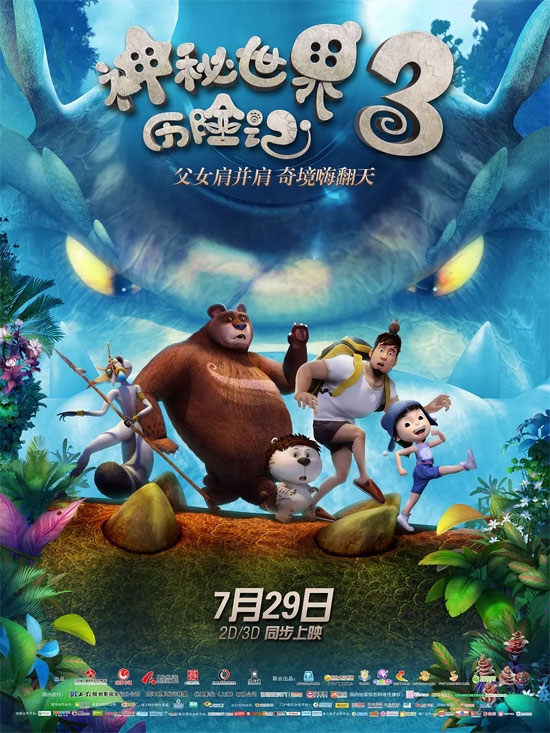
Whether watching “Yugo & Lala” 1 or 2, I’ve always felt a strong sense that the director projected his own yearning onto Hugo’s father. Every glance, every gesture, every word seemed spoken directly to his own daughter. This longing, hidden within the film as an underlying emotion, deeply resonates with why the director poured such profound affection into this series.
By the time we reach “Shen Mi Shi Jie Li Xian Ji 3,” when the director finally decides to bring Hugo’s father into the mysterious world for an adventure, this emotional ambiguity shifts from the background to the forefront. It turns out the director himself could no longer bear merely waiting at home each time. Instead, he wanted to fully nurture Hugo throughout the entire 90 minutes, allowing his own paternal emotions to pour out more vividly. Look at that final scene where the father risks his life to throw Hugo out—isn’t that the climax of this emotion?
Yet amidst the moving and nostalgic moments, I still feel the creative choice to bring the father into the mysterious world remains a directorial whim. In films with such fantastical settings, parents occupy a distinct role: supporting characters who often serve as obstacles to children’s pursuit of freedom. Even when not obstacles, they remain secondary figures, unable to share equally in the extravagant liberty offered by the otherworldly realm.
This explains why, after over 30 years of Doraemon films, Nobita’s mother has never stepped into the time machine. It’s not that her visiting the alternate world where Nobita, Shizuka, Suneo, and Gian reside would be illogical—rather, it would profoundly disrupt the series’ core dynamic of framing children and parents as an inherent duality.
Similarly, in My Neighbor Totoro, only children can see Totoro and the magical scenes. Parents—regardless of how devoted they are—cannot share the experience of waiting for the bus with Totoro. In Miyazaki’s vision, children are supreme beings with pure hearts; adults are unworthy of the wonders accessible only through such innocence.
One consequence of bringing the father along on the adventure is that he usurps the spotlight, even though the ultimate resolution of the core challenge should arguably rest with Hugo and Lala. Leaving the father at home would have had no fundamental impact on the plot’s progression. Instead, it would have allowed for more branching storylines within the mysterious world, further highlighting the bond between Hugo and Lala. It must be made clear: this is a film about a child venturing into another world, a film about a child’s yearning for freedom and imagination, and perhaps a film about family bonds. But it is absolutely not a film celebrating how outstanding, how wonderful, or how loving a father is.
Another consequence of bringing the father along on the adventure is uncertainty about whether he should re-enter the mysterious world in a potential sequel. If he does, the film would essentially be renamed “Hugo and Dad’s Adventure”; if he doesn’t, wouldn’t his arbitrary inclusion in this installment seem rather odd?
Please specify:Anime Phone Cases » Shen Mi Shi Jie Li Xian Ji 3 2016 Animation Film Review: Taking Dad on an adventure is an adventure in itself.