Film Name: 新上海滩 / Shanghai Grand / 新上海灘
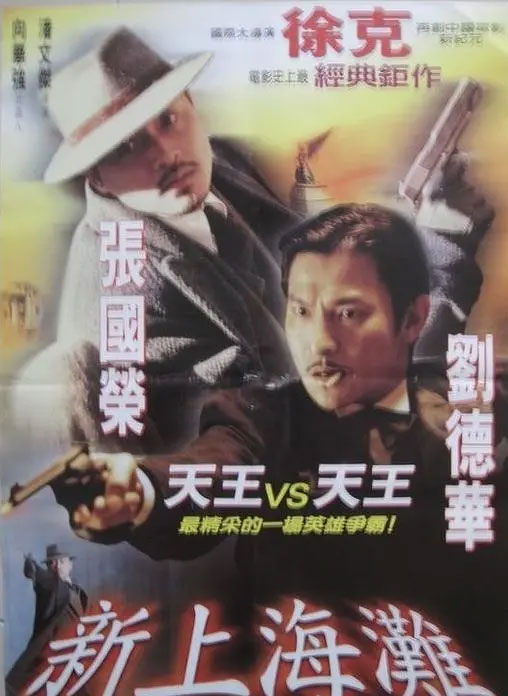
At times, I watched “Shanghai Grand” as if it were a romance film. Later, I realized it was a story about deep brotherly bonds.
“Shanghai Grand” is probably the film I’ve seen that most closely resembles a TV drama. Coming from me, that statement might sound like a criticism, but I don’t mean to imply the film is bad.
I say this because the plot is genuinely convoluted and tangled. For instance, Ding Li (Andy Lau) and Feng Chengcheng (Ning Jing) could have been together, but then Xu Wenqiang (Leslie Cheung) intervened. Later, it’s revealed that Feng and Xu were old acquaintances, meaning Ding was the one who had intruded. So Ding steps aside, leaving Xu and Feng seemingly free to be together. But then it turns out Xu and Feng’s father were sworn enemies, leading to violent clashes that drive Feng insane. Ding vows to avenge Feng, becoming Xu’s enemy, yet his brotherly bond prevents him from killing Xu. However, one of Xu’s associates (?) mistakenly believes Ding killed Xu and shoots him dead. Amidst all this chaos, countless other characters like DEFG complicate matters further. Spread across a dozen episodes (or even dozens?), this narrative might unfold more naturally. But cramming such convoluted, interlocking plots into under two hours feels rushed.
The three-act structure feels disjointed, preventing emotional arcs from flowing smoothly.
Perhaps because the film had too much to cover, the development of Xu Wenqiang and Ding Li’s deep brotherhood wasn’t shown, making their sudden closeness feel abrupt. Ding Li’s extreme protection of Xu Wenqiang—sacrificing his own love, sparing Xu’s life, and rescuing him to Taiwan—makes sense because Xu once saved Ding’s mother from a fire. But where did Xu’s brotherly affection for Ding come from? I only witnessed Xu being tormented by Ding at the film’s outset. How did Xu’s hostility toward Ding suddenly undergo such a dramatic reversal? He lends Ding a gun for self-defense, risks life and limb alongside him (completely unrelated to his own plans—he could have avoided it), and in the end, refuses to use the gun against Ding, switching to blanks solely to repay Ding’s debt of gratitude. I genuinely can’t fathom where this profound affection stems from. It even makes one wonder if Xu Wenqiang harbors a romantic attachment toward Ding Li (I’ll likely get flak from the film’s fans for saying this—let me reiterate, I’m not a BL fan, nor am I interested in that particular subculture). Because only love could be so inexplicable.
Thus, in terms of naturally building emotional depth, this film falls short. It lacks the organic brotherhood portrayed in “Alan & Eric: Between Hello and Goodbye,” and even pales in comparison to “Redux Bugis Street.”
When it comes to romance, the love story involving “Feng Chengcheng” in this film is truly well-done. Brother is just too handsome—his appearance on the train, with his blood-stained and torn shirt, messy hair, and unkempt stubble, makes for a thoroughly sexy image, so beautiful it breaks your heart (or perhaps “intoxicates” you? Probably both). Ning Jing’s portrayal in this film also completely changed my impression of her. Before, I only remembered her as the plump older sister in “In the Heat of the Sun” (who seemed much older than Xia Yu) and the bald woman in “Divergence” (who had intimate scenes with Daniel Wu, which disgusted me back then). In this movie, she plays a younger character, and she pulls it off quite well. So there’s definitely chemistry between the characters.
“Shanghai Grand” is the first film in a long time that hasn’t left me feeling conflicted and depressed. Lately, whenever I see a movie with one or two characters I really like, I always hope they end up together. But with this one, I actually wanted the leads to break up, get separated by fate, or even for the annoying female lead to get killed off (how cruel!). But inevitably, the leads often lock eyes the moment they meet, their feelings set in stone. This leaves my favorite characters pitifully relegated to supporting roles—deprived of romance and happy endings. When the leads finally reunite, their love deepening as they pledge their lives to each other in the film’s romantic conclusion, I can’t help but sob uncontrollably in front of the screen. For instance: “He’s a Woman, She’s a Man,” “Who’s the Woman, Who’s the Man,” “Behind the Yellow Line,” “All’s Well End’s Well, Too” (I always wished Leslie Cheung and Sophie Yung’s characters could have developed something—though Sophie’s initial look was admittedly pretty awful), “Ninth Happiness” (no female character I particularly liked in this one, though Karen Ng’s outfit was genuinely over-the-top), “Alan & Eric: Between Hello and Goodbye” (though Alan Tam and Maggie Cheung did complement each other beautifully, still… sobbing uncontrollably). But in this film, as the female lead, Feng Chengcheng choosing Xu Wenqiang aligns perfectly with my preferences—though saying that feels terribly unfair to Ding Li.
Perhaps it’s a matter of emotional groundwork, but I never sensed Xu Wenqiang’s profound love for Feng Chengcheng. Instead, it felt like Feng’s affection for Xu was far more intense, while his feelings seemed closer to the detached “Xu Zai” from Days of Being Wild. If that’s the case, perhaps his later act of following her to meet her father was also to fulfill his promise to Ding Li. I’m sure such a malicious interpretation is purely my own imagination, not the director or screenwriter’s intent. So, ultimately, the emotional depth wasn’t sufficiently developed.
Ding Li is actually the most moving character in the film. When his friend steals the woman he loves (from his perspective, at least), he quietly steps aside, even considering leaving his hometown behind, all to ensure the woman he loves finds happiness. Even when Xu Wenqiang fails to keep his promise and drives Feng Chengcheng mad, Ding Li still cannot bring himself to kill him.
Three scenes of my brother moved me deeply.
Knowing full well that entering the bar meant certain peril, that he might meet his end there, Xu Wenqiang still pushed open the door and walked in. He thought of the bartender’s faint smile as he said, “Happy New Year.” That resigned greeting was simply to repay a brother’s loyalty—life and death no longer mattered.
As Xu Wenqiang lay dying from Ding Li’s bullet, he whispered faintly, “What I owed you… I’ve paid it back.” In that instant, it felt as though some emotional vapor had solidified, then sank silently downward, creating a sense of sorrow so deep it seemed bottomless.
At the end, Xu Wenqiang sat in the car, recalling conversations with his good brother Ding Li under the bright sun of days past. A single tear slowly slid down the corner of his eye.
“To Shanghai, I was just a passerby,” Xu Wenqiang had once said. Yet how could such bonds of loyalty and friendship be lightly brushed aside, leaving not a trace, not a single mark? In this very place, he had passionately kissed a devoted woman and shared life-and-death experiences with his brothers. Counting it all, every stroke and line was a debt of blood, tears, and loyalty. Yet the debtor owed helplessly, while the creditor lent willingly, never even expecting repayment. Ding Li, fallen in the snow, surely harbored not a shred of resentment. In his final moments, he likely recalled with Xu Wenqiang the shared setting sun, the shared words—so leisurely and beautiful, yet gone forever. Perhaps he smiled quietly in the snow. After enduring so many trials, he knew he had done nothing to betray his brother—and that should have been enough.
Through all the trials, brothers remain;
When we meet again, a smile erases all grievances.
Please specify:Anime Phone Cases » Shanghai Grand 1996 Film Review: A smile in the vast sea is but a simple greeting.