Film Name: 胭脂扣 / Rouge / 沙灘仔與周師奶
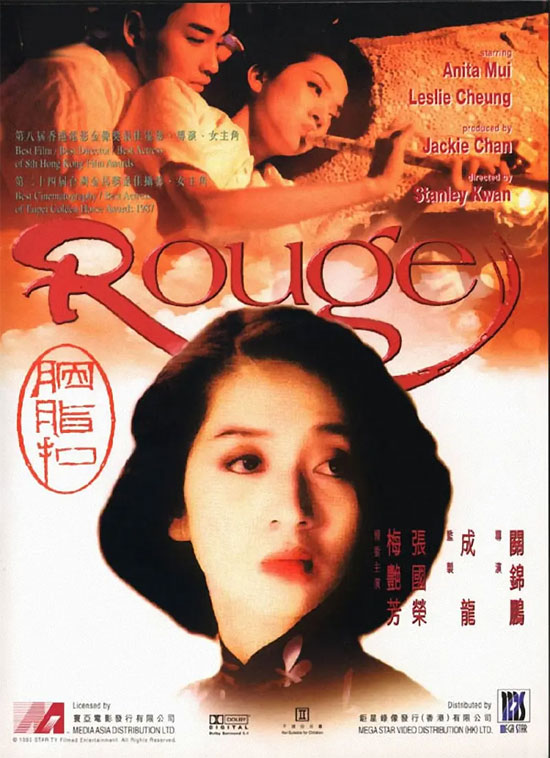
Objectively speaking, this is merely a tragic love story. One was the eldest son of the prestigious North-South Trading Company, the other a courtesan bound by circumstances. Their families were worlds apart. Yet they met by chance, and their love blossomed in the haze of uncertainty. When their families opposed them, they resorted to swallowing opium to die together.
But this was not the end. Fifty-three years passed, yet she still did not find him on the path to the afterlife. She came to seek him out. To find him, she was willing to beg humbly, to confess openly—admitting she had schemed relentlessly to never part from him. Yet in the end, she could not bring this love to its natural conclusion. Finally, she saw him. He hadn’t died; he had survived, but now he was old and destitute. She, however, remained unchanged. In a dilapidated film studio, he languished, smoking opium, content to be an anonymous extra. “Twelfth Young Master,” she said, “thank you for remembering me. I’ve worn this lipstick knot for fifty-three years. Now I return it to you. I will wait no longer.” ” With that, she turned and walked away.
What a pity for a love that never quite found its way. It wasn’t that they didn’t love each other enough. They’d weathered every storm to stand before “forever,” they’d both faced death once—so why did the thread of their ending remain unraveled?
“The real thing is never the most beautiful,” she once said, answering his casual question: “You have so many faces—which one is the real you?”
Yes, reality was ugly—crueler than the present. Amidst love’s intoxicating haze, they could be perfect for each other, indulge in romantic fantasies, and cling to each other like glue. Yet inevitably, she remained a commoner from the riverside, beyond his social reach. Faced with convention, all he could do was flee and compromise.
Her love was undeniably selfish, and he couldn’t bear it; the love she demanded was too earth-shattering, and he couldn’t give it. To ensure they could stay together, she secretly slipped a bottle of sleeping pills into his wine, swallowing opium herself first to show her resolve, threatening death. Alright, he swallowed too. No matter what, she thought, what’s done is done.
Yet she forgot they were different people. He would be saved by those willing to pay a fortune, would resent her cruelty, and would rather live a miserable existence alone. Even burdened by guilt, even if his romantic pursuits were washed away by rain, he never considered dying again.
Fifty-three years later, she recounted the past without regret to the kind entertainment reporter who helped her. “I came to find him,”
she said bitterly, “He was a coward. He left me behind.” She still resented him, blaming him for being too pragmatic, not reckless enough, not resolute enough. He was cowardly, he betrayed their love. She sang mournfully: “Vows turned to smoke and words, Wasting a thousand thoughts. Love burns like fire, How can it last a lifetime? Continuing is not easy. Betrayal is your name,
Wasting all my longing in vain.
Love flows eastward like water,
My devotion poured in vain,
Wishing we’d never met that day.”
She never imagined he too had sacrificed. He did far more than he could, yet fate was not yet ripe, leaving them inevitably separated by heaven and earth.
At that moment, someone remarked, “Why must we make it so tragic when we could simply be happy together?” I still remember in the movie, Anita Mui appeared in male attire, calmly singing the southern melody “Ke Tu Qiu Hen”: Longing for my beloved feels like days stretching into years… Today we’re worlds apart, meeting impossible, So I drift alone in a silent boat, The evening chill deepening.” When they met again, she still sang: “See how the setting sun bathes the pair of swallows in flight, Leaning alone by the window, thoughts grow quiet…” The melody remained the same as years ago, But the heart could never return to that day. This feeling can only become a memory, Yet back then, it was all so bewildering.
When rouge dusts with age, what use is a rouge case?
Fifty-three years have passed—do the carved balustrades and jade steps still stand, though beauty has faded? Could it be, as in the beginning, that sorrow never truly began?
Please specify:Anime Phone Cases » Rouge 1987 Film Review: When rouge is dusted with ashes