Film Name: 哪吒之魔童降世 / Ne Zha / Nezha: Birth of the Demon
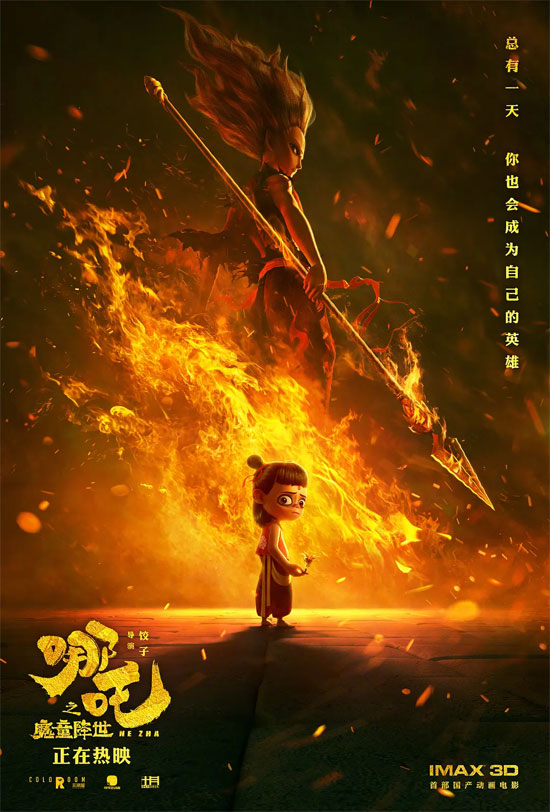
First, congratulations to Jiaozi for finally realizing his dream of making an animated film. It’s been a long and arduous journey—keep moving forward.
This film ranks among the most emotionally rich and profound domestic animations I’ve seen. It explores father-son bonds, mother-son bonds, master-apprentice bonds, and friendships. The father-son dynamic is undoubtedly the most compellingly portrayed, though it perhaps lacks that final, weighty embrace. The mother-son relationship is generally well-handled, though the mother would have been better served as a straightforward devoted wife and mother—there was no need to force her into a “Mulan-esque” role. As for the master-disciple bond, I feel that Master Taiyi’s final rescue at least deserved a heartfelt bow from Nezha. The friendship between the two is quite romantic—female viewers will likely adore it. At least it ends with the handsome guy and the demonic child holding hands. If it had been two handsome guys holding hands, the scene would have been too beautiful to imagine.
After watching this film, I found myself inexplicably recalling “Kui Ba.” Both tell the coming-of-age story of a child demonized by those in power and societal discourse. The director envisioned Nezha as Kui Ba in the world of Fengshen, a calamity star feared by all, yet equally innocent and helpless. Why does Nezha only show a non-malevolent expression when facing that little girl? Why does he crave a friend so intensely? Why can’t he tolerate even the slightest lie or deception from his parents? These are all desperate cries stemming from his inner fear of loneliness.
The seeds of demonic power and the heart of the Tao are inherently neither good nor evil. Shen Gongbao cultivated the Tao, yet he was no less a demon who stirred up trouble and let his selfish desires run wild. Ao Bing was a fine young man, yet he too sacrificed tens of thousands of common folk for his clan’s selfish interests. The people are kind-hearted, yes, but when they become obtuse, they can still create the tyranny of democracy. Thus, in any discourse concerning demons and the Dao, the deepest contemplation lies in discerning which is truly demonic and which embodies the righteous path. You will find that those labeled as demons or monsters often possess profound loyalty and deep affection, while those cloaked in righteous facades are frequently the true demons, disguised in hypocrisy.
I wonder if the director has children of his own, and whether he unconsciously projects himself and his family onto the characters he creates. But Nezha and Ao Bing largely represent two archetypal types of children in the eyes of parents. One is the love-hate, rebellious child who defies expectations, while the other is the model, obedient child who embodies the family’s hopes. Jiang Xiaoyu and Hua Wuque, these twin brothers, truly form a classic contrasting pair. Gu Long’s tale of “The Peerless Duo” teaches us that both delinquents and model students can become heroes—much like Nezha and Ao Bing, who are also twins in a sense. They represent polar opposites, drawn to each other’s differences while complementing one another. The film has already pushed the portrayal of Nezha to its limits; the depiction of Ao Bing could have been even more extreme.
Compared to Nezha’s mischievous nature, the director’s penchant for crude humor feels like a truly “dark sense of humor.” While the theatrical release likely trimmed many such gags, as some netizens pointed out, scenes involving farts, burning pants, and macho men acting effeminate still drag down the film’s tone. It’s no surprise—ever since the “hitting a giant watermelon” scene, the director has clearly had a taste for this style. We can only hope for more scenes like Nezha outsmarting Ao Bing and Shen Gongbao through transformation. Still, managing to pack in a laugh every few minutes within such a weighty theme is genuinely commendable.
The film’s pacing remains relatively polished. Apart from a few slightly drawn-out segments like childhood pranks and training within the Map of Rivers and Mountains, the overall pacing is crisp. Particularly masterful is the scene where Nezha learns of his father’s affection—it cleverly employs the mount’s replay function to echo earlier training sequences while seamlessly inserting a flashback of his father’s visit to the Heavenly Court. From a storytelling perspective, this is exceptionally well-handled. Combined with the film’s already superb visuals and sound design—especially the lifelike portrayal of character expressions and performances—the entire film feels vividly three-dimensional and suspenseful, avoiding the formulaic feel of most domestic animations.
The slight disappointment lies in the fact that the film came so close to making me cry. Though I admit my tear ducts are easily triggered—I even shed tears watching “The Leader” this morning over Marx’s dedication to humanity. Despite its rich emotional content, the film didn’t quite make me cry. Reflecting on it, perhaps the emotional impact felt scattered, lacking a climactic moment like the song “Remember Me” in “Coco,” which awakens the grandmother’s fading memories. Between the father-son bond, mother-son bond, and brotherly love, which emotion did the film most want to move me with? Perhaps a bit more groundwork could have been laid for that particular sentiment.
Please specify:Anime Phone Cases » Nezha: Birth of the Demon 2019 Animation Film Review: Let the demonic seed develop a Dao heart