Film Name: 富贵列车 / Millionaires’ Express / Shanghai Express / 富貴列車
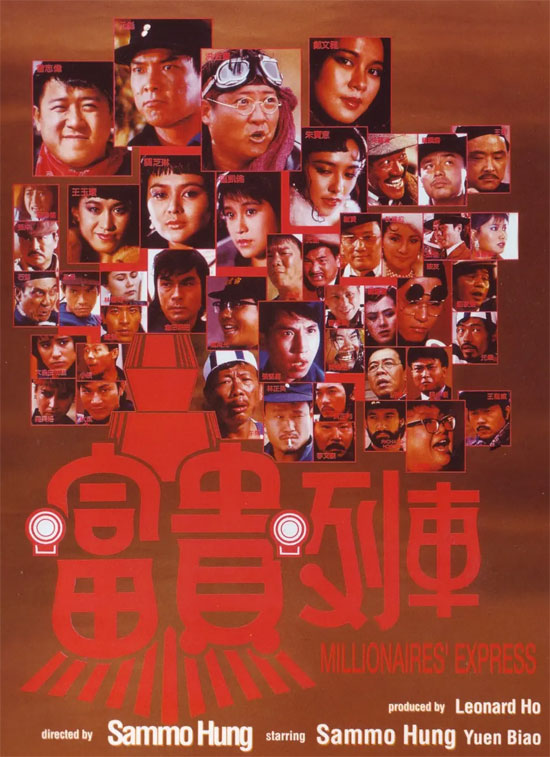
As a longtime enthusiast of classic Hong Kong cinema, I’ve long heard of the fame of “Millionaires’ Express.” First, one of my favorite songs, “Che Zhan” performed by Su Rui and Xia Shaosheng, is the theme song of this film. Second, this commercial blockbuster gathered a star-studded cast at the time, and its box office success was remarkable—second only to “A Better Tomorrow” starring Chow Yun-fat and Ni Rui. Today, I finally found the time to watch the entire film.
Directed by and starring Sammo Hung, the film is remarkably inventive and meticulous in detail. It opens with Cheng Fangtian (Hung) in a snowy chase against Central Special Police, immediately establishing the film’s comedic and slapstick tone. The narrative forms a satisfying circle, culminating in Cheng’s redemption through service, leading to his release from pursuit. The film doesn’t sacrifice humor or depth. The Central Special Police’s sly, knowing smiles carry profound meaning, undoubtedly reflecting the social commentary of its time. I could go on and on about such interpretive analysis, but let’s skip the lengthy discussion and focus on a few key details:
1. The former security team captain (played by Eric Tsang) walking on stilts
Walking on stilts is inherently unstable—why take such a reckless risk? For money, he orchestrated an arson robbery; to conceal his identity, he wore a mask and walked on stilts; and ultimately, he stumbled and fell. Such self-deception is the mark of a petty villain. That’s why such individuals can only be called “cunning,” not “wise.”
2. The Town Chief’s Speech
Speaking truth to no one listening, doing deeds to no one acknowledging—this must be the sorrow of public service. After Hanshui Town was looted, his blunt, thought-provoking admonition sparked a riot. Yet after Captain (played by Yuan Biao) delivered a rousing speech, the villagers supposedly became “united as one, ready to face adversity together”? Films are ultimately artistic creations. In reality, I’d never believe such a thing. Never succumb to sweet illusions (as evidenced later when all villagers are kidnapped again—these “common folk” never truly changed).
3. Xiao Feihong’s “Endurance”
This could be seen as a flashback technique, perhaps even a subtle plug for other films. Yet it carries profound meaning: Master Huang educates Xiao Feihong in “excellent traditional culture,” teaching humility and endurance; his opponent, however, resorts to ruthless violence and short-term gains. “Monkeys stealing peaches is like this~”—this line reveals a sharp ideological conflict when examined deeply. Presenting this through a father-son dynamic inevitably prompts reflection: such contradictions gradually seep into childhood too. I’ve always felt today’s students carry an unbearable burden. They’ve lost the innocence and purity of yesteryear; modern friendships mature far too quickly!
4. Walking on the Train
“Stand steady in your horse stance, then go check—how many people are in the locomotive? Figure out how to stop the train first.” “The result? The philanderer strides in and out with ease, leaving us speechless with laughter. (Whether driven by urgency or sheer determination, his unwavering resolve prevails.) The absurd comedy of “Five Lucky Stars” is an absolute classic of its era!
5. Lam Ching-ying—The Most Dedicated Actor
In the film, Lam Ching-ying plays the underling to Tsang Chi-wai’s arsonist-thief security chief, without a trace of arrogance. (That scene where he pretends to be crazy and sings “Only Mom Is the Best in the World” is absolutely hilarious. If Mr. Lam were to time-travel to today, he’d be the first to experience social death.) For actors of that era, professionalism was paramount; with so many stars gathered, there was no room for diva behavior. Even a minor mistake could cost you your livelihood. You can see in the film that all the stars played themselves.
Our familiarity with Mr. Lam likely stems more from his horror films. I once encountered a claim that he became so deeply immersed in his roles that he ultimately died because of them. Whether true or not, it’s unnecessary to investigate. May that black butterfly forever accompany the late Mr. Lam. This professional integrity is why we loved him. It’s also why we cherish that era of “Hong Kong cinema”!
Please specify:Anime Phone Cases » Millionaires’ Express 1986 Film Review: stroke of genius