Film Name: Mack the Knife / Doctor Mack / 流氓醫生
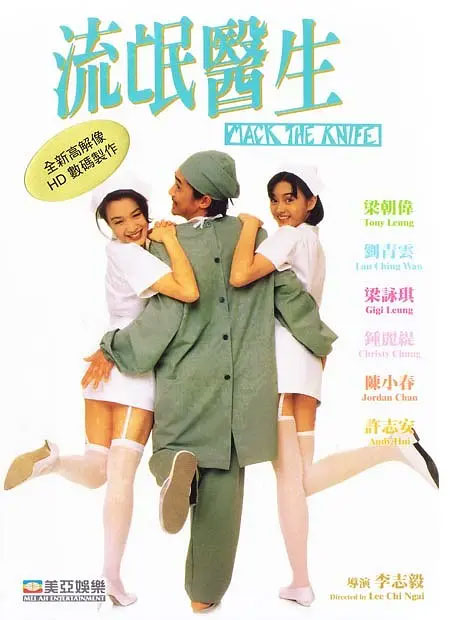
1. Tony Leung’s Eyebrows Speak Volumes Recently, Tony Leung’s new film Europe Raiders hit theaters, suffering a box office disaster and receiving a shockingly low rating on Douban. While many fans regard him as the god of arthouse cinema, it’s clear Tony refuses to be confined to a single genre.
Looking at an actor’s career, the types of roles they land often seem random—or perhaps shaped by fate. Tony is an actor blessed with good fortune, which is how he crossed paths with Ang Lee, Wong Kar-wai, and Andrew Lau. At the same time, he is exceptionally hardworking and talented—though talent undoubtedly plays the larger part. Across every genre, he uses his expressive eyebrows and magnetic gaze to embody diverse archetypes of the male ideal.
Hong Kong cinema’s four classic genres—comedy, crime, thriller, and wuxia—each feature outstanding examples of his work. “Mack the Knife,” a comedy film released the same year I was born and directed by Lee Chi-yi, features Tony as Dr. Lau Man—the most captivating character in my eyes. If I had to sum him up in one phrase, it would be: a worldly rogue, a solitary wanderer.
With disheveled hair, patchy stubble, casual attire, a constant stream of dark humor, and a defiant gaze, he runs a private clinic in the slums, treating prostitutes, gangsters, big shots, and pregnant students seeking abortions. Tony Leung’s rogue doctor is a quintessential vagabond rooted in Hong Kong’s gritty streets.
In truth, this rogue doctor graduated from a prestigious medical school. To take the fall for his best friend, Zuo Zhijie, he abandoned the halls of academia, obtained an illegal African medical license, and now practices among the common folk. Though outwardly disheveled, his medical skills are extraordinary. Trained within the system, he eschews the pursuit of fame and fortune.
In stark contrast to the rogue doctor stands his friend Zuo Zhijie—a renowned young Hong Kong physician, chairman of a medical foundation, and a socialite who moves among the upper echelons of society.
In movies, the role of a so-called best friend is to stab you in the back. Zuo Zhijie repeatedly stole the rogue doctor’s medical achievements, and in the end, he even tried to strip Wei Zai of his right to practice medicine. The villains are always stubbornly deluded, while the good guys are always excessively kind. When Zuo Zhijie was shot, not a single doctor in the hospital was willing to risk performing surgery on him. In the end, it was the rogue doctor who saved him. While this plot twist was predictable, the rogue doctor’s humorous antics in the operating room couldn’t help but make one chuckle, fostering a deep fascination for this cynical yet profoundly kind-hearted man.
As the saying goes, no matter how beautiful the phoenix at home, the wild pheasant outside always seems more enticing. Zuo Zhijie’s wealthy girlfriend fell head over heels for the rogue doctor at first sight. Unlike Zuo Zhijie’s drawn-out courtship, the rogue doctor charged straight into her home after their initial meeting and kissed her forcefully. “Men aren’t bad, women don’t love” is taken to its extreme here, but more importantly, when a man is handsome enough, women simply fall for him.
He treated all patients equally, curing the sick and saving the dying. By day, he diagnosed all manner of ailments in the streets and alleys; by night, he distributed free medicine to homeless elders alone. His kindness wasn’t deliberate; he simply believed a doctor’s true calling was healing, just as a cobbler mends shoes or a watchmaker repairs clocks. This drew an elite medical intern (played by Andy Hui) to follow his practice and a wealthy heiress (played by Gigi Leung) to become his nursing assistant. Facing life and death, he remained unflappable; fame, fortune, and power held no sway over him. The film’s myriad details, dry humor, and portrayal of marginalized characters further highlight the rogue doctor’s charismatic nonconformity.
It must be said that Tony Leung Chiu-wai embodies the rogue doctor role with consummate skill. Having seen through the world’s corruption, he channels it into his arched eyebrows and defiant smile. As one writer observed, the finest way of life is to mentally scorn all the fashions of the age while unhesitatingly following its rules of operation. After watching “Mack the Knife,” one realizes the most artistic approach to living involves not only mentally despising the era’s conventions but also acting entirely on one’s own terms, laughing defiantly at the world.
2. The Hong Kong Image Every Film Fan Dreams Of
The opening scene echoes with the moans of prostitutes and the hymns of churches. Amidst filthy sewers, crowded street stalls, and stacked tenement flats, Tony Leung’s Dr. Lau Man appears, fish balls—a quintessentially Hong Kong snack—stuck between his teeth.
Hong Kong Royal Police officer Lau Ching-wan, played by Lau Ching-wan, shoots the kidnapper holding Wei-zai hostage. Even at the brink of life and death, Wei-zai cracks an unusually dry Hong Kong-style joke. The landlord’s daughter competes in the Miss Hong Kong pageant, a priest distributes missionary leaflets door-to-door, and tattooed thugs roam the streets collecting protection money. Adapted from a Japanese manga, director Lee Chi-yi brings Hong Kong’s gritty underbelly vividly to life.
Unlike Hong Kong cinema’s past reliance on clichés and stereotypes, in the lantern-lit alley dubbed “Mack the Knife,” Gigi Leung’s wealthy heiress ditches luxury cars for daily immersion in this seedy underbelly. Andy Hui’s elite medical intern becomes entangled in a life-and-death obsession with Xu Haoying’s bone cancer patient, while a neurotic Hong Kong Royal Police officer falls for a prostitute dreaming of studying in France. Some say small towns hold many stories, but big cities harbor even more tales in their hidden corners. Hong Kong symbols permeate the narrative: Tony Leung’s gangster-style dry humor, prostitutes’ powerful cries of “Praise the Lord!” in churches—realistic yet absurd. This dimly lit, motley-crowd neighborhood, compared to Hong Kong’s bright, upper-class circles rife with deceit, feels far more endearing as a small tribe brimming with humanity.
3. Building a Hut in the Human World
To transcend the world yet remain engaged in it—to understand its coldness, warmth, and treacheries, yet still immerse oneself in the sea of humanity—this is the mark of the truly enlightened. The rogue doctor exemplifies this. He was not unaware of the betrayal that befell him, but rather, he was utterly unconcerned, thus beyond the grasp of others. At the film’s conclusion, a procession of medical luminaries in tailored suits mobilized to revoke Dr. Liu Wen’s license. Yet the indifferent physician revealed the truth—he had been practicing medicine without credentials from the very beginning—a slap in the face to this ostentatious upper crust.
Dr. Liu Wen believed that practicing medicine for the sake of doing good, rather than for the sake of doing good itself, meant that the profession was just another job—like that of a street cop, a vendor, a henchman, a priest, or a prostitute. Walking among the masses, one should not be swayed by lust, nor by the allure of sound, scent, taste, or touch. One should act solely according to the voice of one’s own heart. He boldly approaches the first woman who catches his eye, casually advising an underage heiress to sleep with more men before discarding them. He jokes and gets physical with prostitutes while providing them free medical care and surgeries. Such a man emerges from life and becomes one with it.
Dr. Liu Wen also carries a tragic story. Though a masterful physician, he failed to save the woman he loved most, a loss that haunted him for years. Yet when he met a new lover, he threw caution to the wind. He willingly relinquished his passionately researched medical thesis and, when his long-established private clinic was shut down, resolutely departed for Africa to practice medicine. Such a soul seems to possess boundless youth—no place can bind him, no rule can confine him. He lives at the very bottom of society, doing the simplest work, yet finding contentment in the ordinary makes him extraordinary.
Please specify:Anime Phone Cases » Mack the Knife 1995 Film Review: Tony Leung’s Most Captivating Roles