Film Name: 姜子牙 / Legend of Deification
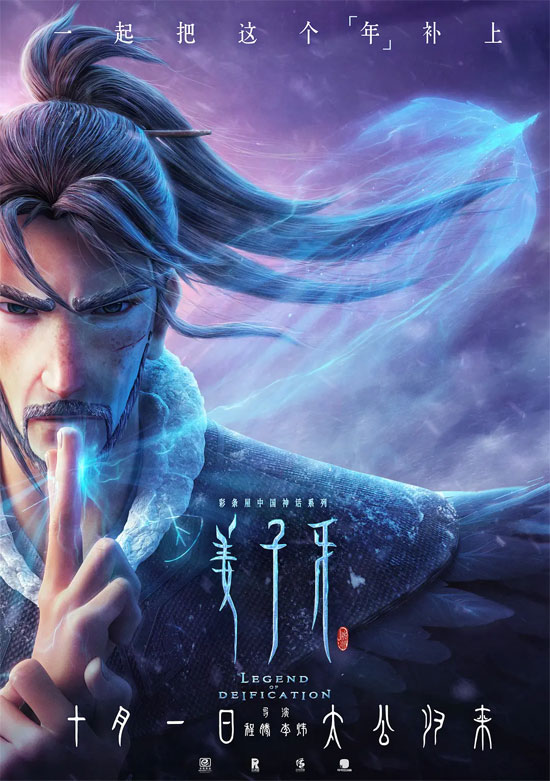
When Jiang Ziya wielded the Divine-Slaying Whip—a staff resembling a broken twig—to open the Abyss, I saw echoes of Moses parting the Red Sea in biblical tales. Yet unlike the biblical narrative, this Chinese “Moses” betrayed his “God” yet still parted the sea to save lives.
The film tells the story of a “betrayal born of following one’s heart.” Jiang Ziya is a deity with a soul. Unlike the masked gods of Jingxu Palace or his hypocritical master, his original aspiration upon entering the immortal realm was to save the world. He steadfastly held onto this conviction, never wavering in his quest to save humanity—even when faced with the dilemma of choosing between saving one person or all of creation.
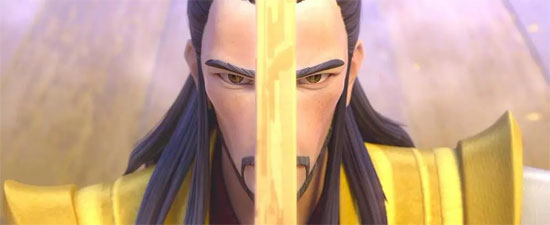
It is precisely this unwavering resolve that earned him the steadfast loyalty of his companion, the Four-Unlikes; the unconditional devotion of his loyal friend and disciple, Shen Gongbao; and the ambiguous affection of his “daughter,” Xiaojiu. He was richly blessed with familial bonds, friendship, and the devotion of his companion. The scene of parting with the Four-Unlikes, in particular, is deeply moving.
Yet as a traitor, his punishment felt insufficient. The moment he crossed the North Sea’s sealed border, he should have braced for Jingxu Palace’s pursuit—but none came. Not that he was unprepared, but that no pursuit materialized. In modern film terms, it’s as if there wasn’t even a single chase scene. If threats only came from outside the established system, without any condemnation from within it, how could his “rebellious” value truly be demonstrated?
He spotted the Mystic Bird with alarming ease. Shouldn’t this sacred bird—liberator of wronged souls from beyond the heavens—have been summoned only when Jiang Ziya, facing his final moment, unleashed the profound love within his heart? Why did it simply glide in and out so casually? Where is its rarity? Where is its mystery?
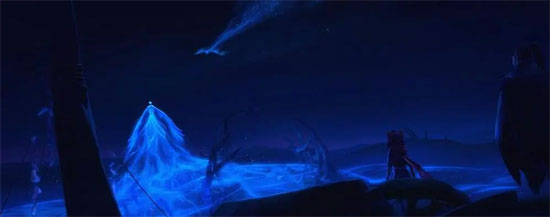
The world’s misunderstanding of Jiang Ziya should have served as a fitting “punishment” for this traitor. Yet the film offers only a fleeting glimpse of this theme in the North Sea Store scene—which is precisely why I consider this opening segment the most compelling part of the entire film. A hero who claims to save the masses has scarcely any connection with them throughout the entire film. How can he brazenly proclaim his mission to save the world? Where does he find the strength to uphold his original aspirations? The sole source of his strength should be the common folk who, despite misunderstanding him, still choose to believe in him. Unfortunately, the film fails to depict this aspect. Consequently, the climactic scene where he destroys the celestial ladder—even with the world watching—lacks the heart-wrenching impact it should have.
The film’s greatest tragedy is that the people remain mere spectators to Jiang Ziya, not his allies.
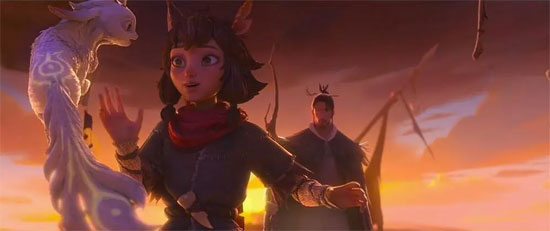
Speaking of tragedy, the character of Xiao Jiu carries a heavy burden. She journeys with heartfelt hope to find her father, only to have the sole scene involving her biological father depict him snatching away her cherished doll. Though Jiang Ziya later picks up the doll, fostering a subtle “father-daughter” bond with Xiao Jiu, could he truly replace her birth father? Even if he could, could he replace the countless fathers like Xiao Jiu’s who push their children into the abyss? Is a world of loveless masses truly worth saving? Thus, the tragedy of Xiao Jiu’s family background, seemingly insignificant, lingers like a bone stuck in the throat.
The film exhibits a tendency to skim the surface with many characters. Some stem from plot shallowness. Take the three children at the beginning—if their sole purpose is to appear in the opening scene, with no subsequent role, no resolution, and no payoff in the narrative, why include them at all? Others stem from superficial characterization. Consider the character of King Zhou. The story of Jiang Ziya unfolds after King Wu’s conquest of Zhou, rendering King Zhou—now a deity of matrimony—irrelevant to the plot. The film’s insistence on including him likely aims to draw meaning from his obsession with fate. His repeated cries of “My beloved!” are memorable yet feel somewhat disorienting. His abrupt introduction and bizarre demise leave a lingering sense of unexplained mystery.
Throughout the film, both its literal hues and the psychological tones it evokes lean toward a somber, oppressive gray. It’s difficult to say Jiang Ziya represents a beacon of light in this darkness, as his radiance is clearly insufficient. Such a profoundly tragic film feels somewhat incongruous during joyous seasons like National Day or Mid-Autumn Festival. Perhaps a neutral release window like summer vacation would be more fitting.
Please specify:Anime Phone Cases » Legend of Deification 2020 Animation Film Review: A Heroic Tale of Salvation Where the People Are Absent