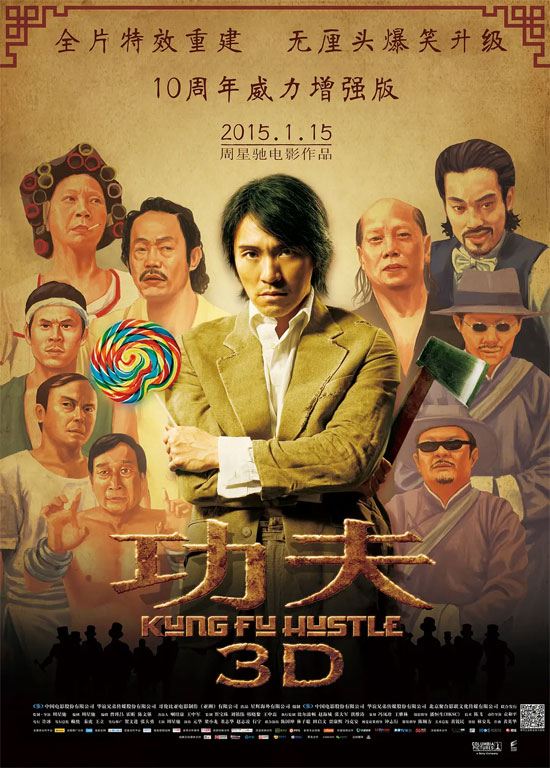
Film Name: 功夫 / Kung Fu Hustle
My first intuitive, concrete understanding of the principle that “there are always higher realms beyond the heavens and greater talents beyond humanity” came from watching the classic version of “Legend of the Condor Heroes.” My understanding of martial arts expanded from the ancestral techniques passed down by Yang Tiexin and Guo Xiaotian, to the foundational mastery of Qiu Chuji representing orthodox martial arts. Then came Lingzhi Shangren, Peng Lianhu, Sha Tongtian, culminating in the five peerless masters from East, West, South, North, and Central standing atop Mount Hua, experiencing that profound solitude. My expression, meanwhile, evolved from wide-eyed amazement to a gaping jaw—and then to a jaw that simply refused to close.
This demonstrates that when it comes to martial arts, especially the utterly unimaginable kind, I possess a certain level of understanding and mental preparedness. I’d grasped certain principles, and now when I observed these techniques—though not with the encyclopedic mastery of Miss Wang Yuyan—I’d gradually elevated my understanding to a philosophical level. Specifically, I no longer fixated on the moves themselves. As the bespectacled clerk once remarked, “Those are mere empty names, like fleeting clouds.” I am like the diplomat in Mr. Wang Xiaobo’s essays who grew sick of “Swan Lake”—viewing specific techniques as mere mechanical motions from elementary physics. What I truly cling to is a martial arts attitude. Witnessing masters’ dazzling displays, I always snort inwardly, echoing Comrade Zhang Ga’s timeless rebuke to national scum: Don’t gloat now, you’ll pay the price later. Truth be told, my predictions about the ultimate fates of many masters have rarely been wrong.
In other words, in the world of martial arts, arrogance is the most undesirable quality. Navigating the martial world isn’t about “righteousness,” but “safety first, safety first.” Comrade Zhou Weixin, the chief escort of the Weixin Escort Agency in Xi’an, Shaanxi, exemplified this perfectly with his “Iron Whip Subdues All Directions” technique. The great master Jin Yong even wrote a book specifically to chronicle and highly praise him, naming it “Yuan Yang Dao.” For no matter how peerless a master you are, no matter how extraordinary your skills, you must accept this reality: there will always be a martial art that can make you weep.
The leader of the Crocodile Gang was quite the character himself. Not only did he cause a huge ruckus at the police station, but he was also rumored to have beaten up certain journalists in the past. He was truly formidable, yet he was chopped into mincemeat by the leader of the Axe Gang. The Axe Gang was certainly formidable, even performing dances with considerable skill. Yet when they encountered the junior masters of the martial world—those wielding Iron Wire Fist, Wu Lang Bagua Staff, and Twelve-Style Tan Leg—they could only take a beating. The two blind musicians who obstructed others from admiring the ladies were intermediate masters. The Divine Eagle Couple were advanced masters. As for the Fire Cloud Evil God, that old man could casually utter profound martial secrets like “All martial arts in the world can be broken, but speed cannot be broken.” Naturally, he was an unparalleled master. Not only did he command a hefty salary, but he likely even enjoyed subsidies from the State Council.
Essentially, when arranged in the order they appear in the passage above, the latter always reduces the former to tears, thereby proving the validity of my theory. Even Mr. Fire Cloud Evil God—who enjoys residing in prison, reading newspapers, studying, spitting blood into the corridor, and playing pranks—would be moved to tears by Ah Xing’s palm strike, realizing his belief that he “would never cry again” was profoundly mistaken. Yes, this perfect hypothesis still has one final flaw, requiring one last argument—what kind of martial arts could make Ah Xing, who has opened the Ren and Du meridians, weep uncontrollably? I’m not an irresponsible or shameless person, so I won’t claim that Ah Xing, having mastered the Buddha’s Palm, has ascended to divine status—no martial art could make him weep silently. Nor will I assert that ultimate truth resides only at the pinnacle, where he stands as a god, the apex of the martial arts pyramid, utterly unbeatable—then whisper to you: “Do me a favor, I can’t resort to circular reasoning. Let’s stop here.”
I’m not shameless because there’s no need for shamelessness. There truly is a martial art that could make Ah Xing weep: the moves the mute girl demonstrated to him with her long-neglected lollipop.
What is the world’s most powerful martial art? Not the Buddha Palm, not Toad Style, not Tai Chi or Lion’s Roar. The world’s strongest kung fu is vividly portrayed in Kung Fu Hustle: when Ah Xing was beaten senseless by Fire Cloud Evil God, he delivered a light tap to the face with a wooden stick barely thicker than a matchstick. This light strike wasn’t like the earlier one where Ah Xing’s finger lightly touched Fire Cloud Evil God’s bald head, causing him to immediately hide behind Guan Yu. That was too ridiculous. This light strike signified that his conscience hadn’t been completely extinguished. Choosing kindness required immense courage, and once he possessed that courage, resisting evil forces—even the strongest ones—became a natural consequence. Ah Xing failed to fulfill his lifelong ambition in this era of “money everywhere, women everywhere”—to seize an opportunity to kill someone and thereby liberate himself. For evil, too, demands skill and professionalism. He was too clumsy and utterly unprofessional. Yet he began to reclaim the world’s most formidable martial art—kindness—for himself.
Mastering this art is exceedingly difficult. Even if you showed early promise, rushing to defend the weak and vowing to protect their lollipops without grasping the difference between “trees swaying in the wind” and “striking objects from afar” is futile. Cultivating this martial skill demands fundamental qualities and elements—like an unwavering resolve to uphold world peace—and requires enduring trials, such as being surrounded by men while taking a urine bath in front of a woman. If you cannot endure the trials and suddenly realize, cleverly telling yourself “…I understand that being good brings no reward. I will become evil. I will kill,” the tiny bit of power you’ve just gathered in your dantian vanishes instantly. But when you remain steadfast in striking villains’ heads with a wooden staff even in dire straits, your progress accelerates. Thus, when your palm strike veers off course, transforming the “Tathagata Palm” into the “Great Compassion Palm,” you finally achieve mastery and perfect virtue. Then, the weapon sheds its evil mechanism, blossoming into a lotus. The Buddha in the clouds gazes upon you, plucking a flower with a smile—no greater kindness exists.
PS: As the great Jin Yong once wrote in “Yuan Yang Dao”: “When the crowd gathered to look, they saw the blade of the mandarin duck knife engraved with ‘Benevolent One,’ and the ying knife engraved with ‘Invincible.’ ‘The benevolent are invincible!’ This is the great secret to being unmatched under heaven.” I never dreamed that one day, writing a review for Stephen Chow, this would be its central theme. Luc Besson once remarked that film is but an aspirin. Writing such an article makes me seem rather foolish. The online acclaim for “Kung Fu Hustle” borders on blind adoration and frenzy, while any dissenting voice is met with countless insults and attacks. I adore Stephen Chow. Regarding “Kung Fu Hustle,” I find it commendable—not because of debates over “special effects” or “nonsense humor,” but because, as a director, he is forging his own distinctive style. For him, the existence of such fervent fans—whether it’s a blessing or a curse—remains an open question.
Please specify:Anime Phone Cases » Kung Fu Hustle 2004 Film Review: There’s always a kind of martial art that brings tears to your eyes.