Film Name: 倚天屠龙记之魔教教主 / Kung Fu Cult Master / 倚天屠龍記之魔教教主
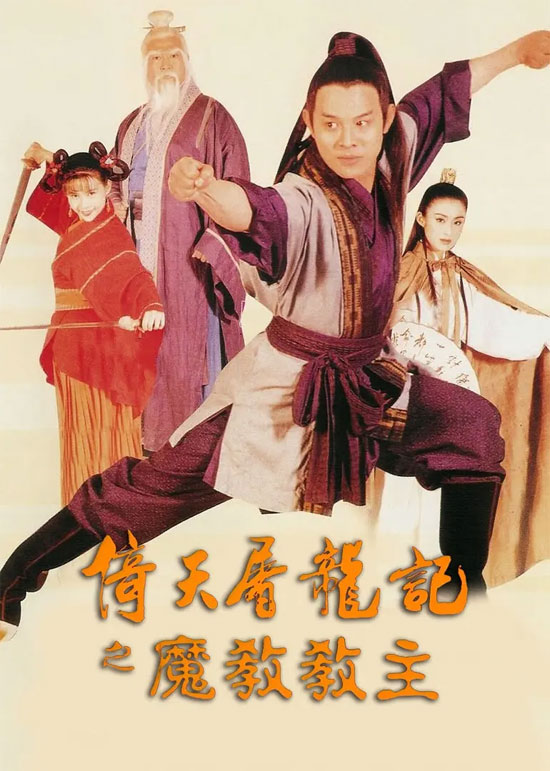
Wong Jing’s adaptation of The Heaven Sword and Dragon Saber was a real treat to watch.
Two standout elements were the casting and the plot alterations. Chiu Shu-ching played Xiao Zhao, Zhang Min portrayed Yin Susu/Zhao Min, and Gigi Lai took on the role of Zhou Zhiruo.
The most significant change was Zhou Zhiruo’s characterization. In the film version, she became a thoroughly villainous figure. She seduces Zhang Wuji with Song Qingshu at the beginning. On the Summit of Brightness, she stabs Zhang Wuji unexpectedly. In the original novel, Zhou Zhiruo was already a highly scheming individual. Both in appearance and ruthlessness, she could rival Zhao Min. However, when writing, Jin Yong deliberately downplayed their ruthlessness. Take Zhao Min: her ruthlessness is often glossed over in the text. She allowed the Eight Divine Archers to freely kill other Mongol soldiers to gain Zhang Wuji’s trust. She casually severed fingers at Wan’an Temple. She resembles Yin Susu before meeting Zhang Cui Shan—a woman who loves and hates with equal intensity. As for Zhou Zhiruo, Jin Yong never directly portrays her scheming; instead, he hints at it through minor details. It’s simple: despite her youth and inexperience, she earned the favor of Abbess Mo E. Facing doubts from fellow disciples, she endured humiliation with resilience. How could someone without scheming endure Ding Minjun’s taunts? As a reader, I’d seethe every time—how could Ding Minjun be so vile? If it were Golden Flower Granny, she’d have killed her long ago. Later, I revisited several chapters of the original novel and sensed something amiss. Ordinary people would have lost their temper. Only then did I realize: Zhou Zhiruo wasn’t placid—she was calculating. She understood that her youth demanded she cultivate connections and patience to rise. She had to endure until her divine skill was mastered. I’d never grasped this truth before. That’s why I remained myself, not Zhou Zhiruo.
Here, Wong Jing directly externalizes Jin Yong’s underlying metaphor. He transforms Zhou Zhiruo into a woman who wields her beauty as a weapon. That beauty becomes the ultimate divine power capable of defeating the invincible Qiankun Da Nuoyi and Jiuyang Zhenjing. Whether in the original novel or the film adaptation, she ultimately overcomes the peerless Zhang Wuji. In the film, Gigi Lai portrays Zhou Zhiruo as an innocent, naive young girl when she first arrives at Wudang. During her two seductions of Zhang Wuji, she embodies the alluring, mature beauty of an adult woman. Yet when confronted by Xiao Zhao, she reveals her true, repulsively vicious nature—the Zhou Zhiruo we all remember.
Like Zhou Zhiruo, Zhao Min also skillfully leveraged her appearance. In the film adaptation, both women recognized Zhang Wuji’s affection for them. Their most significant difference lies in the fact that Zhao Min loved Zhang Wuji more deeply than Zhou Zhiruo ever did.
Jia Jingwen’s portrayal of Zhao Min is undeniably beautiful, capturing the princess’s regal elegance. Yet it lacks the commanding presence to lead heroes, coming across more like a young girl. To put it plainly, she wasn’t tough enough!
As for Gigi Lai’s version, I can’t recall the specifics anymore. But I do remember she excelled in every aspect—she was ruthless, alluring, and stunningly beautiful. Rumor has it she even earned Jin Yong’s personal approval.
Zhang Min is stunningly beautiful with an excellent figure. Her signature short haircut gives her a more assertive edge than most actresses, so I consider her portrayal on par with Gigi Lai’s Zhao Min. It’s a shame the film didn’t have a sequel to showcase more of her Zhao Min.
Wong Jing’s version of Zhang Wuji could be called the “evil” Zhang Wuji, fully expressing the transformation from an ordinary guy into a rich, handsome, and powerful man. The only similarities to the original character are his ability to endure and the name Zhang Wuji. In the film, after deceiving the Fire Monk into passing on the Nine Yang Divine Energy to him, he refuses to help the monk escape the cliff. When his divine power awakens, his face contorts with ferocity, his mind consumed by vengeance—a carbon copy of Lin Pingzhi. When the Ming Cult followers plead for him to become their leader, he appears utterly confident and ambitious, showing not a shred of hesitation. Even his feigned refusals ring hollow, only amplifying his desire for the position. Who does this Zhang Wuji remind you of? Isn’t that fucking me? In the original novel, as Zhang Wuji’s martial arts grew ever more formidable, his character became increasingly humble and magnanimous. He was rarely consumed by hatred. It was I, the reader, whose eyes were clouded by vengeance. Every time I saw Zhang Wuji repaying hatred with virtue, I seethed with rage. Whenever I encountered someone who had wronged Zhang Wuji, I wanted to kill them. Eliminate them and feel relieved. If it were like the novel, my rage had nowhere to vent. This is where Wong Jing’s genius lies. He took the opposite approach. He unleashed the demon within me. It felt incredibly satisfying to watch. But afterward, I felt terrified—this could easily lead one down the path of darkness.
Sammo Hung’s portrayal of Zhang Sanfeng is arguably the biggest highlight of the entire film. This portly old man completely subverts the ethereal, otherworldly image people associate with Zhang Sanfeng. Yet it perfectly captures Zhang Sanfeng’s true character—easygoing and unconcerned with trivialities. The Zhang Sanfeng in this film spews profanities, has a fiery temper, and acts on impulse. His furious beating of Abbess Mo E is deeply satisfying. When he avenged Zhang Cui Shan, he was also avenging the readers.
I believe Zhang Sanfeng, like Tai Chi itself, values substance over form. Appearance and physique matter little. What truly counts is portraying his childlike innocence, easygoing nature, and broad-mindedness. Wong Jing is a smart man. He naturally understands this truth.
One final note: Chiu Shu-ching is stunning. She is the perfect Xiao Zhao.
Wong Jing has unearthed every demon lurking in my heart.
Please specify:Anime Phone Cases » Kung Fu Cult Master 1993 Film Review: Wong Jing has unearthed the demon city within my heart.