Film Name: 喜剧之王 / King of Comedy
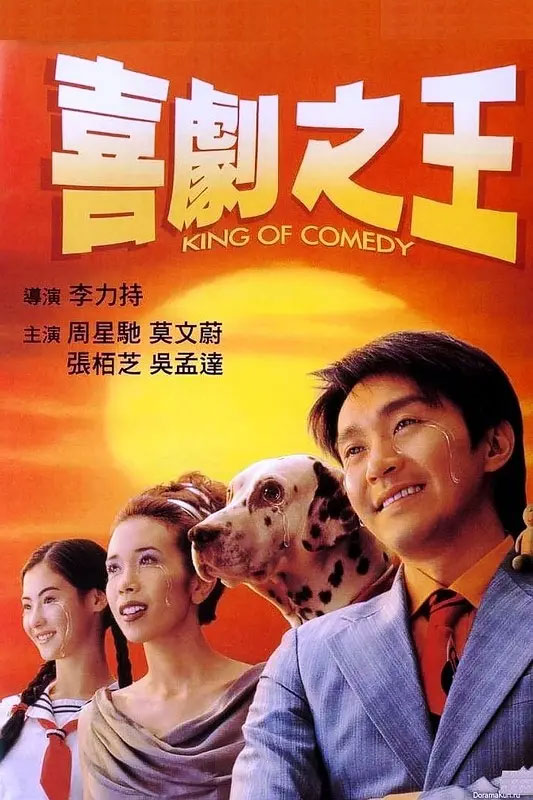
I can’t recall the first time I watched “King of Comedy.” Probably because I didn’t understand what the film was about back then. As a comedy, it wasn’t funny enough; as a tragedy, it made me laugh from start to finish; as a cop thriller, the gunfight at the end was too brief; and as an adult film, Cecilia Cheung didn’t have any nude scenes.
Strangely, each subsequent viewing of “King of Comedy” brought clearer memories. And it wasn’t me actively revisiting the film—it was that whenever I watched Stephen Chow’s other movies featuring grand heroes and supernatural warriors, I’d always think of Yuen Tin-chau teaching acting in the neighborhood theater. After watching “Shaolin Soccer,” seeing “King of Comedy” again made me begin to understand what made this film great; After watching “Kung Fu Hustle,” I started to think this film was incredibly awesome; after watching “CJ7,” I felt relieved: Thank goodness Stephen Chow once made such a film. Now, after watching “Odyssey,” revisiting “King of Comedy” only leaves me with a sense of helplessness: There will never be another film like this again.
Watching “King of Comedy” after “Odyssey,” revisiting “Infernal Affairs” after “Cold War,” rewatching “New Dragon Gate Inn” after “Flying Swords of Dragon Gate”… Sometimes I feel like an immoral relic, a shameless bastard cursing under my breath, an unprincipled infiltrator in the cinema. Will I go to hell after death? I reckon the difference between heaven and hell is this: Heaven screens “King of Comedy” and “New Dragon Gate Inn,” while Hell plays “Cold War” and “Flying Swords of Dragon Gate.”
“King of Comedy” isn’t as laugh-out-loud funny as its title suggests. It guarantees your tears won’t be from laughter, but from sorrow; it guarantees your tears won’t fall, but will just circle in your eyes; it guarantees not a single gag exists solely for laughs—every punchline holds decades of Stephen Chow’s life. Unwrap them all, lay the wrappers flat and piece them together, and you’ll see his entire existence, a chronicle of Hong Kong cinema’s bit players; It guarantees every actor—even the extras, from Sister Xia to Brother Sunny—is precisely tuned to the same frequency, creating a holographic film where a single actor can reconstruct the entire movie; It guarantees every shot is flawless, every note in the score precisely matches a frame of the film…
The film “King of Comedy” promises far too much. Its greatest promise is that after filming the final shot, Stephen Chow would call “Cut,” brush the dust off his clothes, nod, and declare, “I have fulfilled my mission as an artist. I have exhausted all my talents. From now on, call me Stephen Chow.” There will never be another film like this again.
That final scene with the takeout box is profoundly significant. A simple meal heightens the tension to its peak. A simple meal awakens the stubborn Yin Tianchou to sudden clarity. Backstage at the neighborhood theater, Yin Tianchou sighs resignedly: “Forget it. I never had much talent for acting anyway. Better to stay in the audience.”
Yesterday, seeing this line and scene, I was suddenly reminded of David, the screenwriter in “Bullets Over Broadway.” Like Stephen Chow, he declares at the story’s end: “There are two things I know for sure. First, I love you. Second, I’m not an artist. God, I said it. What a relief.” Suddenly, I understood this film. “Bullets Over Broadway” ends here. If “King of Comedy” had ended with this line, letting the camera slowly pull back to a wide shot of the neighborhood theater’s backstage—where we could see Yin Tianchou, Liu Piaopiao, and Mr. Hong bustling about—then the credits would slowly roll… If that were the case, “King of Comedy” could easily score a 9.9. Blame it on that overly bright ending, as if it had been censored by the State Administration of Radio, Film, and Television. Oh, right—that ending belongs in a New Year’s blockbuster.
I love films with heartfelt sentiment, and “King of Comedy” takes that sentiment to its ultimate extreme. What is ultimate? It means no one can surpass it. It means there will never be another film like this again.
“Actually, I don’t have much talent for acting either.” I believe this line captured Stephen Chow’s inner voice at the time—it encapsulates the entire essence of “King of Comedy.” Over a decade of a performing career filled with bittersweet laughter and tears, pouring his heart and soul into crafting this script, meticulously shaping every bit part, achieving near-perfect composition in every frame… only to reap a mere 20 million yuan at the box office and walk away empty-handed at the awards ceremony. Two years later, with “Shaolin Soccer,” Stephen began heavily incorporating CGI and casting mainland actors. This shift earned him Best Picture, Best Director, Best Actor, and a 60 million yuan box office. That year marked a watershed moment. From then on, filmmaking became purely a business. Stephen ceased being an artist and transformed into a businessman. He repeatedly peddled his old gags, and you couldn’t blame him. He’d just shrug and say: “I told you so. Truth is, I’ve never been that talented at acting anyway. Now I’m just a chicken at KFC, selling smiles at the door. Fast food, no overnight stays—thanks.”
“A Chinese Odyssey” spawned numerous sequels, but “King of Comedy” never did. Not a single one. All these years, no matter how many scandals Stephen Chow has been involved in, no matter what hardships Cecilia Cheung has endured, no matter whether Chen Bolin or Huang Bo plays the role of the Supreme Treasure, in “King of Comedy,” Yin Tianchou and Liu Piaopiao have always lived together, lonely yet eternally happy. Thank you, Stephen Chow.
Please specify:Anime Phone Cases » King of Comedy 1999 Film Review: There will never be another movie like this again.