Film Name: 落凡尘 / Fall Into The Mortal World / Into The Mortal World
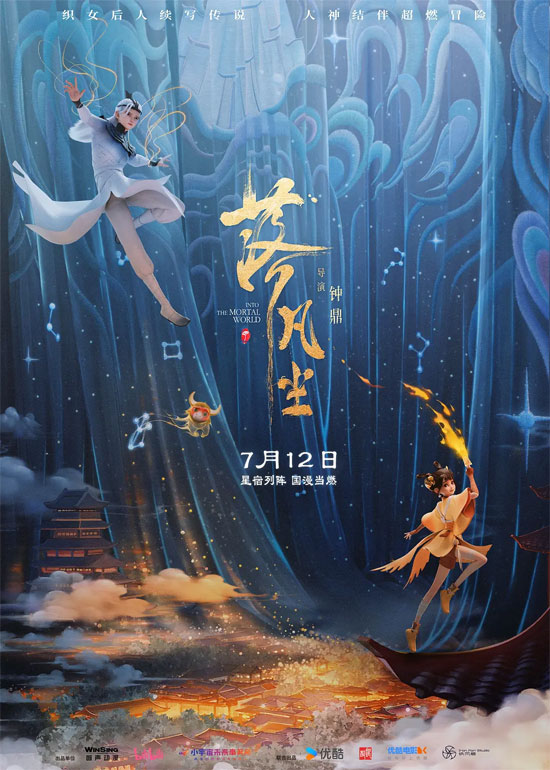
“Into The Mortal World” is a paradoxical symbiosis.
First, it portrays two deeply human deities yet fails to clarify why humanity deserves divine protection. Does the Weaver Girl safeguard the mortal realm and release the stars purely out of benevolence, or does the mortal world truly hold something worth protecting? The film leaves viewers haunted by its protagonists—their appearances, personalities, and playful banter. Yet it fails to anchor their sacrifice in a tangible purpose.
When descending to Earth, the male lead must transcend merely capturing the Twenty-Eight Constellations. His true mission lies in experiencing the genuine human emotions that distinguish the mortal realm from the celestial court. This genuine affection is what he, as a deity, must protect—the very meaning behind his mother, the Weaver Girl, sacrificing her life. Even a humble street vendor or an innkeeper deserves to be remembered for their moral integrity and heartfelt kindness. Yet among all the minor human characters he encounters in temples, streets, hotpot restaurants, and the old city—which one truly touches his heart?
One scene might be intended as a playful, cool moment in the film. When two thugs suddenly appear at the hot pot restaurant entrance to bully the female lead, the male lead coolly beats them away. I believe such moments can exist, but carelessness should not. If the human world is filled with such thugs, what is there worth saving? Moreover, from a moral standpoint, the female lead’s fondness for theft goes unpunished—instead, it becomes part of her charming, spirited, and mischievous personality. This portrayal would inevitably draw criticism in international audiences.
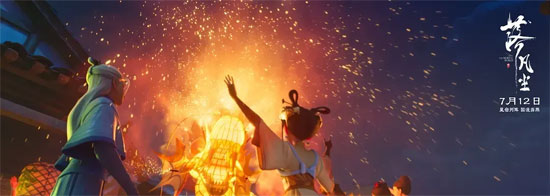
Second, the film’s first half soars to heavenly heights, only to plummet back to earth in the latter part. The first half is utterly immersive—tightly paced, briskly rhythmic, seamlessly blending dramatic and action sequences. Magical artifacts and adorable pets take center stage, while familiar elements intertwine with an unknown worldview. The protagonists’ journey from meeting to understanding unfolds naturally, rich with detail, making you feel: this is the rhythm of ascending to the celestial court!
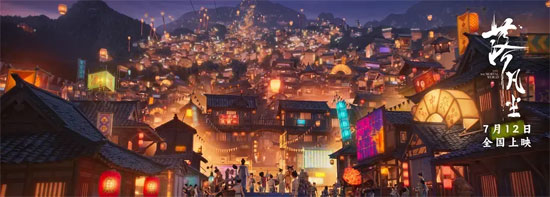
The film incorporates numerous local cultural elements from Chongqing and Sichuan—Sichuan opera face-changing, spicy hotpot, the night views of Hongyadong—evoking a down-to-earth, earthly delight. Simultaneously, it reimagines Song Dynasty attire with a contemporary twist, showcasing an Eastern fashion sense. The tear in the celestial map is cleverly utilized, embodying the serendipity and inevitability of karma arising from the union of humans and deities.
Yet in the latter half, the narrative becomes passive and forced. Characters abruptly turn dark, become deified, or grow virtuous. Concepts like the Heartstrings emerge without foreshadowing, while the setup of the temple’s deity being demoted for Weaver Girl’s transgression goes unresolved. The protagonist’s fall is painfully arduous, yet his return is simplistic. The tense countdown of golden threads on palms, building suspense for half the film, ultimately fails to reach its climax. Everything seemed to reveal the answers, yet only brought forth more questions.
Third, the story begins with a classic, timeless love legend but concludes with a deliberately crafted tale of familial affection. Cowherd and Weaver Girl—the Romeo and Juliet of the East—their love became so passionate and rebellious precisely because it defied the barriers between gods and mortals. Doesn’t the very notion of descending to the mortal realm imply that this earthly love awakened humanity in gods who were once numb and emotionless? Yet this reimagined tale reduces the descent to a mere quest for family by a second-generation deity. Without the crossing of boundaries or the presence of love, the rebellion feels contrived and hollow.
Using familial bonds to mirror romantic love is the film’s greatest flaw. Imagine if in “White Snake,” Bai Suzhen and Xu Xian had been siblings 500 years prior—how absurd that narrative would be. It suffices for the Cowherd and Weaver Girl to have a divine child who inherits his mother’s powers, wielding golden threads as weapons. Let us call him “Weaver Boy.” Then we’d need a purely human woman—bold, unrestrained, and free-spirited—whom we could call “Niu Nü.” Niu Nü and Zhi Lang must still navigate a love that transcends class and complements their natures; that’s the true legacy of descending to the mortal realm. If Zhi Lang’s descent ultimately meant assimilating Niu Nü, turning her into a deity too, that would be utterly bizarre.
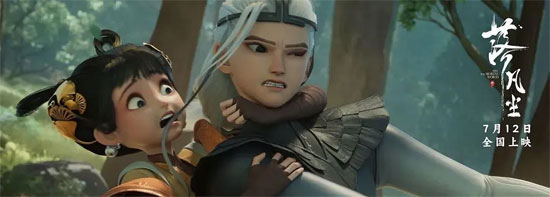
Despite being such a contradictory symbiosis, “Into The Mortal World” remains worthy of attention and viewing. Perhaps it is precisely this contradictory symbiosis that offers us more space for reflection—a quality often lacking in many domestic animated films.
Please specify:Anime Phone Cases » Into The Mortal World 2024 Animation Film Review: The Story of the Cowherd and the Weaver Girl