Film Name: 天若有情 / If Sky Have Love / A Moment of Romance
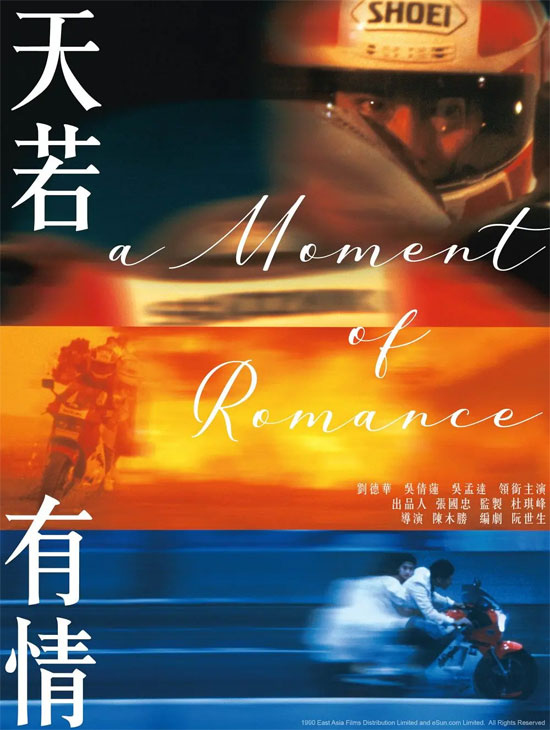
I originally watched it just to pass the time, knowing it was a clichéd love story, yet I ended up crying so hard my heart ached.
For me, what makes a classic truly classic boils down to these points:
1. It pioneered a new path. I haven’t seen many films, but the story of a rich girl and a street gangster is a common trope. However, the wedding dress + motorcycle scene in this film has been imitated by countless movies.
2. Richly developed plot. The film actually weaves three storylines: the male lead’s gangster arc, the romantic relationship between the leads, and the female lead’s family subplot (less prominent). The cause-and-effect relationships, intricate details, and interactions between these threads are flawlessly executed. To use a modern phrase, it’s completely gripping—no dull moments, no padding.
Ultimately, what moved me about this film was discovering humanity’s true goodness and beauty within it. Tragedy, in essence, is witnessing the destruction of what is beautiful.
Setting aside such philosophical musings, let me share the moments that moved me purely on an emotional level.
Wu Qianlian’s character truly embodies my ideal woman—a girlfriend, a wife. What touched me most in “If Sky Have Love” was her unwavering devotion, a blend of innocence and courage. She combines the gentle grace of Zhou Zhiruo with the boldness and stubborn “I will have it my way” spirit of Zhao Min. My shift from skeptic to fan began when she sought out Tai Po (played by Ng Man-tat) for news about Huazi. A frail young woman venturing into a gang-infested neighborhood. When Tai Po refused to tell her, she stood there, smiling at him relentlessly. That smile melted Tai Po—and it melted me. Next came the underground dance hall, a place even more foreign to her. Risking harassment from others, she pressed on to find Huazi. At that moment, I genuinely feared she’d be dragged away, defiled, or worse… (This happens multiple times in the film—whether it’s the wilderness at the beginning, the gang chase during their second meeting, or this dance floor scene…) Just as I was relieved that Huazi had finally taken her out, he brought her to an even more dangerous place… I believe JOJO climbed onto the car roof partly to prove herself to Huazi, but also because of her stubborn nature. Thankfully, when Jojo broke down completely, Huazi finally softened. He realized she genuinely loved him and stopped pushing her away. The sweet moments that followed showed me this character was also playful and adorable, not just perpetually miserable. Her delighted expression when she got the lucky pillow, helping the three mothers with household chores—all these moments deeply moved me. Knowing the story’s trajectory, I thought I wouldn’t cry. But what first hit my tear ducts was JOJO’s impending departure for Canada. Defying her mother, she jumped off the train, cleaned Hua Zai’s house, and waited for him. Hua Zai, drunk and seething—angry at himself for being a gangster who couldn’t provide JOJO with a stable life—smashed flower pots and refrigerators, leaving everything in shambles. Yet there was Jojo, wiping away her own tears while tidying up the mess, settling Huazi back into bed, and tending to him. Finally, she left a note: “I love you without regret.” Without resentment, without regret—Jojo truly achieved this. From start to finish, no matter how badly Huazi hurt her, how fiercely he pushed her away, or how terrified she felt, she never uttered a single word of complaint. I believe that if her mother hadn’t had the means to put Hua Zai behind bars, JOJO wouldn’t have agreed to go to Canada, no matter how brave she was. All of this was for love—the kind of love that lets go. Hua Zai was probably JOJO’s first love. Now that she’s been given a ring and worn a wedding dress, how will she face the rest of her life? My heart truly aches for her…
Ah-Wai is an even more thoroughly tragic figure—he never knew his father, and his mother took her own life. I believe this left him profoundly insecure, driving him to live day by day with no regard for tomorrow. He must have been incredibly lonely. He possessed formidable skills—a master at street racing and fighting, capable of taking on multiple opponents—and a reckless courage that knew no bounds. In the cutthroat world of organized crime, he steadfastly upheld his code of honor—a principle that ultimately led to his violent demise. His love for JOJO was fraught with conflict: he repeatedly asked her if she regretted their relationship, sometimes pushing her away, yet other times showering her with dangerously thrilling romance. Wild car chases, Mid-Autumn Festival fireworks, a stolen wedding dress—no young woman could resist such passion. Sometimes I wonder: he could have chosen not to return and kill Horn. Perhaps then JOJO wouldn’t have spent her life searching for him, waiting for him, unable to let go. But if he hadn’t gone, he wouldn’t have been the impulsive, loyal Hua Zai. I even pondered whether his final visit to JOJO stemmed from knowing his death was near, or because he knew she was leaving for Canada. I’ll never know, and I don’t want to speculate further—I’m afraid of getting dark circles under my eyes again. Once you enter the underworld, there’s no turning back. You could say Wah-zi’s death was inevitable, sooner or later. Even under the best boss, he was just a henchman. Of course, Wah-zi’s bloody nose and his struggle to keep his eyes open to stay conscious still deeply moved me… That was pure sincerity and solitary courage…
Now about the supporting cast: Wu Mengda’s character was incredibly compelling—a cowardly figure who only dared to bluster after the big bosses of both worlds had departed, scraping by on the fringes of the underworld yet unable to even protect his own small turf. Yet he was endearingly lovable. In the end, he finally showed some backbone. The housekeeper at JOJO’s home—when she saw Andy coming to find JOJO, she didn’t alert JOJO’s mother but instead guided her gaze elsewhere. That moment also moved me deeply. Every supporting character, even the humble housekeeper, has their own story and distinct personality.
Many reviews describe JOJO’s love for Huazi as Stockholm syndrome, but I think that oversimplifies their relationship. Stockholm syndrome occurs when a hostage falls in love with their captor during prolonged captivity—essentially, the victim develops affection for the abuser, finding even the smallest kindness overwhelmingly sweet after prolonged suffering. Their dynamic is nothing like that. From the moment Huazi took Jojo hostage to the time he sent her home, barely half a day passed. Had the police not found Jojo’s bag and secured her testimony, they might never have crossed paths again. Moreover, Jojo isn’t a masochist. After Huazi terrified her by making her climb onto the car roof, she genuinely gave up on leaving. Had Huazi not recognized her sincerity and acted in time, their relationship likely wouldn’t have progressed. I believe their love, beyond the attraction born from their vastly different backgrounds, stemmed primarily from mutual admiration for each other’s character—truly beginning with physical attraction but deepening through character. JOJO loved Huazi’s kindness, justice, and his willingness to risk his life to protect her; Huazi loved JOJO’s innocence, determination, and reckless devotion. Sadly, such love is like Mid-Autumn Festival fireworks—too fleeting, too beautiful, yet destined to fade. A young girl’s wish—God won’t hear it. This is perhaps the film’s subtle blend of irony and reality. Yet we’ll always be moved by the boy’s passion and the girl’s sincerity.
Tragic yet fortunate, the screenwriter’s pen immortalizes their love at its peak. But we must return to reality—Huazi is no suitable partner. Had they truly been together, after the honeymoon phase of “love conquers all,” would JOJO have regretted leaving her comfortable life? And how much harm would Huazi’s insecurities from his family background, his inferiority complex, and his habit of resorting to violence have inflicted upon her? The consequences are all too easy to imagine. Writing this, I finally begin to detach from the film. After all, art transcends life, and we must return to our own realities.
Please specify:Anime Phone Cases » If Sky Have Love 1990 Film Review: Forever moved by the prayers of young girls