Film Name: 潜艇总动员:海底两万里 / Happy Little Submarine:20000 Leagues under the Sea
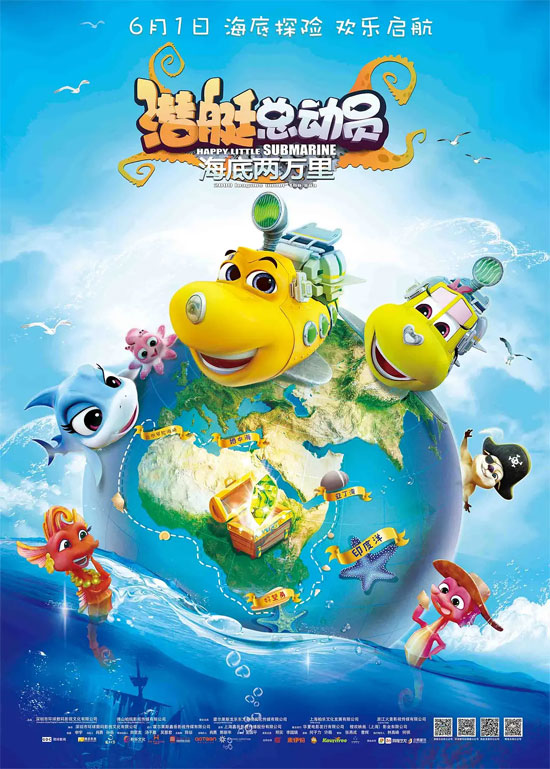
If one word could describe this film, it would be “return.” A return to the core protagonists of the two submarines, Ali and Bei Bei, and a return to the original focus on oceanic adventure. Unlike the previous World Cup year, there was no attempt to capitalize on football themes for the sake of trend-chasing. If anything, the film aligned with the national strategy of the Belt and Road Initiative.
I believe animated films should be encouraged to embrace policy themes unapologetically. This film repeatedly references the Maritime Silk Road and even sets its climactic scene in the Red Sea. Yet it’s slightly disappointing that its portrayal of the “Maritime Silk Road” theme feels somewhat coy—like a maiden shyly hiding behind her pipa, hesitating to speak her mind. Why not have the submarines journey directly along the Maritime Silk Road? Why not have them stop at key cities along the route to showcase local customs and cultures? Why not confidently connect the entire Maritime Silk Road with a beautiful map?
Animated films tapping into policy hotspots should adopt this mindset: use animation to cleverly and creatively convey the concepts the nation wishes to disseminate. They should avoid the mentality of merely riding the wave, skimming the surface. Audiences won’t accuse a film of being hollow and grandiose simply because it reflects national strategy; they will do so if it fails to reflect that strategy effectively. Creating with a hot-topic-hopping mindset is worse than not creating at all.
Creatively, the film’s major challenge lies in reactivating supporting characters from previous works—like the shark father-daughter duo and the seahorse brothers—while assigning them fitting roles that feel organic and purposeful to audiences. From this perspective, the film handles it well. However, the “Qian Ting Zong Dong Yuan” series must consider whether every new installment should indiscriminately feature all these characters—clearly, some choices must be made.
The IP “Qian Ting Zong Dong Yuan” has evolved to establish a rich visual universe, encompassing both the ecological civilization of diverse sea creatures and the mechanical civilization of various submarines. It now stands at a crossroads: one path leads to vastly expanded imagery yet risks becoming an unsupported空中花园, while the other path offers a more stable visual foundation focused on solidifying the world-building. Personally, I recommend pursuing the latter development path.
By the sixth film, we suddenly find ourselves somewhat unfamiliar with who Ali is. We’ve begun to forget its origins, who its owner is, what its actual technological capabilities are, and what its original mission was. This film has Ali undertake another scientific expedition, as if to help us regain a fragment of memory, but it remains highly ambiguous and vague. Each sudden introduction of new elements like cryogenic guns or force fields in the theatrical films doesn’t heighten our curiosity about this world; instead, it deepens our sense of uncertainty. These additions feel arbitrary, lacking cohesive consideration. Unless the submarine worldview is clarified anew, audiences—especially younger viewers—will struggle to fully embrace Ali’s world and his heroic identity.
Therefore, it’s time to reboot the planning for the “Qian Ting Zong Dong Yuan” TV series. Through this series, we must reclaim Ali’s origins and mission, clarify the mechanical civilization landscape of his world, and give his marine creature companions more distinct personalities. I’ve already thought of a name: “Qian Ting Zong Dong Yuan: Yan Zhou Hai Si Zhi Lu” (The Ocean’s Secret Chronicles). Ha ha!
Please specify:Anime Phone Cases » Happy Little Submarine:20000 Leagues under the Sea 2018 Animation Film Review: The intersection where paths converge