Film Name: 九龙冰室 / Goodbye Mr. Cool / 九龍冰室
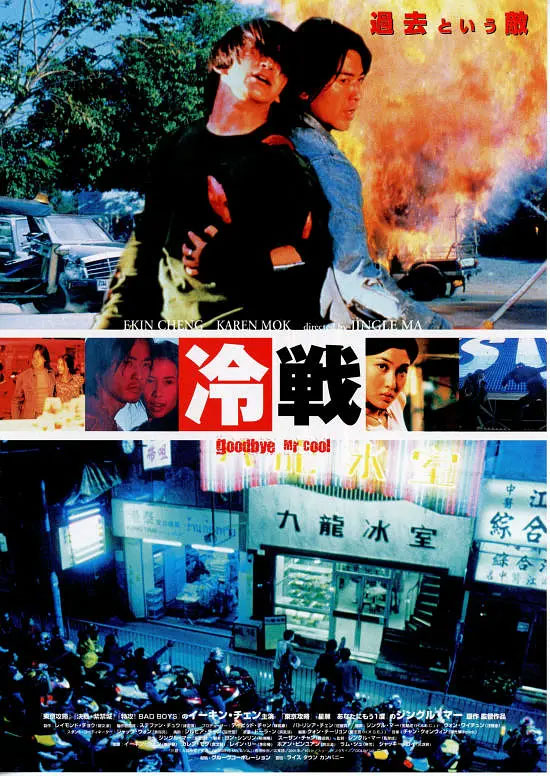
Another title for this film should be “Father and Son.”
I never imagined I’d write a review. Nor did I expect a movie I initially watched just to kill time would move me so deeply. There’s so much I want to say, so I’ve decided to put it down.
First, let me gush: E-Men is so handsome!!!
This film was released in 2001. Now it’s 2010. It’s a movie from nine years ago. Eason Chan has a song called “Shi Nian” (Ten Years), which shows how time truly carries away so much.
How many of those actors from back then are still active in the entertainment industry? Some are semi-retired, some keep acting, and after this film, other roles awaited them. Regardless of their current status, looking back at this movie, you realize their acting careers were once so brilliant.
This film left me deeply moved. From start to finish, despite its bloody fights, it remains filled with warmth throughout. This is the best film I’ve seen Ekin Cheng in, and the cast—including Karen Mok, Lee Chai Wah, Lui Sung Hin, Wong Bun Yuen, Lam Suet, and To Wai Chak—delivered powerful performances.
This is a story of street gangsters. The film opens with inevitable bloody brawls, followed by a failed mission. Dragon Brother, the gang leader, is betrayed by a crime boss and sent to prison for years. During his incarceration, an event occurs that transforms this once-powerful crime lord—he repents, reforms, and turns over a new leaf. That event is the death of Dragon Brother’s father.
Like many troubled youths, Ah Long had a strained relationship with his father. His father strongly opposed—even despised—Ah Long’s involvement in the underworld. Yet Ah Long believed he could support his family with his own hands, seeing nothing wrong with this way of life. Communication proved futile, and his father kicked him out of the house. That parting became a matter of life and death. When his father passed away, Ah Long was still in prison. The funeral arrangements were entirely handled by his former brothers. Ah Long received his father’s final letter, which contained the words: “Dad has forgiven you.”
They say those who live by the streets value loyalty above all else, with “righteousness” as their guiding principle. They worship Guan Yu, the God of War, and cherish the deep bonds of brotherhood. Yet most of these street toughs were also deeply filial. Though their families might not accept them, those who roamed the underworld carried the words “loyalty,” “filial piety,” and “righteousness” engraved in their hearts.
Perhaps it was the bitter betrayal by his gang boss, or the regret of never seeing his father one last time. After his release, Ah Long resolved to leave the underworld behind, yearning for a quiet, ordinary life. He took a job as a waiter at the ice cream parlor owned by a former gang brother who had also retired from the life. Mopping floors, taking orders, cleaning windows—he did these unassuming tasks.
Word of his return reached his old brothers, who flocked to the parlor hoping he’d lead them back into the underworld. But Ah Long had lost all desire for conflict, his heart set on seclusion.
Then came the unexpected arrival of his son, Zhaolong—a “lottery jackpot from heaven,” as Ah Long himself put it. Through their time together, he gradually revealed tender paternal affection. Perhaps through his son, he could fulfill the unfulfilled love he owed his own father.
The beautiful young teacher, Ah Meng, radiated youthful kindness and charm. Drawn to Ah Long, she frequently visited the ice cream parlor under the guise of being Zhaolong’s teacher, and they slowly grew close. The story seemed headed for a happy ending, but fate loves to toy with people. Zhao Long’s mother, Sister Hong (played by Karen Mok), tried to lure Ah Long back into the underworld. She claimed she loved him and had been waiting for him all along. Yet she failed to realize that what she truly loved was herself—the image of a powerful man who could give her prestige. She ignored Ah Long’s needs; he no longer wanted to return to the underworld. Every time Sister Hong appeared, she sought out Ah Long, ignoring her child. Even when Ah Long asked her, “Don’t you want to see your son?” she remained indifferent to the boy. In contrast, Teacher Ah Meng’s kindness and innocence felt far more heartwarming.
Karen Mok’s插曲, “Ji Mo De Lian Ren A,” is truly beautiful.
Writing this far, I suddenly feel reluctant to continue. The rest of the story is compelling, with the actors’ expressions perfectly captured, so I won’t spoil too much. Though some netizens call the ending cliché, I still find it deeply moving. This is a work from nine years ago—please don’t judge it by today’s market standards.
I can’t forget Ah Hong carrying a large bag of drugs to the ice room to find Ah Long. When he asked why she hadn’t come to save her, she replied: “Quit? Why didn’t you tell me when I joined you at 17? All of us out there trampling on lives pretending to be heroes—we learned it from you.” And Ah Long replies, “I’m sorry. I never imagined my image as a hero would influence so many people.”
I can’t forget when Ah Long bought a new schoolbag for his son, only to later discover the boy had stolen change from the ice cream shop. His son said, ” You guys always disappear, so I had to take the money myself. Otherwise, I’d be hungry with no money for food.” The boy actually hated being passed around like a ball by adults, yet he remained remarkably understanding. Watching him wave goodbye to his mother’s retreating figure from the second floor of the ice cream shop, his face filled with sadness, broke my heart.
I can’t forget the farewell when Ah Long told his son, “I’m sorry, Dad couldn’t keep his promise to you. I’m leaving you behind again. I’m sorry.”
I can’t forget the final scene, Ah Long standing in the building’s courtyard, gazing toward home and saying, “I’m back.”
A reformed rogue is worth his weight in gold. When a man truly makes up his mind, not even a herd of oxen could pull him back.
Please specify:Anime Phone Cases » Goodbye Mr. Cool 2001 Film Review: Another name for this play should be “Father and Son.”