Film Name: 海上花 / Flowers of Shanghai
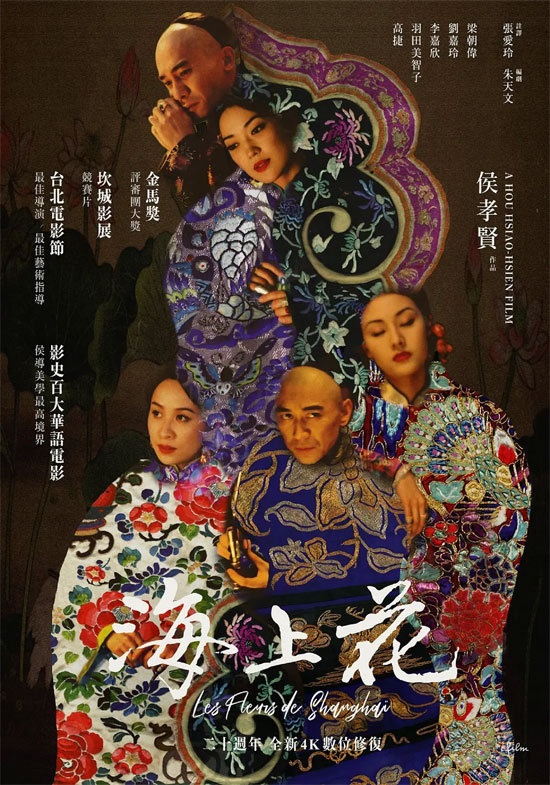
“Flowers of Shanghai”
Prostitutes who were both attractive and capable of running their own businesses were called “masters.” Those kept as mistresses were called “sugar daddies.” Wealthy young men of high standing who patronized them were called “clients.” When a client took a mistress, it was called “keeping.” When clients and mistresses gathered to drink and dine together, it was called “setting up a scheme.” The prostitutes in the story clearly earned their income not only through selling their charms but more significantly through “hosting gatherings,” facilitating collusion between officials and merchants or among officials themselves to generate profits.
The film’s settings are limited to two: “hosting gatherings,” where guests play drinking games and converse; and “private rendezvous,” where guests visit courtesans to smoke opium, dine, and chat.
Though depicting profoundly decadent activities, the film avoids any sensationalistic pandering to eroticism. It captures scenes of eating, drinking, smoking, and casual conversation, rendered with the painterly aesthetic of Chen Yifei’s oil paintings.
Truly, only the late Master Hou dared to make such a genuinely artistic film!
The brilliance lies in the constant repetition and switching between these scenes—it’s pure aesthetic fatigue! Even with a cast of crisp, popular actresses at the time, their roles become confusing. I imagine foreign viewers would be utterly bewildered.
Even more intriguing is how Tony Leung’s portrayal of Magistrate Wang feels particularly sinister and cunning. Consider this: when others gossip about affairs and scandals, he silently slips away; when everyone rushes to see the commotion after hearing of an injured man outside, he alone remains seated, fanning himself (not having fanned before, yet now suddenly feeling the heat?). Yet in the end, it’s he who rises through the ranks. Then again, he was the one who played both sides—first with Shen Xiaohong, then with Zhang Huizhen. He professed undying devotion to Shen Xiaohong, vowing to be her sole patron (essentially supporting her financially) and promising to settle her debts (likely covering her extravagant bills). Later, he fell for Zhang Huizhen, spending more freely on his new lover and promising even greater rewards. Not only did he help repay her debts and furnish her home, he even hired actors to perform for her. Yet when Shen Xiaohong beat up Zhang Huizhen, he returned to appease Shen Xiaohong out of obligation and concern for his reputation. He then went to Zhang Huizhen, playing the role of the exposer. He deliberately claimed Shen Xiaohong had been speaking ill of Zhang Huizhen behind her back, enticing Zhang Huizhen to reveal Shen Xiaohong’s secrets to him. He also mentioned how Shen Xiaohong had initially demanded he repay her debts and marry her, only to keep delaying and making excuses. He appeared generous but was actually shrewdly calculating. When Zhang Huizhen spent sixteen dollars on a hairpin, he called it expensive; when Shen Xiaohong spent sixteen dollars on a hairpin, he said it was poor quality and unnecessary, suggesting she buy something else instead. He played both sides, and upon discovering Shen Xiaohong had a lover, he immediately dumped her. Shen Xiaohong never recovered. She couldn’t even afford servants anymore, keeping only one old woman while living in a small house. She claimed she would marry Zhang Huizhen, though whether she actually did is unknown. Later, Zhang Huizhen also “cheated,” and he beat her, forcing her to swallow opium (she was saved and survived). Clearly, when the servants recounted these events, Wang was still in Shanghai, not yet in his post in Guangzhou. Thus, it’s evident he discarded both women before his departure. Compared to the nearly ten thousand he spent on Shen Xiaohong over four or five years, Master Zhu Wu seemed like a novice. He was utterly infatuated with Shuangyu, only to be swindled out of ten thousand dollars. Moreover, he was truly wronged. He loved Shuangyu, but when his family arranged a marriage for him, Shuangyu threatened suicide, insisting on sharing opium with him. The pimp’s solution? The Fifth Young Master pay ten thousand yuan to arrange Shuangyu’s release from servitude and marriage. He never knew who actually received the money or whom Shuangyu married.
But upon reading some promotional materials for the film, it seems Magistrate Wang is portrayed as a complete unlucky bastard. How peculiar—a movie can actually be so open to multiple interpretations!
In the film, the shrewdest character is probably Huang Cuifeng, played by Carina Lau. Not only is she wealthier than the madam, but she also redeems herself and secures her future. Even Luo Zifu, who initially intended only to play around and had no plans to buy her freedom, ends up obediently paying up. Yet it’s clear she remains utterly detached from emotional entanglements—not only juggling multiple clients simultaneously but also frequently setting up schemes to make money. When she finally leaves the brothel, her belongings alone fill ten trunks. But despite her independence and business acumen, even with her formidable skills, achieving a happy ending in that era proved impossible. Of course, things would be different today.
As for Shen Xiaohong and Zhang Huizhen, both fell victim to Magistrate Wang. They trusted his professed devotion, only to discover he was playing both sides. Disillusioned, they turned to him for support, yet their emotional void left them unsatisfied by either path. Even Madam Huang Cui Feng, the madam of the brothel, was no different. Though an old hag herself, she kept a lover and had to borrow money from Huang Cui Feng to sustain it, enduring her lectures. And clearly, even with a fool like the Fifth Young Master, first, the chances of meeting him were slim; second, even if they did meet, he could only marry a young lady from a distinguished family; third, looking back, he too would become another Magistrate Wang after a few years. In the world of pleasure, insincerity is the norm. For figures like Magistrate Wang, the bottom line is simply avoiding fatalities and keeping one’s conscience clear.
Put plainly, the film portrays women’s dependence on affection and the tragedies that ensue. In short: “Seeking love brings no benefit; seeking benefit brings no love.”
Please specify:Anime Phone Cases » Flowers of Shanghai 1998 Film Review: Genuine Art House Film