Film Name: 江湖龙虎斗 / Flaming Brothers / 江湖龍虎鬥
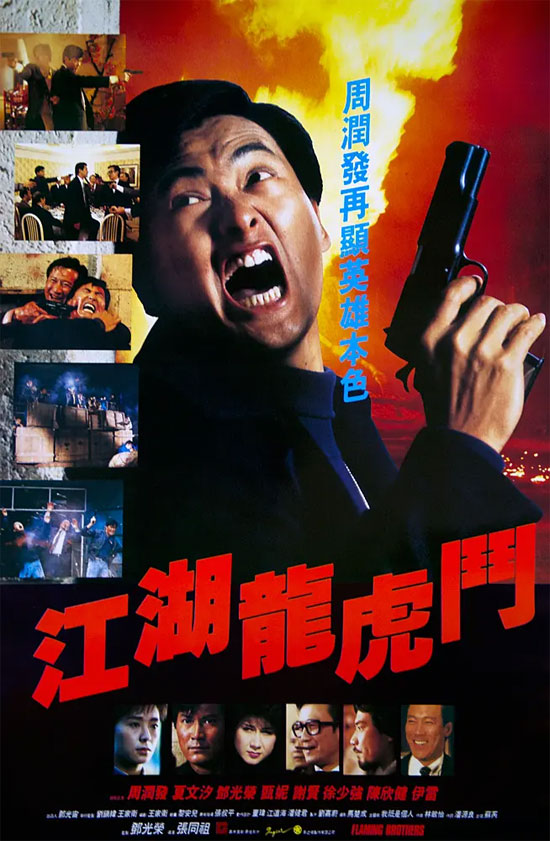
Although its plot isn’t particularly unique among Hong Kong’s numerous gangster films, it stands out as one of the rare examples in the genre that portrays brotherhood and romance with remarkable subtlety. The film presents its main characters with nuanced, multidimensional, and comprehensive depth. The male figures aren’t the stereotypical macho archetypes found in traditional gangster films.
In childhood, the elder brother spares the prawn for his younger brother, claiming, “I’m afraid eating it will give me sores.” When the younger brother discards the prawn head and the elder picks it up, he remarks, “Better to get sores than waste it.” Watching this scene evokes sympathy for their hardships, yet the elder brother’s tender care for his younger sibling feels endearing and charming.
When the elder brother learns the younger is leaving for Cassie, he shoves Jenny away and angrily confronts Sammo: “She’s the woman I love most, but if I had to choose between you and her, I’d never choose her. Could you do that?”
At the wedding, he severs ties with his younger brother, yet when trouble arises, he urges him to flee Hong Kong and never return to Macau.
He wanted to propose to Jenny but broke up with her to spare her from being dragged down.
These moments reveal the big brother’s responsibility and tenderness beneath his boldness, courage, and sharp wit in business dealings.
Sammo Hung is the same. Though part of the underworld, he also has a kind, lovable, and gentle side behind his sharp heroism—like the amusing scenes when he does volunteer work.
When confronted by the boss with “Can you do it?”, he replied with sincere regret yet clear conviction: “I can’t. I can die for you, but I can’t live without Cassie.”
Before leaving, he explained to Cassie: “Even if I have a thousand reasons not to go, there’s one reason I must. Without the boss, there’d be no me. When he’s triumphant, I can ignore him, but when he’s in trouble, I must help him. I know this isn’t fair to you, but I have no choice. I hope you can understand me.”
The female characters also break away from the traditional gangster film tropes of weak, helpless women—or the beautiful yet foolish types who always get in the way at critical moments. Both leading ladies are intelligent and wise. While their outward personalities contrast sharply—one bold and assertive, the other reserved and gentle—both possess an inner understanding of the male lead and a reasonable, compassionate nature. For instance, Jenny’s self-sacrifice to save the boss was calculated—she didn’t throw herself into danger blindly. Xia Wenxi’s line, “What do you want me to say? Would you even listen? I was an orphan growing up, thinking I’d live alone forever. But then I met you. Just being with you this long has been enough for me,” along with her response to Chow Yun-fat’s plea, “I hope you can understand me,” followed by her wish for his safe return, all demonstrate her deep understanding of her gangster husband. ” followed by her “I just want you to come back safely,” both demonstrate her profound understanding of her husband’s past in the underworld. The farewell necklace, the comforting kiss goodbye, the Christian prayer, the tear falling into the cup, and her quiet yet playfully humorous expressions during the candlelit dinner—all these moments made me deeply fall for this character. It’s like if your husband told you he was going to die for his brothers—you wouldn’t cry and scream for him not to go, nor foolishly say you’d die with him. Instead, though your heart aches unbearably, you’d calmly and gently tell him: “I don’t want you to go, but I know you must. I understand. I’m content with the time we’ve shared. Go.”
The villains are also portrayed with nuance. Xie Xian’s portrayal of gang boss Gao Laosi is effortlessly seasoned and cunning enough to make your teeth grind. For instance, when facing death, one uses his own men as shields to survive, killing his own brother-in-law to frame the enemy, while the other does everything possible to protect his men. The contrast between Xie Xian and Zheng Guangrong is stark.
It may not be the best, but its characters are sufficiently three-dimensional, and its emotional depth is meticulously explored—hallmarks of Wong Kar-wai’s films.
Among gangster films of that era, it stands out as unique and one I truly enjoy. With personal sentiment factored in, I give it four stars.
Please specify:Anime Phone Cases » Flaming Brothers 1987 Film Review: Wong Kar-wai’s gangster films are a bit different.