Film Name: 正牌韦小宝之奉旨沟女 / Hero from Beyond the Boundary of Time / 正牌韋小寶之奉旨溝女
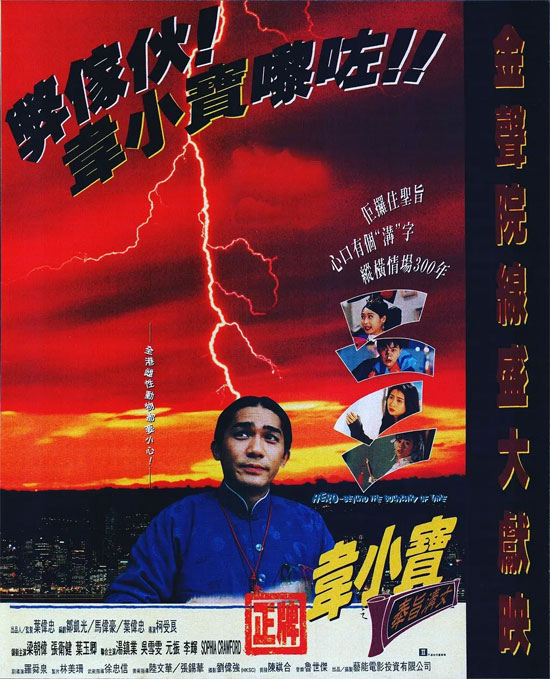
Ko Shu-liang is not only adept at stunt driving, singing, and acting, but also excels as a director. Most of his films are action-packed with a touch of comedy. During the 1990s, he directed several comedy action films, including ‘Dragon’s Revenge,’ arguably the finest action film starring Jacky Cheung, and ‘The Days of Being Dumb,’ a distinctive anti-triad comedy. However, ‘Hero from Beyond the Boundary of Time’ admittedly felt somewhat like a cash grab. 1992 was Stephen Chow’s year, with both instalments of ‘Royal Tramp’ securing top-five positions in the annual box office rankings, raking in a staggering 80 million yuan. It’s no wonder his peers were envious, especially since the original actor recognised by the venerable Jin Yong for the role of Wei Xiaobao was someone else entirely. Tony Leung’s performance in the 1984 version of The Duke of Mount Deer was truly outstanding. That was the first adaptation I ever saw, and it remains unforgettable to this day. I distinctly recall that this version omitted Zeng Rou from Mount Wangwu. Eight years later, after Stephen Chow popularised the ‘Royal Tramp’ IP, Ko Shu-liang assembled Tony Leung Chiu-wai and Tony Leung Ka-fai from TVB’s Five Tigers, paired with adult film actresses and rising star Eric Tsang, to film ‘Hero from Beyond the Boundary of Time’. The title’s claim to legitimacy likely stems from promoting Tony Leung as the first universally recognised portrayal of Wei Xiaobao. (earlier adaptations included Wang Yu’s film version). The film barely surpassed ten million in box office, ranking 35th in Hong Kong’s 1993 earnings. It remains a period martial arts action piece that Hong Kong cinema enthusiasts may or may not bother with, marking the end of Tony Leung’s portrayal of Wei Xiaobao.

‘Hero from Beyond the Boundary of Time’ tells a nonsensical time-travel tale where Wei Xiaobao, seeking the true destined woman for Emperor Kangxi, travels three centuries ahead to Hong Kong. There he encounters the idly idling policeman, played by Zhang Weijian. Together they cause considerable merriment amidst the glitzy, hedonistic capitalist society. Compared to protagonists in previous time-travel films, they stir up far more comedic chaos. The protagonist here is the self-made Lord Wei, who adapts to modern society with remarkable speed, swiftly embracing a life of luxury and debauchery. The film’s middle section is pure audience indulgence. So when Tony Leung tackled ‘Lust, Caution,’ he was no stranger to pushing boundaries—this film, made two decades earlier, already pushed the envelope with its explicit content. What hasn’t he tried? By contrast, audiences seem far too innocent. Who could have imagined that the song ‘A Little Love Each Day’ would be paired with scenes of Wei Xiaobao chasing women? It feels rather jarring, especially since this is one of those accessible pop tunes anyone could sing (with minimal difficulty).
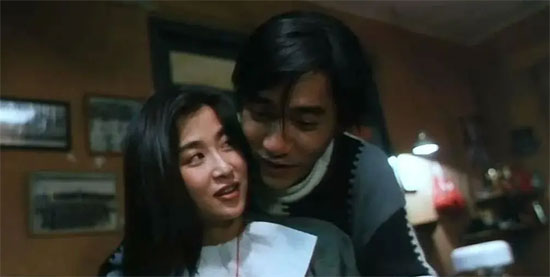
The womanising scenes deliver frequent laughs, followed by Wu Sangui’s men tracking him to the modern era. The ensuing battle features remarkably low technical skill in its fight choreography – though audiences likely weren’t expecting hard-hitting, acrobatic combat in a Wei Xiaobao film anyway. Throw in a possession ritual for good measure, and it’s all muddled through. Ironically, the climax—Tony Leung’s heartfelt confession to Wu Xuewen—gains a touch of pure romance thanks to the Oscar-winning actor’s delivery.
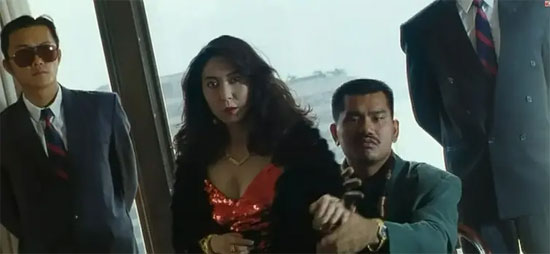
‘Hero from Beyond the Boundary of Time’ is an early Sino-Hong Kong co-production, with some exterior scenes shot on the mainland. Unfortunately, due to its subject matter and content, it never received a mainland release. Years later, it aired on certain television stations, and that was my first viewing. Expecting a wuxia film, I was surprised to find a veritable hodgepodge touching on all sorts of genres – yet it proved rather entertaining. The most hilarious scene involves Wei Xiaobao’s beauty pageant audition to find his true love. Though unsuitable for minors, it’s genuinely funny. The production values wouldn’t cost much to replicate today, but the creativity behind it remains hard to match. Lu Jianming once again showcased his comedic genius as the delightfully absurd Blackboard Boss, who, having found the jade pendant, could have simply snatched it but insisted on writing a cheque instead. Once the cheque secured his compliance, he instantly switched to grovelling obsequiousness towards Xiao Bao – truly masterful acting. As for the actress playing Sister Xiong, though plump, she possessed a certain voluptuous charm and delivered the film’s sole shipboard scene.
PS: Do revisit the 1984 version of ‘The Duke of Mount Deer’ when you get the chance – it’s a genuine childhood memory.
Please specify:Anime Phone Cases » Film Review: Nostalgia for Hong Kong Cinema 1993 ‘Hero from Beyond the Boundary of Time’