Film Name: 红场飞龙 / The Dragon from Russia
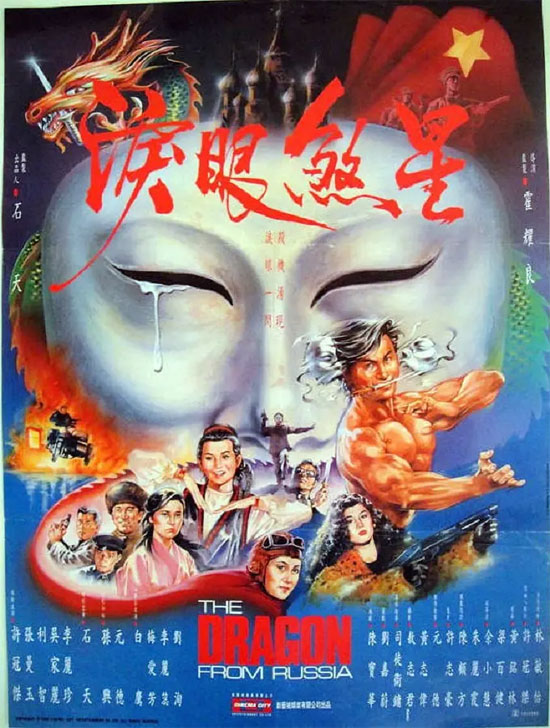
I’ve no idea why I keep mistyping it as “Red Sausage Flying Dragon”—maybe Harbin red sausage leaves me craving more. Before I knew it, a year had passed since director Huo Yaoliang passed away. A reader mentioned this film the other day. Truthfully, I’ve loved the “Freeman” manga for ages. Later, I watched the animated adaptation of “Freeman” and at least three live-action adaptations—two from Hong Kong: one a low-budget flop starring Simon Yam, and another a star-studded flop directed by Huo Yaoliang. The French version was the best, though casting a foreigner as Ryu Taiyo felt a bit off. The female lead, however, was stunning.
02
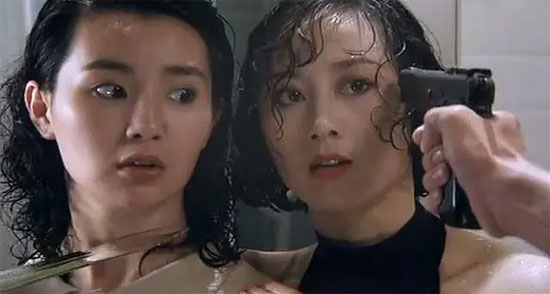
“Freeman” is a manga by Ryoichi Chigami and Kazuhiko Koike, chronicling the rise of the couple Ryu Taiyo and Tiger Fengling (one an assassin, the other a witness at the manga’s outset) through the assassin underworld until they seize supreme power within the 800 Dragon Organization. Hong Kong directors Huo Yaoliang and Gao Fei adapted it for the screen the same year—the former as a big-budget production, the latter as a low-budget effort. Both featured star-studded casts, with “The Dragon from Russia” boasting even bigger names. Both films adapted only parts of the manga, largely reusing the backdrop while inventing most of the plot. Frankly, they’re pretty much on par—both are terrible. Sam Hui stars as the protagonist Yao Long (actually spelled “Yao”), portrayed as an orphan adopted by the traitorous Tai Qiu of the 800 Dragons. Maggie Cheung plays his devoted girlfriend, contrasting with the female lead in the original work. Tai Qiu and his daughter are portrayed by Shi Tian and Li Lirui, while Yuan Hua plays Tear Seven Dragon. Actors like Li Zhi and Wu Jiali also take on names from the original story. The plot roughly follows the first volume: an assassin and a witness become entangled, one willing to die while the other hesitates to kill. The wife of a Japanese gangster victim conspires with a police officer, leading to a manhunt by both organized crime and law enforcement.
03
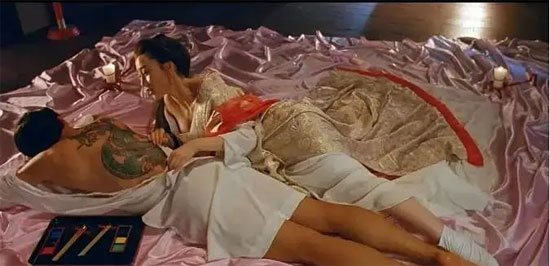
The Hong Kong remake completely dismantled the original character relationships, filming scenes at Moscow’s Red Square (before the Soviet Union’s dissolution). It introduced the traitor Hua Long Er, played by Bao Long, who defects to a Japanese gang. Sam Hui, gifted with extraordinary talent, was trained into an assassin by Tears Seven Dragon. The training sequences were lifted straight from Shaw Brothers martial arts films. Li Lijun and Li Zhi served dual purposes: one to break up the monotony of training, the other to attract audiences with suggestive scenes, both having little relevance to the actual plot. Wu Jiali fared worse. Bearing the name of the highest-ranking woman in the original organization (the names of the Eight Hundred Dragons’ leaders are fixed and hereditary), she was reduced to playing the gangster’s mistress. Particularly in the scene where she shoots and kills a police officer, she appears ruthless and cold-blooded, yet this was entirely unnecessary and not part of the comic’s original setup. Before the finale, all supporting characters either vanish (like Li Zhi) or meet their demise at lightning speed (Wu Jiali, Liu Xun), leading into a rushed climactic battle. Unfortunately, despite Sam Hui’s hard-earned muscles and his toe-knife-pinching move (a faithful comic adaptation that later inspired Ghost Foot Seven’s tough-guy antics), the fight scenes are merely decent. but the constant counter-move-for-counter-move formulaic speed-up technique grows tiresome after a while. The film’s greatest highlights are the chemistry between Sam Hui and Maggie Cheung, along with the relatively obscure theme song “The Freeman.”
04
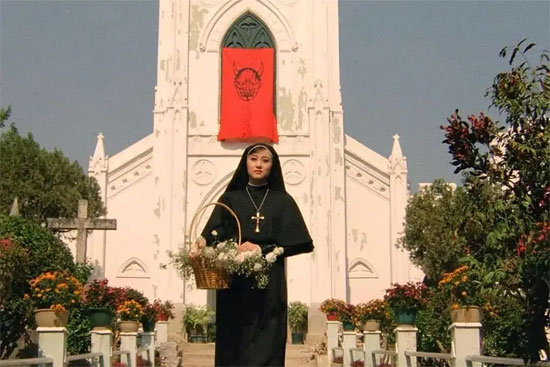
Adapting comics into films is incredibly challenging. First, skilled comic artists often employ cinematic framing techniques that were difficult to achieve with live-action photography at the time. Emotionally charged, romantic scenes that look stunning in comics can be notoriously hard—or even impossible—to replicate in animation or film. Disney’s recent trend of creating live-action remakes of its animated classics is a relatively recent development. Three or four decades ago, Hong Kong directors had few options beyond adaptation to faithfully recreate comic book settings. “Freeman” (also known as “Crying Freeman”) features global settings. Director Huo’s determination to shoot on location in Moscow was truly impressive. At that time, the Soviet Union was in turmoil, likely keeping production costs low—a scale Hong Kong films could still manage.
PS: If you get the chance, do watch the animated version. Finding the manga to read is even better—after all, those who appreciate the styles of Koike Kazuo and Ikegami Ryōichi know exactly what I mean.
Please specify:Anime Phone Cases » Film Review: Nostalgia for Hong Kong Cinema 1990 “The Dragon from Russia”