Film Name: 醉拳2 / Drunken Master II / Legend of the Drunken Master / 醉拳Ⅱ
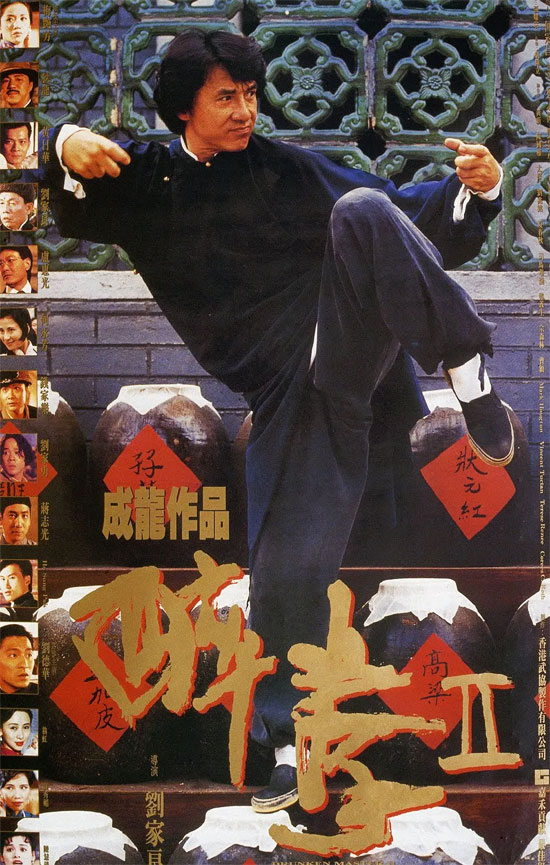
Such an exceptional film deserves a cigarette or a glass of wine to savor and savor, for nearly every scene is pure gold.
The Paper-Wrapped Fire Comedy Structure
An old Chinese saying goes, “Paper can’t wrap fire.” Yet the film’s first half builds its comedic effect precisely by wrapping fire in paper—the imperial seal, the ginseng, the royal heir, the necklace, the fake pregnancy. Layer upon layer of concealment unfolds, and with each new wrapping, the audience finds humor in the cover-ups. This hot potato grows larger and larger, eventually igniting into a raging inferno. Ti Lung and Anita Mui—one classical, one postmodern; one solemn and serious, one wildly comedic. Their contrasting styles create perfect tension and release, delivering nonstop laughs.
A More Grandiosely Expanded Growth Model
Under his strict father’s discipline, Jackie Chan has gradually reined in the youthful recklessness he displayed in Drunken Master. His initial pursuit of Liu Chia-liang stemmed from the latter’s insolence. Yet during the duel with Master Tsai, he consistently yielded—even declaring victory a draw. This avoidance of conflict and preservation of others’ dignity clearly stemmed from his father’s teachings to show mercy when possible. His first real street brawl aimed to catch a thief, and secondly because his stepmother insisted it would bring honor to the family. This narrative arc seamlessly connects with the growth trajectory of Drunken Master 1, shifting focus from the self back to the family. Ultimately, the martial arts scholar played by Liu Chia-liang even opened his third eye, endowing him with a sense of universal compassion. The crime-fighting narrative masterfully intertwines with resistance against external humiliation, infusing the film’s combat sequences with a stirring heroic spirit. It elevates the national ethos of “Heaven’s way is vigorous; the noble man strives ceaselessly” through the pursuit of justice, thereby tempering the inherent hatred and bloodshed. After his defeat, Jackie Chan finally transforms from a reckless lone hero into a grandmaster who prioritizes the greater good.
Shaping Form, Elevating Intent, and Displaying Martial Grace
Drunken Fist is both the most realistic and the most expressive of martial arts styles. It significantly emphasizes the sculpting of form in the initiation and conclusion of movements, endowing the typically playful and comedic Jackie Chan with an aesthetic quality in his actions and the dignified bearing of a grandmaster. This transformation owes much to Tsui Hark’s Wong Fei-hung series and the solid martial arts foundation of Liu Chia-liang. Shaping refers to the intuitive display of movement forms themselves. Without a certain foundation in martial arts, it is impossible to appreciate the inherent beauty of the actions. Moreover, this technique of pausing at the beginning and end effectively resolves the issue of action rhythm: bang-bang-bang, then a pause; bang-bang-bang, then another pause. The rhythm of the fight emerges instantly. Another key feature is the interplay of motion and stillness. While less pronounced in Jackie Chan’s films, this concept will be explored in depth when discussing Jet Li.
Cultivating Martial Spirit Through Combat
This is first seen in the written exam scene between Jackie Chan and Wong Yat-wah. Wong insists on his superiority, while Jackie repeatedly yields. Even after winning, he declares it a draw. This martial spirit of forgiveness is amplified in the climactic finale: Jackie saves the foreigner nearly crushed by Chin Ka-lok, refusing to kill one who cannot fight back. Ultimately, Jackie’s selfless act of saving his enemy’s life emotionally moves his adversary.
The action sequences in this film are truly spectacular. Beyond the martial arts duel between Jackie and Wong Yat-wah, there are four main segments. Below is a brief analysis of each, focusing on different aspects.
Jackie Chan vs. Lau Kar-leung
In this section, I primarily want to discuss the issue of space. Jackie Chan’s strength lies in his mastery of choreographing chase sequences.
This segment also begins with a chase—from the train carriage to the roof, then to the underside of the train, followed by a warehouse, and finally a thatched hut. The fight scenes primarily unfold in the last three locations. First, consider the fight beneath the train. This sequence was both difficult to fight and difficult to film, mainly due to the severely limited space. where fighters could barely stand upright. In such cramped quarters, Master Liu Ka-leung also wielded a long spear, making it doubly difficult. Yet he remained perfectly composed, executing each move with precision and fluidity, even adding several spins. Truly worthy of his status as a grandmaster of kung fu. The low-angle shots also brilliantly conveyed the tense and intense atmosphere. The second space offered significantly more height, but wooden posts added new obstacles. Swinging the spear here was no easy feat either, yet Master Liu executed it flawlessly. In Jackie Chan’s scenes, Chan himself becomes the supporting actor to Master Liu Chia-liang. The third space, however, allowed for much more fluid and relaxed combat, incorporating substantial comedic elements—the characters’ banter, Jackie Chan’s sudden slip after playing the flute. Additionally, the film imposes time constraints on the train fight, making it feel perfectly paced. The first three segments I’m analyzing are each around 7 minutes long, while the final climactic fight lasts about 14 minutes. I suspect these durations were meticulously calculated through years of practice.
Segment Two: Drunken Universe
This segment introduces a physical space, but what I want to discuss is the expansion of narrative space. This segment also begins with a chase sequence, with Anita Mui’s character serving as the pivotal element in creating this mirror-within-a-mirror narrative space. The audience’s focus constantly shifts between Anita Mui and the fight scenes. Anita Mui interacts with the audience on screen, creating a viewing experience where she continuously comments on the fight, escalating the action. This, in turn, creates a secondary viewing experience for the audience outside the screen. This mirror-within-a-mirror structure serves a dual purpose: it allows the fight to build layer upon layer, while also creating a rhythmic pattern of entry and exit for the viewing experience. As for the fight itself, it embodies the concept of “drunk in the universe”—physically intoxicated yet mentally clear—a breathtaking performance that shapes form, establishes intent, and showcases martial prowess.
Part Three: The Great Battle Against the Axe Gang
This narrative segment focuses on analyzing the visualization of action sequences. Cheng Siu-tung demonstrated remarkable skill in this area. Early kung fu films were largely grounded in realism, but if the martial arts were entirely realistic, the result could be tedious. Later directors made valuable explorations in visualizing kung fu. For instance, how to film a powerful punch? Early kung fu films rarely considered such questions (Hsu Hsiao-hsiung being an exception). They might show a single punch killing someone, but never depict the punch sending the opponent flying five meters away. That five-meter flight is precisely the visualization of martial prowess—creating spatial distance while conveying the punch’s immense force. Returning to this scene: how many people were flung through the window, smashing chairs and tables? Master Lau Kar-leung stomping the staircase in half with both feet—that’s pure gold.
Fourth Segment: Climax
Rarely does a kung fu film achieve such a psychological climax for the audience at its dramatic peak. Focusing on the final showdown between Lo Wai-kwong and Jackie Chan, the sheer speed, density, and intensity of their blows are utterly breathless. Silver vases shatter, water sprays everywhere, pearls large and small tumbling onto a jade plate. Amidst this suffocating intensity, the sudden “Eek!” as someone is flung away mirrors the physical sensation of climax.
Please specify:Anime Phone Cases » Drunken Master II 1994 Film Review: Capturing both form and spirit