Film Name: 鬼马天师 / Drunken Arts and Crippled Fist / Drunken Wutang / Taoism Drunkard / 鬼馬天師
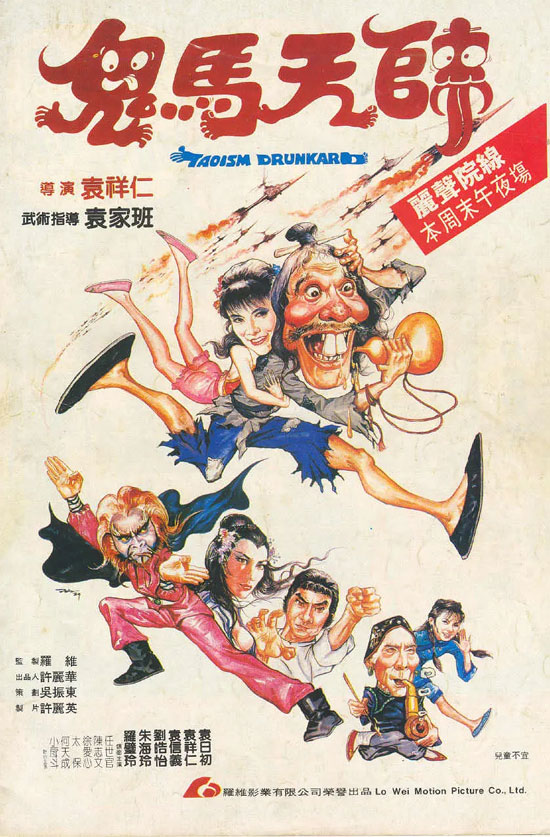
Having watched the 1980 version of The Mystic Nine Gates, I made a point of seeing this film! After viewing it, only four words come to mind: utterly hopeless! As a renowned Hong Kong filmmaking team, the Yuen Brothers’ golden brand carries considerable box office appeal. Yet having seen this film, I must say I cannot praise its quality at all – indeed, it’s hard to fathom that the Yuen Brothers’ team actually guided this production!
Sequels to good films often fall prey to the curse of being a poor imitation. Provided the production standards are maintained, I believe the finished product shouldn’t be too bad! Although this film’s production team remains the original cast from the first Mystic Nine, compared to the original masterpiece, the quality is worlds apart! To quote Mr Fan’s classic line: ‘How could the difference be so vast?’
The opening credits display the four characters ‘Ghostly Master’ prominently, with the production team going out of their way to highlight ‘Guidance by the Yuan Family Team’ – as if afraid audiences might not realise the Yuan Family Team was behind it! The film opens with the Grandmaster of the Science Sect judging his disciple, the Old Demon. Centered in the frame, the venerable Grandmaster sits solemnly upon a high platform like a judge, passing sentence upon his wicked pupil. Upon hearing the verdict, the Old Demon, refusing to accept it, absurdly retorts, ‘I appeal!’ It’s impossible not to laugh at this blend of Eastern and Western comedy tropes – a genuinely fresh gag! Unfortunately, the film’s humour ends there. as the subsequent plot descends into utter, utter rubbish!
The first villain to appear pursues the owner of the fortune-telling parlour to seize a talisman. Overpowered, the owner is gravely wounded. On his deathbed, he reveals that should the villain find the talisman, it will mark his own demise. This dialogue serves as a crucial plot device, with the talisman becoming the central thread. Any competent screenwriter would have built a compelling narrative around it. Yet the problem lies squarely with the script! Whoever this hack of a writer was, they managed to turn a story with such rich potential into utter rubbish!
The subsequent plot tokens serve but one purpose—to act as burdensome decoys drawing enemy fire. Beyond this, the tokens offer the protagonist scarcely any assistance whatsoever! Whether carried by protagonists or supporting characters, once the token is discovered by antagonists, sides engage in a series of acrobatic, farcical skirmishes. Early on, the villains appear virtually invincible, forcing the heroes to flee when outmatched. After escaping, they never fail to deliver a few pointless, sarcastic quips for comic relief—though the humour falls flat, leaving an awkward impression! Certain supporting characters appear with no connection whatsoever to the main plot, serving virtually no purpose in advancing the narrative. They are utterly dispensable, existing solely to clown around and cause chaos! Take Yuan Xiangren’s portrayal of the drunken Taoist priest – an utterly unlikable character. His first scene sees him hurtling through the Taoist temple in a rickshaw, clutching his wine gourd like a headless fly. His rampage leaves the temple in utter disarray, He even decapitated the statue of the Celestial Master. When caught red-handed, he refuses to own up, instead trying to shift the blame onto others to clean up his mess. It’s clear the character design is a carbon copy of Ji Gong! Yet this characterisation remains shallow, capturing only the form but not the spirit. Had he been portrayed as an enigmatic living Buddha like Ji Gong, audiences might have accepted him. But this fellow’s combat prowess is abysmal—he scarcely ever prevails against major antagonists. His lack of martial skill is one thing, but this chap also gets drunk and stirs up trouble wherever he goes, spouting disgusting dirty jokes to amuse the audience. Far from being funny, it just makes people feel repulsed! Such an irritating character—lacking in fighting prowess, unlikable in personality, and failing to deliver comedic relief—contributes nothing to the plot development. Yet he’s given so much screen time? Honestly baffling.
Then there’s that useless protagonist. I thought he’d be a Jackie Chan-style martial arts whizz! Never in a million years did I expect him to be a useless, spineless coward. Not only is he physically and intellectually inept, but he’s utterly unmotivated. Yet somehow, he’s got the most ridiculous luck, always managing to escape danger! I genuinely don’t understand the point of creating such a dullard with zero redeeming qualities. The more I watch, the more pointless it all seems! At the very least, give us a satisfying underdog-turned-hero narrative—like the sharp-witted protagonist in Snake in the Eagle’s Shadow who finds a master, trains relentlessly, and defeats villains to become a force to be reckoned with! But the screenwriter seems intent on treating the audience’s intelligence with utter contempt. As a viewer, I simply want to see the martial arts novice’s journey of self-improvement and triumph. Yet the writer deliberately goes against the grain, refusing to deliver the story the audience craves! The title ‘Ghostly Taoist’ immediately suggests a motivational kung fu comedy akin to Drunken Master. Alas, the quality of the film stands in stark contrast to its promising name! Sigh! Another glaring flaw in the script is that the film is titled Ghostly Taoist, yet the Taoist never actually appears throughout the entire film! The protagonist doesn’t cultivate into a Taoist either. Where on earth is this Taoist? A rotten script turned into a rotten film, truly reaching new depths of awfulness!
This “Ghostly Taoist” has no Taoist about it—just a load of silly, gimmicky nonsense! As for its humour, this film is utterly dreadful. Certain plot points aren’t just cringe-worthy but downright vulgar and disgusting—a veritable compendium of dirty jokes! The spherical monster ‘Banana-Eater’ encountered by the male lead upon his entrance is utterly baffling. Its bouncy, spherical body looks rather cute, but when it opens its gaping maw, it fixates on biting people’s crotches (one deep bite and you’re done for). The two net-like appendages on its head extend specifically to cling to people’s chests – the design of this thing is thoroughly revolting! (How on earth did they come up with such revolting ideas?) Even more repulsive is the scene where a drunken Taoist recruits ‘virgin boys’ on the street. A line of boys stand with trousers down awaiting inspection. The first lad is found not to be a virgin and demands a ‘green-headed’ replacement. The next removes his cap to reveal a scalp covered in pus-filled sores, declaring he wants a ‘small-headed’ boy instead of a ‘big-headed’ one. The third boy appeared to be a “green-headed” candidate, only for it to be revealed his hair was dyed. The screenwriter’s inclusion of such vulgar gags isn’t remotely funny; instead, each one is more revolting than the last, utterly nauseating!
Beyond these crude gags, the film intersperses unrelated subplots—a professional mourner wailing at funerals, a widow’s affair, a shaman summoning spirits—reminiscent of Stephen Chow’s whimsical comedies. Yet these mundane, everyday jokes feel forced into a kung fu film, and the director’s clumsy handling renders them not funny but utterly contrived!
Despite its numerous flaws, I did spot one stroke of brilliantly twisted genius: the sequence where the Rakshasi is drugged by the Old Demon, rapidly ageing as the poison takes effect. The shot composition here borrows from The Shining. Though the makeup looks a bit crude upon closer inspection, the detail work is actually quite good. Those few seconds sent shivers down my spine – easily the most chilling moment in the entire film! It’s rather clever to blend Western horror elements into an Eastern kung fu flick!
The villain’s final rampage through the Taoist temple at least provides closure to this dreadful film. The array of Taoist priests looked rather intimidating, only to be blown to smithereens by the old demon’s drone bombs (the villain wields both magic and high-tech weaponry). The priests were reduced to bald-headed wrecks! Particularly the Grandmaster Taoist – initially I thought he’d be a formidable boss, only to discover his combat skills were worse than his own junior disciple. The villain effortlessly subdued him, pinning him to the wall like a sticker. What was the point of introducing such a useless character? The drunken Taoist accidentally knocked the villain’s weapon away and gloated, ‘Your dan’s been knocked away!’ And right before the end, the director couldn’t resist throwing in a bit of innuendo! Bloody hell!
Without his weapon, the villain was easily dispatched by the old man and the lad teaming up. Such a formidable antagonist met such a pathetic end? Utterly baffling! An hour wasted on this? The characters in this film appear and disappear with such arbitrary abandon, utterly devoid of any logical coherence!
The action design, the most crucial element in a kung fu film, is utterly lacklustre. Certain fight sequences feel like circus clowns deliberately clumsy for cheap laughs, lacking the wild imagination of its predecessors!
This film is nothing but a slapdash hodgepodge of elements, thrown together at the eleventh hour with a few clownish supporting characters providing slapstick to meet the release deadline and rake in the cash! The result is a complete and utter nonentity! I consider myself a seasoned film buff, having seen my fair share of rubbish, but a film this utterly dreadful from start to finish is an absolute first in my lifetime!
Please specify:Anime Phone Cases » Drunken Arts and Crippled Fist 1984 Film Review: No mischievous spirits, No Taoist priests.