Film Name: 天龙八部之天山童姥 / Dragon Chronicles: The Maidens of Heavenly Mountain / 新天龍八部之天山童姥
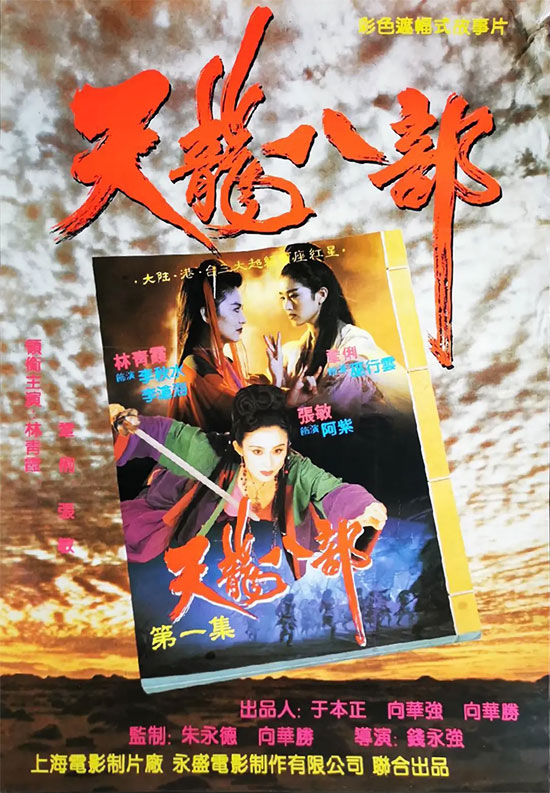
This story is quite simple.
A pair of twin sisters (Li Qiushui and Li Canghai) both fell in love with their senior brother (Xiaoyaozi), but Xiaoyaozi’s heart wasn’t big enough to love both—he only loved the kind-hearted younger sister, Li Canghai. Meanwhile, their senior sister, Wu Xingyun, also fell in love with Li Canghai. Li Qiushui and Wu Xingyun, both pining for unrequited love, came to know each other and mocked one another. Through the scheming of the villain Ding Chunqiu, their feelings escalated to a new level—a hatred so deep they wished to cut each other down. The tragedy of this immortal world lies in the villain Ding Chunqiu, who possessed not only godlike ambition but also godlike willpower. Decades ago, he poisoned their master, Xiao Yaozi, and has since relentlessly expanded his influence while cultivating evil arts. This societal cancer has grown unchecked, threatening the harmony of the martial world and plunging its people into suffering. The story reaches its climax and concludes…
Though I’m a die-hard fan, my initial rating isn’t arbitrary. In my view, the film earns this rating solely on the merit of being “a wuxia film imbued with poetic and Zen-like depth.”
Poetic Language
First, the names of the three female leads: Qiushui (Autumn Water), Canghai (Cang Sea), and Wuxingyun (Wuxing Cloud) all derive from the verse “Having gazed upon the vast sea, other waters pale in comparison; beyond the Wu Mountains, no clouds can compare.” This verse itself subtly hints at their emotional entanglements. Second, the film features a series of poetic lines, such as: “Life is like mist, like a dream; When bonds form and fade, it remains free,” “One thought of injustice breeds a thousand evils,” “When life smiles upon you, revel in joy; Laugh at the world’s mortal affairs,” “No birds fly over Tianshan; Old friends have long forgotten each other.” Third, the names of the palaces themselves are equally evocative, such as the Pavilion at the Edge of the Sea (where “pavilion” in Cantonese sounds like “corner”) and the Palace of the Sacred Vulture. The beauty of the language is too rich to fully enumerate.
Poetic and picturesque visual effects
Though the special effects may not match modern cinema’s realism, they perfectly capture the ethereal essence of wuxia fantasy films. Not to mention the ethereal grace of Lin Zhiwei and Gong Li’s costumes and movements, radiating celestial charm in every step. If awarding a “Best Visual Effects Scene” for the entire film, this sequence would undoubtedly take the prize. Li Canghai, Wu Xingyun, and Li Qiushui dance gracefully amidst the ethereal landscapes of Mount Tian, its jade-like towers and celestial pavilions creating a dreamlike setting that transports viewers to a realm of pristine serenity, far removed from the tumult of the mortal world.
Ethereal and Poetic Soundtrack
The soundtrack carries a distinct Hong Kong wuxia film vibe—clean and crisp during fight scenes, tender and slow during romantic moments—effectively enhancing the narrative. Particularly noteworthy is the theme song. Faye Wong’s rendition of “Only Me” is melodious and captivating, significantly elevating the film’s appeal.
Zen philosophy permeates this film, and I’ll briefly highlight one memorable scene.
What struck me deeply was the opening sequence where one must solve an intricate chess puzzle to obtain legendary martial arts skills. This puzzle transcends ordinary gameplay, serving as a dialogue with one’s deepest obsessions. Simply put, if you cannot overcome the barriers within your heart, you’ll easily make wrong choices and find no peace in life. Moreover, with great power comes great responsibility. One who attains supreme martial arts without the mental fortitude to master it invites boundless harm. Life is like a chessboard—every move is a choice. Watching this scene, I couldn’t help but recall two familiar proverbs: “One wrong move ruins the entire game” and “One misstep brings eternal regret.” This brought me a sudden realization: in the Chinese context, the chessboard and life are remarkably similar. So why could the seemingly simple-minded young monk Xu Zhu break the stalemate, while Su Xinghe could not? Does this not hint at a subtle Zen-like wisdom, inviting every viewer to ponder it deeply?
Having discussed the film’s poetic and Zen-like qualities, I must give it extra credit.
When Shaolin Temple faces imminent attack, the abbot’s comedic interaction with Xu Zhu is utterly hilarious. The normally stern abbot suddenly acts like a mischievous old child—surprisingly funny and endearing.
After singing the film’s praises for hundreds of words, I must still point out a few unsatisfying plot points.
First, Li Canghai’s “dying and coming back to life” sequence is poorly explained, leaving viewers baffled. My guess is that Li Canghai astral projected to find the Jade Linglong, causing his body to appear dead. After finding and returning it, he died from exhaustion.
Second, the young monk’s exit feels abrupt and unexplained. As a significant supporting character, his sudden disappearance after asking Wu Xingyun a single question leaves the audience bewildered.
Third, the explanation of how Ding Chunqiu plotted against Xiao Yaozi is overly brief. Why Li Qiushui remained oblivious to Ding Chunqiu, the traitor who harmed Xiao Yaozi, is somewhat perplexing. This could have been elaborated upon.
The root cause of these unclear plot points is the film’s short runtime. It’s simply challenging to thoroughly explain every storyline within an hour and a half.
For this “unobjective review” of the film, I’ll borrow someone else’s words: Just seeing the three beauties floating about is enough to satisfy me, but you also get music, thought-provoking moments, and humor! It fulfills N of my wishes at once—if I don’t give it a rave review, if I don’t give it 80 points, I’d be betraying my own heart~
At the very end, I can’t help but reflect on the fates of Li Qiushui and Wu Xingyun: neither of these leading ladies ultimately found the love they’d pursued for a century. Yet perhaps they received the most precious gift the mortal world offers—a few beautiful memories, a genuine peace. After a century of life lived with such intensity, they chose this path. So how will the final chapter unfold for us, still struggling through our own lives?
Please specify:Anime Phone Cases » Dragon Chronicles: The Maidens of Heavenly Mountain 1994 Film Review: A martial arts film imbued with poetic and Zen-like sensibilities