Film Name: 冒险王 / Dr. Wai in the Scripture With No Words / 冒險王
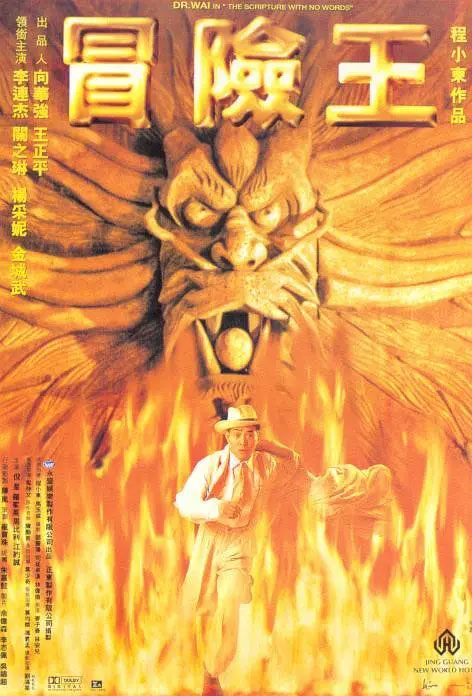
Several years ago, a “time-travel craze” swept across mainland China. The result? Time-travel sketches launched Shen Teng to stardom, time-travel dramas and films propelled two couples to fame, and time-travel novels spawned countless online writers. After the blazing fires and lush blossoms came the spent flames and scattered petals. Nowadays, attempting to tell an original story under the banner of “time travel” is like trying to taste meat in a plate of stir-fried greens—an incredibly difficult feat. That is, until recently, when I accidentally revisited the 1996 Hong Kong film Dr. Wai in the Scripture With No Words. Suddenly, I felt a surge of surprise, like turning around and seeing something unexpected.
I’ve lost count of how many times I’ve seen this twenty-year-old film, yet this reunion felt like seeing it with fresh eyes. The movie weaves two parallel threads—a Hong Kong love story and a Republican-era adventure—with each plot twist seamlessly bridged by the protagonists’ narration, twisting these two worlds into a single rope. At the film’s conclusion, after the death of his beloved Kameko, the Adventurer King utters a prophetic question: “Will I ever see Monica again?” Instantly, a mural reveals her solitary, melancholy silhouette. Here, imagination and reality become inextricably intertwined, completing a narrative structure reminiscent of Zhuangzi’s Butterfly Dream—a tale rich with lingering resonance.
“Dr. Wai in the Scripture With No Words” offers a fresh take on time-travel narratives—like a farmer accustomed to cornbread and pickles suddenly savoring a hamburger meal, instantly recognizing its distinct flavor. Unlike the tired trope of “returning to the past to change history,” this film explores the journey of human imagination itself. Coincidentally, Earlier this year, the big-screen adaptation of the British series “Sherlock” premiered in mainland China. Benedict Cumberbatch employs his “mind palace” to traverse historical and contemporary timelines, hunting down imaginary killers. After watching, it feels like waking from a dream. Additionally, the film’s historical settings are officially touted as faithfully recreating Victorian-era aesthetics. If true, Cumberbatch’s mind-bending performance carries a distinct “Inception”-like aura of a dream architect. In terms of narrative style, “Dr. Wai in the Scripture With No Words” is as crisp and straightforward as the martial arts choreography designed by Cheng Siu-tung, while “Mad Detective” feels far more cold and eerie. In short, the two films share a unique approach to time travel that stands out in the genre.
Of course, the King of Comedy Stephen Chow is also a time-travel enthusiast. Three of his films—God of Gamblers Part III and the two Chinese Odyssey films—incorporate time-travel elements. While Chow excels at portraying ordinary folk, the protagonists in these films possess extraordinary abilities. They traverse time and space, making a grand splash, yet remain powerless to alter the fated outcomes of love and separation. Comedic heroes meeting tragic ends—even those who defy heaven and earth cannot escape the cycle of fate. This is the depth of Stephen Chow’s comedies. Compared to “Dr. Wai in the Scripture With No Words,” these films carry a lighter touch yet an added layer of melancholy. Having discussed films, let’s turn to novels. Time-travel novels emerged and matured on the internet, their core essence boiling down to “alteration”—the protagonist single-handedly reshaping their surroundings to their advantage. “A Step Into The Past” stands as the seminal work by master writer Huang Yi, often regarded as the progenitor of the genre. Beyond its ubiquitous sensual scenes, the book offers Huang Yi’s unique insights into martial arts philosophy. Most profoundly, protagonist Xiang Shaolong’s actions—though seemingly disrupting the political landscape of the Six Kingdoms—consistently align with historical trajectories. Huang Yi’s commitment to respecting history lends “A Step Into The Past” a weighty authenticity, infusing the entire novel with tension.
I believe the rise of time-travel narratives caters to readers’ curiosity. Most such works prioritize sensationalism for its own sake, inevitably fading into obscurity after initial excitement. A select few, however, leverage the “time-travel” trope to convey deeper ideas, resonating with audiences. May the latter kind of work continue to flourish.
Please specify:Anime Phone Cases » Dr. Wai in the Scripture With No Words 1996 Film Review: Pondering the Concept of “Time Travel”