Film Name: 狄仁杰之通天帝国 / Detective Dee and the Mystery of the Phantom Flame
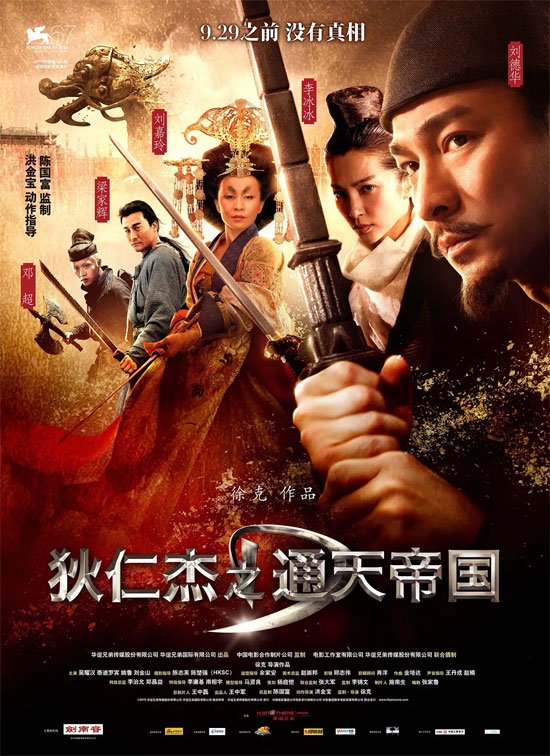
Detective Dee and the Mystery of the Phantom Flame feels like a film that runs out of steam. While the opening heavily builds suspense and the protagonist Di Renjie makes a grand entrance, by the end you realize the solution to the mystery is utterly ridiculous—and Di Renjie himself has little to do with solving it. “Detective Dee and the Mystery of the Phantom Flame” resembles CCTV-10’s “Approaching Science”—mysterious throughout, yet its resolution leaves audiences exclaiming “What the hell?” This film fails to represent either Chinese suspense cinema or historical Chinese suspense cinema.
Admittedly, the first half is quite well-crafted. Whether showcasing the splendor of the Tang Dynasty or building suspense, it swiftly draws viewers into the narrative. However, screenwriter Zhang Jialu seems indecisive about whether he’s telling a fantasy tale or a realistic story. This inconsistency makes “Detective Dee and the Mystery of the Phantom Flame” oscillate between fantasy and realism—or rather, it becomes a fantasy film when fantasy is needed, and a realistic film when it isn’t. This inconsistency leads to the frustrating plot twists seen in “Young Detective Dee,” where Detective Dee diligently investigates only to discover that supernatural forces are ultimately responsible. A competent suspense film hinges on two essentials: an irreplaceable mystery and sufficient plausibility. Yet “Detective Dee and the Mystery of the Phantom Flame” fails on both counts, rendering its so-called suspense somewhat deceptive. A great mystery film not only delivers that satisfying “aha!” moment but also compels viewers to revisit it for hidden details. Yet after watching “Detective Dee and the Mystery of the Phantom Flame,” we realize this so-called thriller hides almost no clues in its plot. Far from making us want to rewatch it, it leaves us wanting to curse.
Even the minimal suspense present is diluted by the film’s patchwork approach, resulting in a mediocre period drama. The most glaring and irritating example of this is the action sequences. Personally, I feel Tsui Hark knew full well that this fundamentally flimsy mystery plot couldn’t sustain nearly two hours of runtime. To prevent audiences from cursing Tsui Hark and the entire crew upon leaving the theater, he resorted to the desperate tactic of “filling the gaps in mystery with fight scenes.” This time, however, Tsui Hark entrusted his most trusted collaborator in the wrong role. Sammo Hung is an outstanding action star, but that doesn’t automatically make him an excellent martial arts choreographer. Sammo Hung’s action choreography consistently lacks sufficient ingenuity. While well-suited for modern kung fu films emphasizing bone-crunching realism, it proves ill-matched for the romanticized style demanded by “Detective Dee and the Mystery of the Phantom Flame.” The film’s action sequences offer no fresh ideas and overuse excessive close-ups, rendering it the most tedious “kung fu flick” I’ve endured in recent years. The film’s dwindling suspense elements became my sole motivation to endure it to the end. The action sequences in “Detective Dee and the Mystery of the Phantom Flame” feel like a careless child filling in blanks on a worksheet—utterly arbitrary. Regardless of narrative necessity, the film constantly forces in lengthy fight scenes, causing it to oscillate between thriller and kung fu movie. It seems to want to please both genres, but ultimately fails at both. Still, it’s fortunate that Sammo Hung packed in so many action sequences, preventing the film from descending into excessive melodramatic love triangles (the character relationships already hinted at this). Otherwise, “Detective Dee and the Mystery of the Phantom Flame” would have truly become a boring hodgepodge.
Upon delving into the film’s scarce remaining elements of suspense, we must sadly acknowledge that its protagonist, the legendary detective Di Renjie, plays surprisingly little role in unraveling the mystery. From his very first appearance, he’s led by the nose by the mastermind behind the murders. Throughout this process, he’s constantly fighting others—the Crimson Flame Golden Tortoise was revealed to him by the criminal mastermind, Shatuo; it was Shangguan Jing’er who pointed out the fundamental flaw in his investigative approach; and it was Pei Donglai who uncovered the most crucial evidence to unravel the mystery. Good heavens! Aside from uncovering the secret that Shangguan Jing’er was actually the Imperial Astrologer Lu Li—a revelation barely connected to the case (and one that indirectly led to Shangguan Jing’er’s death)—what exactly did you accomplish, Detective Dee? In a mystery film, the detective protagonist is the most irreplaceable role. Yet in “Detective Dee and the Mystery of the Phantom Flame,” Di Renjie’s fate is more tragic than the film’s mystery itself. The mystery is merely replaceable, while Di Renjie seems utterly unnecessary in this film. Ultimately, the film’s most pivotal character turns out to be Pei Donglai—that arrogant, initially unlikable figure. This man embodies loyalty, courage, and strategic brilliance, sacrificing himself without hesitation to solve the case with consummate professionalism. Had he not perished so prematurely, the film could easily have been renamed “The Case of the Tang Dynasty’s Brave and Loyal Detective.”
“Detective Dee and the Mystery of the Phantom Flame” passes as entertainment, but by Tsui Hark’s standards, none of its elements meet expectations. Even its special effects—Tsui being a pioneer of CGI in Hong Kong cinema—fall short of his earlier work “Zu: Warriors from the Magic Mountain.” Old Tsui, Old Tsui—we see only the “old,” not the “strange.”
Please specify:Anime Phone Cases » Detective Dee and the Mystery of the Phantom Flame 2010 Film Review: Watch the White-Haired Detective Solve Baffling Cases