Film Name: 忌廉沟鲜奶 / Cream, Soda & Milk / 忌廉溝鮮奶
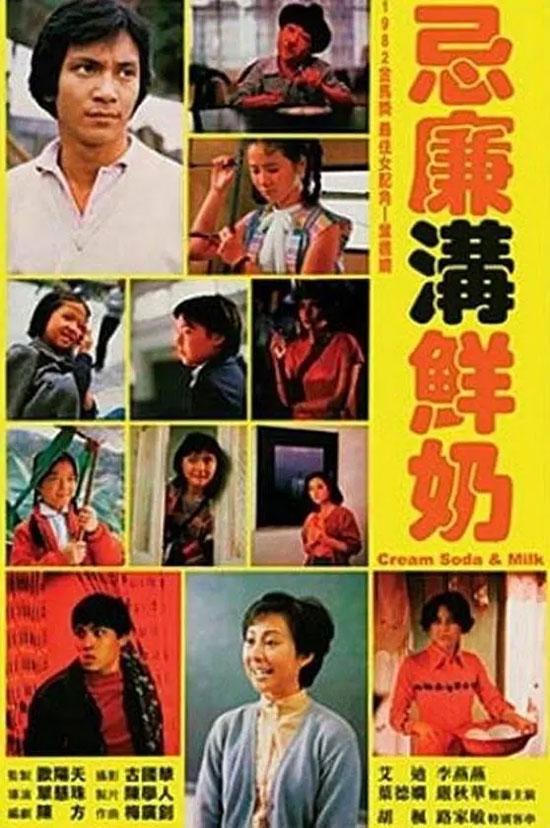
Film Synopsis:
Sisters Ding Ling and Ding Dang were separated for years after their parents divorced when they were young. As adults, Ding Ling lives with their mother but remains deeply concerned about her brother, who lives with their father. Ling’s social worker boyfriend, Yang Guang, knows many teens from broken homes. One day, he notices an 18-year-old boy named Ding Tiansheng who bears a striking resemblance to Ding Dang. Tiansheng shares Ding Dang’s quirks—like mixing cream soda with fresh milk—and has the same stubborn streak. Yet he denies being Ding Ling’s brother.
The story highlights various youth issues in society through the perspectives of Yang Guang as a social worker and Ding Ling as a teacher. Ding Tiansheng spends his days with many teens from broken homes. His fifteen-year-old girlfriend, forced into prostitution to help her mother repay debts, ultimately loses her life while fleeing police pursuit. Enraged, Ding Tiansheng seeks revenge against her mother, resulting in his imprisonment for assault.
Character Overview:
1. Ding Tiansheng (Ding Dang)
Ding Tiansheng and his biological sister Ding Ling were separated at a young age, growing up in vastly different environments. His sister enjoyed a far more affluent life, receiving an overseas education before becoming a teacher. Ding Tiansheng, raised by his chronically ill father, was forced to drop out of school and enter the workforce. Making a living as a street vendor, he accumulated a string of offenses. Deprived of family care, he learned to solve problems and face challenges alone, fostering an intense pride that led him to reject his long-absent mother’s apologies and offers of help. Though his father was gravely ill and unable to care for him, Ding Tiansheng still visited his bedridden father regularly at the hospital. This shows that after his mother left, his father effectively took on the role of a surrogate mother. According to Harlow and Ainsworth’s experiments on attachment styles, individuals require a reliable attachment figure throughout developmental stages to enhance personal security. The presence of such a figure enables confident exploration of unfamiliar environments. Ding Tiansheng’s habit of drinking his father’s favorite cream mixed with fresh milk and his reverence for his father’s ashes reveal his father as a crucial emotional anchor.
Ding Tiansheng and Ding Ling exemplify how family influences shape personal development. The parenting style he experienced can be categorized as uninvolved, as he faced no discipline or guidance. His confrontation with his mother—questioning why she didn’t teach him earlier and only offered compensation after he had fallen into destitution—highlights this issue. Without parental guidance, peers became his most significant companions. He associated with youths from similar backgrounds, leading them in survival strategies and building his self-esteem through social approval. However, Ding Tiansheng’s real self and ideal self were quite incongruent. He persistently believed he could free his girlfriend Ah Hua from her “fishball girl” sex work, yet proved incapable. For instance, he attempted to earn money through illegal street racing but ultimately failed. resulting in Ah Hua losing her life while working as a “fishball girl.” It must be noted, however, that due to his lack of proper upbringing, his problem-solving methods were learned from society. His environment was filled with replicated social patterns, inevitably exposing him to frequent acts of violence. According to Bandura’s 1977 Bobodoll experiment, these behaviors (including violence and lack of courtesy) became observational models for him. resulting in a reliance solely on violence. The story’s conclusion, where he attacks Ah Hua’s mother with a knife following her death, exemplifies this. In contrast, Ding Ling grew up under her mother’s influence, within an authoritative parenting environment. Her mother possessed a domineering personality and disliked her children opposing her views. The film illustrates the impact of different family environments on children through the siblings’ experiences. However, since Ding Ling is portrayed as an adult in the story, she falls outside the scope of this discussion.
2. Alan
Alan’s mother was a prostitute. She never knew who her father was, but she and her older sister Ah Hua were definitely half-sisters from the same mother but different fathers. This was evident from the stark difference in their skin tones—Alan’s resembled that of someone of Indian or Pakistani descent. Precisely because of her negative self-image and body image, she was often ridiculed, causing her self-esteem to plummet. When she confessed her feelings to Yang Guang and was rejected, she assumed it was because he disliked her appearance. This led to frequent suicidal tendencies. Her first appearance in the story was after a failed suicide attempt, when Yang Guang visited her in the hospital. Not knowing her father and possessing an unusual appearance also caused her an identity crisis, leaving her unable to recognize who she was or her own worth. Simultaneously, her mother’s lack of discipline in raising her made her a girl raised by an uninvolved parent. Despite this permissive parenting style, her mother occasionally reprimanded her, leading to frequent arguments and conflicts between them. This approach, however, failed to yield positive results. Instead, it prompted her to seduce her mother’s lover as an act of revenge. This behavior signaled her entry into the stage of developing independence, where she rejected her mother’s directives (de-idealizing parents) and shifted her sense of autonomy from her parents to herself. Ultimately, Alan decided to emulate her mother by entering prostitution. Combined with her background as a single-parent household child and her lack of schooling (low educational goals), these factors contributed to her becoming sexually active at a young age (sexually active adolescents).
3. Bai Ban and Wu Xin
Bai Ban and Wu Xin respectively exemplify bullying issues. The former suffers from a chronic illness, unable to receive treatment due to poverty. He is frequently bullied in society because his appearance signals weakness and an inability to defend himself. For instance, when he first began selling gum, he was verbally mocked by a pair of teenagers—an act of verbal bullying. Wu Xin, a student from mainland China, faces perceived differences from local peers and has few friends, making him a target for bullying.
Both primarily reveal the hardships faced by impoverished youth and new immigrants in society, ultimately preventing them from having a joyful and healthy environment for growth.
Final Thoughts:
“Cream, Soda & Milk” is a film that exposes the problems faced by young people in society. Through the experiences of different youths, it highlights the importance of family and school education for children’s development. Ting Tiansheng and Alan represent youth neglected by their families, ultimately embarking on uncertain paths. Bai Ban and Wu Xin symbolize marginalized communities, trapped without prospects—one succumbing to illness, the other choosing to leave Hong Kong. These narratives vividly portray the realities of marginalized youth in 1980s Hong Kong.
Please specify:Anime Phone Cases » Cream, Soda & Milk 1981 Film Review: A Brief Discussion on Adolescent Behavior in Films