Film Name: 神经侠侣 / Crazy n’the City / 神經俠侶
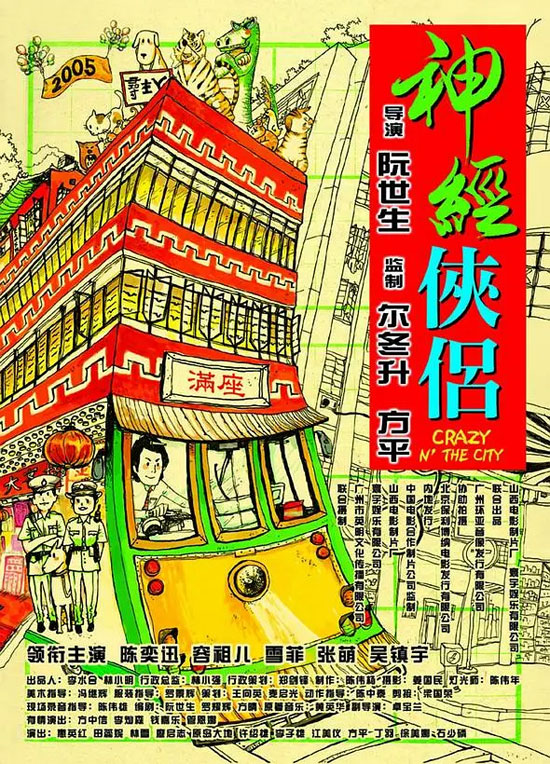
Just seeing the title “Crazy n’the City,” I assumed it might be another unreliable Hong Kong comedy that relies purely on slapstick. But when the first shot appeared—Eason Chan and Liao Qizhi as cops walking through a downpour at a street corner— The subtle atmosphere it conveys in that instant inexplicably perks me up. When I later learn that this gimmicky cop-criminal confrontation was merely Eason Chan’s meditation— Crazy n’the City” reveals itself not as a police myth but a stark confrontation with reality. Paying attention to its English title, “Crazy and the City,” perhaps offers deeper insight into the intricate ties between Hong Kong’s fate and the film’s characters.
The defining feature of “Crazy n’the City” is its rich texture of lived experience. It’s evident the screenwriter drew from genuine feelings and invested considerable thought—unlike Yuen Siu-sang’s previous work “Driving Miss Wealthy,” which told a completely fictional “male Cinderella” fairy tale. Each character in “Crazy n’the City” embodies a collective archetype. The three police officers portrayed by Liao Kee-chi, Eason Chan, and Joey Yung represent distinct phases of life. Eason Chan once shared the same youthful vigor as Joey Yung’s character, but after seven years of real-world trials, he gradually shifts toward the retired mindset embodied by Liao Kee-chi. Shing, portrayed by Ng Chin-yu, epitomizes the victims of Hong Kong’s economic downturn. Crushed by immense pressure, he descends into neuroticism bordering on madness. Ng Chin-yu is perfectly cast for this role, navigating the line between feigned and genuine insanity as he forms a heartbreaking connection with massage parlor worker Fei Fei. The appearance of Hui Yinghong as Brother Cheng’s sister offers a small delight. Though the former martial arts star “Bawanghua” is now a street newspaper vendor, her presence perhaps reflects the relentless passage of time in Hong Kong cinema. Yet the resilience she conveys in her few scenes instills a measure of confidence in facing life.
In a film where both screenwriter and director show such deep care for supporting characters, the sincerity is palpable. Especially after a friend is murdered by the “Rainy Night Butcher,” when a group of young girls continue wrestling and tumbling in the judo dojo—admittedly, the film’s treatment here leans sentimental. Yet it instantly brought to mind Johnnie To’s “Throw Down” from last year. Johnnie To’s “Throw Down,” using judo as an inspirational vehicle, served as an encouragement and mutual support for his peers in the film industry. The segment in “Crazy n’the City” here could be seen as a positive response to “Throw Down” from the younger generation, directed by Yuen Siu-sing. When both on and off screen brim with inspirational spirit, “Crazy n’the City” elevates its overall quality beyond the film’s actual level. Moreover, the confidence it conveys during Hong Kong cinema’s current slump is all the more commendable.
For some reason, I’ve always been powerless against the unique blend of laughter and tears, sorrow and joy found in Hong Kong’s inspirational films. Unlike Hollywood movies or Japanese dramas, which often feel like they’re relentlessly preaching their values, Hong Kong’s uplifting stories carry an intimate resonance—they breathe the same air and share the same fate as the present reality. Perhaps it’s because we share the same cultural background that we understand the struggles and enduring faith expressed in Hong Kong cinema, accepting it all so naturally.
Please specify:Anime Phone Cases » Crazy n’the City 2005 Film Review: A heartfelt Hong Kong inspirational film