Film Name: 天才与白痴 / Crazy Money / The Last Message / 天才與白痴
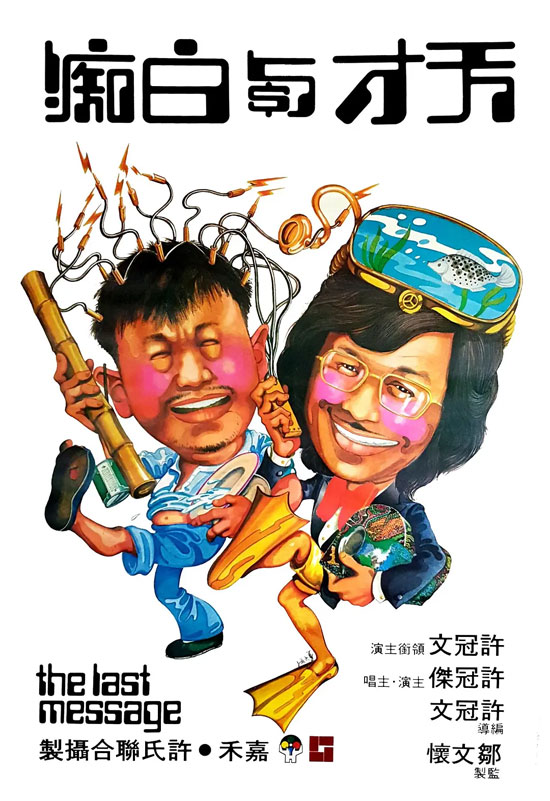
Nowadays, few people mention the Hui brothers anymore. Hui Koon-man, Hui Koon-wai, Hui Koon-ying, and Hui Koon-kit—four talents from one family. They could fight, sing, tell jokes, host shows, write scripts, and direct films. Each brother developed his own distinct style, yet they collaborated seamlessly. They were the box office guarantee for Hong Kong cinema in the 70s and 80s, a constant source of joy on the silver screen. Before Stephen Chow emerged, they were the undisputed masters of humor in their era.
The Hong Kong-style humor of the 70s relied heavily on exaggeration and theatricality. Viewed today, its punchlines inevitably seem a bit flat. Yet its colloquial dialogue, tight integration with local politics, and rich street-smart flavor remain distinctive. Many gags still circulate online today, having once made entire families laugh until their sides ached. Since Hsiao Kuan-wu primarily worked behind the scenes, they’re commonly referred to as the Three Brothers.
Each brother had a distinct persona: Eldest brother Hsiao Kuan-wen was the deadpan comedian, capable of directing and acting—he won the first Hong Kong Film Award for Best Actor. The second brother, Xu Guan-ying, often played the role of a dim-witted pushover who got bullied. He frequently appeared alongside Lam Ching-ying in early Hong Kong zombie films. The closing credits of Nicholas Tse’s 2013 debut film “Rigor Mortis” paid tribute to him. The youngest brother, Alan Hui, possessed striking good looks and a powerful singing voice. Proficient in various instruments, he excelled at composing and performing his own music. During an era dominated by covers of Japanese and Western pop songs, Cantonese music lacked mainstream appeal and was considered lowbrow. Alan played a pivotal role in promoting local culture and elevating Cantonese pop music, dominating half the Hong Kong music scene throughout the 70s and 80s.
Doctors and patients in mental hospitals are beloved characters in comedies. The more absurd their dialogue and actions, the greater the contrast, the more laughter they provoke. Examples include the underpants slingshot in “The Marriage Certificate” and the final real estate prophecy in “Big Shot’s Funeral.” Ordinary people dream of wealth and fortune. When faced with the ramblings of the deranged, the speaker may be oblivious, but the listener takes it to heart. Using the madman’s mouth to speak reality, using the dying man’s mouth to voice desires—the irony is profound. In 1975, the Sino-British Joint Declaration was still years away, its contents unrelated to the handover. Yet every era carries its own anxieties.
The dying old man on his deathbed still asks about the Hang Seng Index before his last breath. The hotel houses smug Middle Easterners feasting on roast pork (a deliberate jab, as they are known to abstain from pork) while boasting about oil prices—all mirroring reality. The 1973 Hong Kong stock market crash saw the Hang Seng Index plummet 90% in a single year. Compounded by the following year’s Middle East oil crisis, it nosedived from 1,774 points to 150 points within two years. Tens of thousands went bankrupt, some even jumping to their deaths. Grievances rose like a tide, and cries of despair echoed everywhere. This bear market persisted until 1981, when the index gradually recovered to its initial highs. The son’s comforting fantasy—that the 17,000-point milestone would finally be achieved in the millennium—could now be fulfilled with the line, “Don’t forget to tell your old man at the family memorial.” Without understanding the era’s context, these lines might seem detached today, but they surely resonated deeply in theaters back then.
Please specify:Anime Phone Cases » Crazy Money 1975 Film Review: Hong Kong-style humor of the 1970s