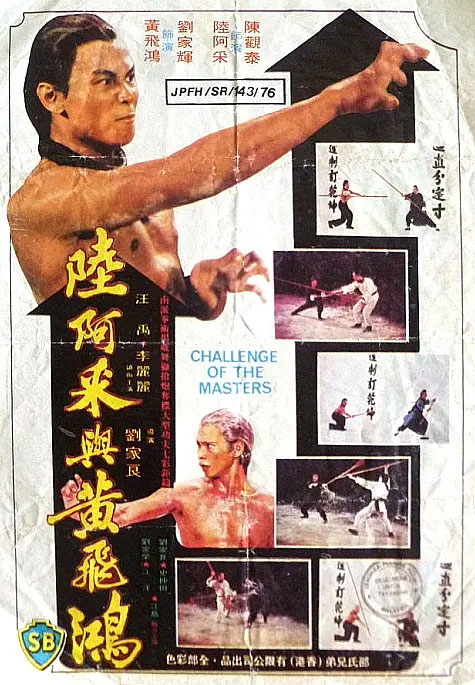
Film Name: 陆阿采与黄飞鸿 / Challenge of the Masters / 陸阿采與黃飛鴻
One who is sufficiently powerful yet does not bully the weak—when attacked by an opponent, defeats them but stops short of causing harm, holding benevolent intentions to dispel their malevolence and nurture their righteous spirit, subduing their heart to lead them back to the right path—this conduct is called benevolence.
Thus, the benevolent have no equal, for it requires possessing the strength of benevolence. In martial arts, first your skills must be sufficient to subdue your opponent; otherwise, what right do you have to speak of benevolence? To attain supreme martial prowess, one must dedicate oneself to rigorous training—practicing boxing techniques and cultivating inner strength. This principle is emphasized throughout all films directed by Liu Chia-liang: extraordinary martial arts demand extraordinary discipline. Thus, both Lu A-tsai and Wong Fei-hung underwent such trials; the timing of their success hinged on individual diligence and innate talent.
Once you possess formidable martial prowess to subdue an opponent, refrain from taking their life. Stop at the critical moment, allowing them to learn from defeat and ultimately awaken. Thus, after defeating Zhen Erhu in the bamboo grove, Wong Fei-hung recalled his master’s teachings: show more forgiveness, less arrogance. He ultimately spared Zhen Erhu’s life.
At the climax of the firecracker theft, Wong Fei-hung again resolved a feud with the same benevolent intent and extraordinary skill. As the saying goes, the benevolent have no equal. This principle applies to human interaction as well: if you don’t press your advantage, fists rarely strike a smiling face. Even if an opponent is unreasonable, your strength alone can command their respect.
Thus, in martial arts, you must first become sufficiently powerful before speaking of the benevolent having no equal.
Today, some so-called martial arts masters, when challenged by others, dare not even strike back, yet still call themselves masters, claiming they must yield to others. These are clearly frauds deceiving the world, afraid of destroying the honor they’ve deceitfully built over years and losing their livelihood. Such “masters” are far too common now. Precisely because there are so many fake masters, fake martial arts are becoming increasingly prevalent.
Many claim their ancestral martial arts are ineffective, but that’s only because they can’t endure the rigorous training. Could techniques honed over two or three millennia of battlefield combat truly be useless? Instead, they chase after fast-food martial arts—kicks that look flashy from afar. But martial arts aren’t dance routines. You can practice them as leg exercises, yet they fall far short of our own traditions. Can’t someone dedicate themselves to preserving our heritage? Folk traditions abound, yet they’re absent from the ring. This is the reality of our world—concealing the genuine while promoting the fake. Perhaps it’s for the best, sparing us from having our martial arts turned into mere gymnastics routines.
An amusing phenomenon in the film involves the supporting actor Eric Tsang. He plays a servant to Master Huang Qiying in one scene, then a servant to Master Peng—Master Huang’s rival—in another. Back in the day, he truly had it rough. Even playing a servant required portraying betrayal…
Please specify:Anime Phone Cases » Challenge of the Masters 1976 Film Review: Only through strength can one speak of benevolence.