Film Name: 大鱼海棠 / Da Hai / Big Fish & Begonia / Big Fish & Chinese Flowering Crabapple
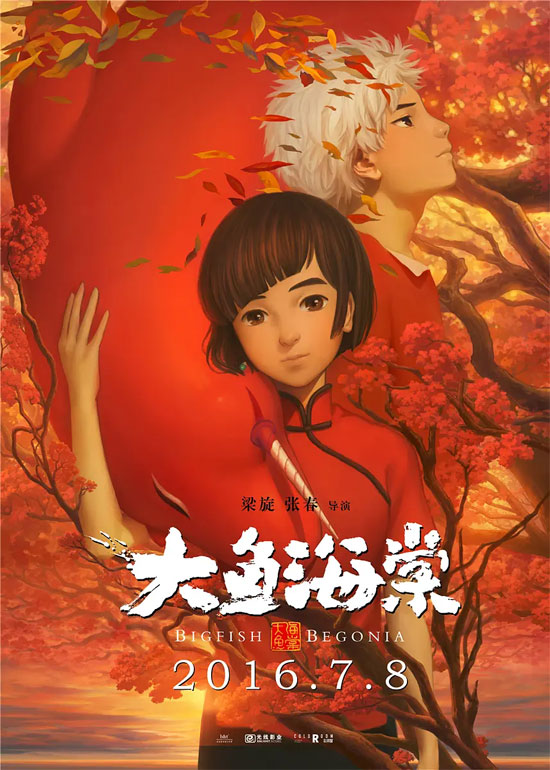
From the opening lines—”In the Northern Sea there swims a fish, its name is Kun. Kun is vast, its size unknown, spanning thousands of miles”—to the closing lines—”In ancient times there grew a great tree called Chun, whose spring lasted eight thousand years, and whose autumn lasted eight thousand years”—one cannot help but feel a mix of emotion, inspiration, and reflection. The film strives to present the wisdom and imagery of “A Happy Excursion” through an aesthetically pleasing lens, reinterpreting it with a love story that transcends time and space. This sincere effort is commendable.
For any animated tale that crafts a new world, the simplest criterion for judgment is whether it ignites your yearning to visit that realm—whether it sparks imaginings like “What if I were in that world?” or “What if I were the protagonist?” In this sense, the film falls short.
This is a world where matters of life and death remain mere words. When Tsubaki transforms into a begonia blossom to uphold the world, we are moved by her sacrifice—only to see her resurrect elsewhere the very next moment. When the Spirit Mother murmurs, “Your resurrection owes thanks to the one who traded their lifespan for it,” we begin to mourn Shu’s disappearance—only to witness him reappear in the middle of the ocean the instant after. Anyone can die, and death can be reversed—the cost is never truly etched into the soul.
This is a world without memories. Though the film uses narration to evoke a sense of reminiscence, the over-100-year-old Tsubaki never appears. Did she and Kun live happily? Is she content as the new Spirit Grandmother? Without these realities, such recollections hold no meaning. Conversely, the film neglects to tell stories that should be remembered. Take the beautiful love story between Tsubaki’s grandparents, or the origins of the Spirit Grandmother and Rat Grandmother. Even childhood memories of Tsubaki and Shu—any recollections that could deepen our connection to this world, fuel our hopes, or enrich our understanding of the protagonist’s relationships with friends and family—are entirely absent. In a world devoid of memory, any seemingly wondrous setting carries only symbolic meaning, failing to truly move us. For all human emotion is accumulated through recollection.
This is a world lacking true rites of passage. The film is not short of solemn ceremonies or magical rituals—for instance, Tsubaki’s coming-of-age ceremony at the beginning is a pivotal scene meticulously crafted, while her journey to the spirit midwife and the life-exchange ritual are equally shrouded in mystery. But did Tsubaki truly come of age through these ceremonies? If the ritual consists merely of spending seven days in the human world to observe how it functions under divine influence, then this coming-of-age is, at best, a graduation ceremony for supernatural arts. True adulthood should be marked by mental maturity—understanding how to love others and how to take responsibility. The film lacks a weighty statement about what it truly means to become an adult.
This is a world overflowing with imagination yet pale in humanity. Every frame is visually stunning—or more accurately, every scene is beautifully composed. Some shots even create the illusion that the lens isn’t wide enough, that more needs to be seen. Yet beneath the surface, the exploration of human nature feels shallow. Some elements linger in mystical charm, like the spirit midwife, who treats mystery as a personality trait; others remain stuck in the superficiality of “cute and fresh,” such as the trio of protagonists. If Qiu could have turned love into hatred, it would have created more conflict and made the resolution more moving. Still others rest on simplistic dogma, like Chun’s mother and the immortals within the clan, all cut from the same cloth.
The Kun is vast, its size unknown, stretching thousands of miles. Yet this fish named Kun ultimately grows only to the size of a small whale, failing to become the colossal creature spanning thousands of miles. It misses a golden opportunity to create a more striking, awe-inspiring contrast with the protagonist’s diminutive stature. Crucially, a Kun that never truly becomes a “great fish” cannot endure the vicissitudes of human life, cannot accumulate sufficient emotional depth, and thus cannot undergo the qualitative transformation from fish to human. From the outset, I opposed Tsubaki’s decision to raise Kun as a pet. How could treating a lover like a pet from infancy deepen their bond? It only bred a sense of disquiet.
If I were in that world, I’d hope that Tsubaki, on her first descent to the human realm for her coming-of-age ritual, would not only fall for the boy on the fishing boat at first sight but also rescue his swaying vessel during a storm. That way, his later rescue of the stranded Tsubaki would feel far more natural. I’d even hope Chun missed the seven-day deadline and was forced to stay in the human world, embarking on a truly forbidden romance with the boy.
If I were in that world, I’d hope for the conflict between Chun and Qiu. Spring and autumn are inherently opposing seasons—they cannot merge, yet they are also unified. This tension and harmony are far more complex than “I see you as an older brother.”
If I were in that world, I would hope the collapse of the divine realm is ultimately driven by the gods breaking through their so-called taboos with the mortal world—overcoming barriers like prejudice and the shackles of love. Kun’s arrival may shatter the divine realm, but it is also through Kun and Chun’s joint efforts that this world achieves greater harmony and universal unity. After all, they’re all “big fish” in their own right.
Please specify:Anime Phone Cases » Big Fish & Begonia 2016 Animation Film Review: If I were in that world