Film Name: 安娜玛德莲娜 / Anna Madelina / Anna Magdalena / 安娜瑪德蓮娜
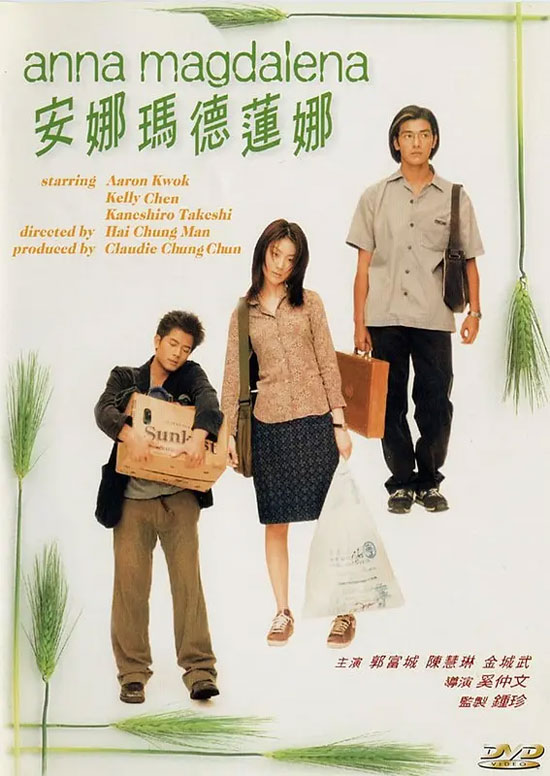
Secret crushes are neither novel nor lonely, nor do they carry class barriers—yet they remain the most natural thing in the world. Some, with their hasty judgments and exaggerated tales, force budding feelings onto a single person. They declare with conviction, “I have someone in my heart, and I want us to be together.” Thus, if things go well, all is well; if they go wrong, all is lost. Take Liang Zhi and Yingtai, Tang Yin and Qiuxiang as proof. Of course, there are also those that fizzle out, like Chen Jiafu and Mo Min’er, or perhaps, me and you.
These tales become movies, tucked into little boxes, with favorite actors playing the leads, accompanied by beautiful music and signature lines like “Dumb Goose, Qiu~~~~Xiang Sister” etc… They serve as conversation fodder or playful banter. But to truly blur the lines, it takes an eruption of volcanic emotion. Sure enough, when “Anna Madelina” played, that sense of déjà vu and heart-wrenching nostalgia flooded over me. It was just love, yet it choked me up until my eyes stung.
“Anna Madelina” starring Takeshi Kaneshiro, Aaron Kwok, and Kelly Chen, produced by Golden Harvest in 1998. Directed by a former art director, the film’s visuals feature deep blues, warm oranges, and Aaron Kwok’s clueless line: “The sky’s red, it’ll rain tomorrow, we’ll be stuck on rough roads.” This perpetually complaining, short-tempered, under-six-foot-tall, unemployed young man somehow charms a crowd of girls, leaving Takeshi Kaneshiro helpless—because this world is twisted.
The narrative’s backbone is the song “Anna Magdalena.”
In the film, Chen Jiafu (Takeshi Kaneshiro) loves his neighbor Mo Min’er (Kelly Chen), while Mo Min’er loves Nomad (Aaron Kwok). The interwoven fragments only intensify the lover’s desire and deepen the beloved’s innocence. One scene shows the Nomad skating alone, drinking water, then splashing it over his head. It finally dawns on us: this very gesture set Mo Min’er’s thoughts alight, and it was her imitation of him that made Chen Jiafu’s heart soar. The one you can truly love isn’t hard to find—they’re right beside you. But whether your relationship can blossom into something beautiful is already predetermined. Those who seek love see things differently: you want deep affection, I want bright sunshine. Even after embracing with passion, we remain worlds apart. Yet those destined to be lovers stand inches away, yet as distant as the horizon.
Mo Min’er found Chen Jiafu “so boring.”
Nomad called Mo Min’er a “busybody.”
Their premeditated banter and teasing—or rather, the reflections of love. Chen Jiafu was a lonely soul, spending his days alone listening to music, keeping fish, and solving crossword puzzles titled “Someday I’ll Move You.” When Nomad and Mo Min’er moved into his building, a quiet affection blossomed. Mo Min’er’s, Chen Jiafu’s, Nomad’s. The trio lived in serene mystery. This love story, already heart-wrenching with its imbalance of women to men, intensified with Chen Jiafu’s desolate expression. He asked Nomad, “Have you fallen for her?” He also told Mo Min’er, “When I was young, there was a classmate who skipped class all the time, didn’t study well, and was always causing trouble. But every day after class, the girls in our class would line up to copy his homework. When he transferred schools, all the girls in the class were sad for a long time, and even the teacher seemed listless.” When he said these things, it was as if he were talking to himself. There was a sense of resignation in his words—to put it bluntly, it was like saying, “Forget it.”
Nomads are born free spirits. He defined his work as a primary occupation as a writer, with horse racing as a side gig. Though he had no fixed abode, he never felt his life was fragile. He neither anticipated nor pursued love, just as he never feared running out of money—it was something he simply “couldn’t die from.” The only overlap between him and Chen Jiafu was the ever-present loneliness that shadowed them both. Yet there were differences: he wore his resilience on his sleeve, flirting indiscriminately, while Chen Jiafu remained more loyal to his solitude than to any friend. So, could only love save them? Did Mo Min’er count? Considering she could play “Anna Magdalena,” of course she did.
Women with sixth or seventh senses are often sharp as a tack. Mo Min’er seemed that way, yet secretly made one think she was foolish. You knew Nomad had no job, no home, and even his living expenses came from horse betting, yet you loved him. But love that confronts life so directly isn’t love at all. The night Nomad left, Chen Jiafu stayed with her. He asked cautiously, “May I play your piano?” Mo Min’er replied, “He never asks. If I want to play, I just play.”
The implication was clear: love is the same. No need for questions—love when you feel it.
Chen Jiafu’s speechlessness was understandable. He wasn’t her cup of tea, her glove, or even the air she breathed.
A film crafted by a clever director still delivers beautiful moments. By the fourth chapter, the story takes flight. Chen Jiafu begins writing a novel, weaving Mo Min’er into his tale—childhood sweethearts roaming the world together, humming “Anna-Maria” to voice his love aloud. He writes his own ending: he says, “Mo Min’er, I love you,” and she replies, “I’ve known all along.” ” This moved the other two supporting characters, Anita Yuen and Leslie Cheung, deeply. Though these two acting legends had limited screen time, their brief yet emotionally charged dialogue portrayed another layer of unrequited love. The story unfolds in such a way that it truly refreshes the spirit.
Hong Kong-produced romance films are bright and fast-paced, unlike Taiwanese productions that tend to be emotionally raw and verbose. After some digging, I discovered this director contributed to the costume design for The Forbidden Kingdom. So does one’s aesthetic taste evolve over time? Heaven forbid that ten years from now, I’ll still adore such minimalist visuals, still be moved by Takeshi Kaneshiro’s fleeting moments of contemplation, still find contentment in the beauty of unrequited love.
Please specify:Anime Phone Cases » Anna Madelina 1998 Film Review: Most hateful is meeting when secretly in love