Film Name: 英雄本色2 / A Better Tomorrow II / Yinghung bunsik II
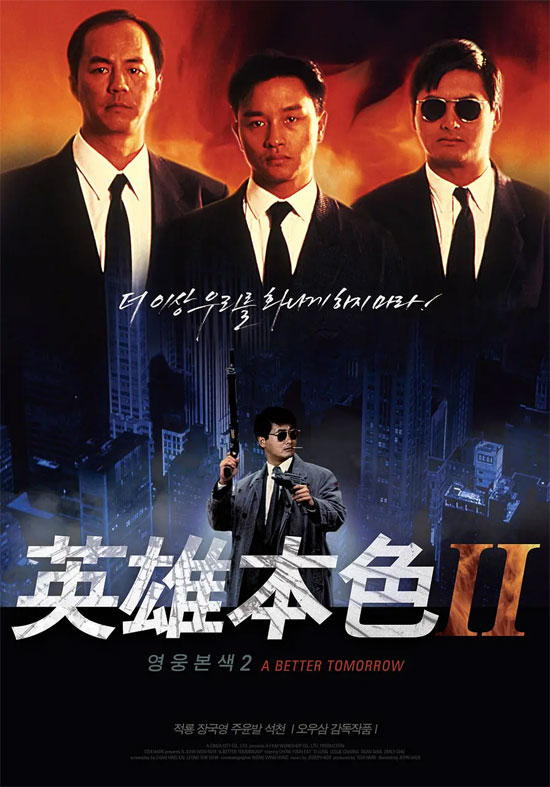
Picking up where the first installment left off, the sequel continues the heroes’ unfinished tale.
The most striking transformation belongs to Song Zijie, whose character evolves from the fiery, rebellious youth of the first film into a more understanding, neighborly younger brother figure. After all the twists and turns, he returns to his most fundamental essence, though this purity now carries an added layer of compassion and devotion toward his brother. Leslie was thrilled about this hard-earned redemption. It’s said that once, while watching a midnight screening at the cinema, he told his friends: “I’m dying here! The audience loves Fa-chai so much, yet I’m the cop who has to arrest Fa-chai and my own brother!” By the second film, he beamed: “Now people sympathize with me! Look how well I act! I died while my wife was pregnant with our child.” Lam Yuen-ni recalled watching A Better Tomorrow with her brother. Knowing Jacky was unpopular, he’d cheerfully clap whenever his character appeared. When Lam asked why he clapped for himself, he innocently replied, “Who else should I cheer for? I have to get the audience excited!” Zhang Guomeng, you’re just too adorable! Ah-Jie’s death was inevitable—not only for the plot, but also due to the unbreakable “white-clad character must die” rule. Rumor has it the founder of this genre was Chang Cheh? During his final moments, Ah-Jie’s phone call scene made me break down in tears. How badly? Tears choked my windpipe, leaving my voice hoarse from coughing. Blood streaming down his face, he fought through the agony to share the joy of becoming a father with Ah Ken beside him. He didn’t even get to see his wife and child one last time, leaving behind only the name “Song Haoran” before quietly slipping away.
Song Zihao, as Ah Jie’s older brother, remained the devoted big brother he always was—a genuine emotional outpouring that transcended mere acting. My first encounter with Ti Lung was as the Emperor in My Fair Princess, where I didn’t care much for him. Little did I know he was once a dashing heartthrob, the go-to leading man for Gu Long’s novels. Brother Hao poured his heart into protecting his younger brother—sacrificing his position as a triad boss, humbling himself to admit mistakes, and risking everything to shield him. In this film, forcing him to shoot his own flesh and blood is utterly heartbreaking. Upon learning of his brother’s death, he staggers in a daze, oblivious to the oncoming car and everything around him. In that instant, he mistakes the police officer saving him for Ah Jie. His muttered words, overlapping faces, and undeniable truths flood his mind. If he could, I believe he would gladly trade his own life for his brother’s survival.
After being beaten to a pulp in the first film, Little Brother Ma probably couldn’t be resurrected. Yet the star-studded cast had to be preserved, so Ah Ken emerged out of nowhere as Little Brother Ma’s younger sibling. In Chow Yun-fat’s scenes, he naturally radiates comedic charm. When acting alongside his brother, their roles are clearly defined: you handle the goofy innocence, I’ll take the cool and dashing. He effortlessly quotes Xu Zhimo’s verse—I leave as quietly as I came, waving my sleeves without taking a single cloud. This line echoes Chow’s confession in “Once a Thief,” embodying the signature style of director John Woo. Following his iconic bill-lighting cigarette in the first film, Chow once again pioneered a signature show-off move—mouth-blowing flames. This stunt must have inspired countless teens to imitate it upon release. Another breathtakingly cool shot was him firing a gun while sliding down stairs—utterly electrifying!
The assassin Xiao Zhuang remains an enigmatic figure throughout the film, delivering zero lines and maintaining a stone-cold expression. Cold and ruthless, he treats killing not just as a job but as his very purpose. Money isn’t his sole motivation—he clearly had the chance to walk away with the cash. Perhaps he was waiting for someone, a worthy opponent who could heighten his thrill of slaughter. That person wasn’t Long Si, nor was it Ah Jie. Fortunately, he found him: Ah Ken. By then, the outcome no longer mattered. He had not wasted the bullets fired from his gun. Even as he fell, he would smile in death.
As for Song Zijie, the film features far too many unnerving close-ups of his face. Only such a handsome man could calmly declare in the midst of a bloodbath, “This is my girlfriend Peggy. This is my wife Jackie.” As for the music, the first film needed only one song—”Dang Nian Qing”—and the second needed only one—”Ben Xiang Wei Lai De Ri Zi.” The golden standard of Hong Kong cinema, composed by Gu Jiahui and lyricized by James Wong, has long since vanished.
Watching the three of them force themselves into the role of big shots after exacting their revenge, one realizes that heroes tempered in blood only mature—they never grow old.
Please specify:Anime Phone Cases » A Better Tomorrow II 1987 Film Review: Heroes only mature, never grow old.