Film Name: 英雄本色 / A Better Tomorrow / Gangland Boss
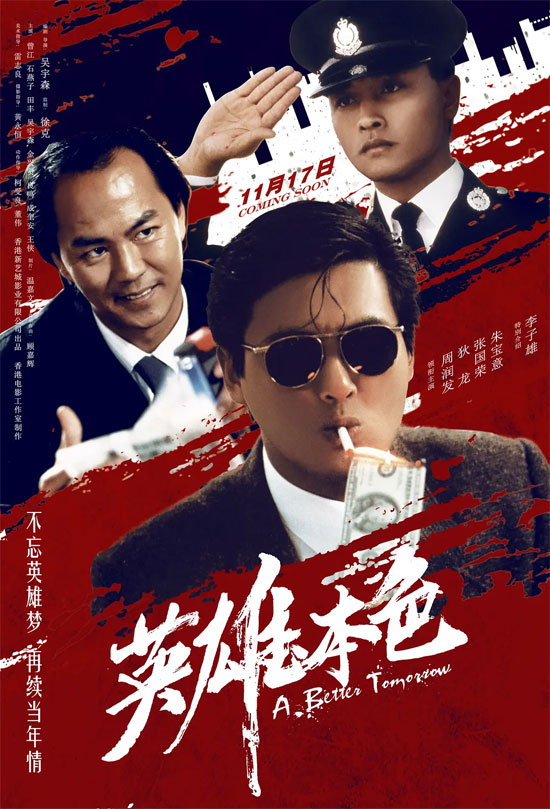
I don’t know how many times I’ve watched this movie. All I know is that I’ve seen it in theaters, and I’d watch it whenever it aired on TV—it never gets old. From initially admiring the handsome leads and the gunfire-filled action scenes, I now seek out the real-life reflections the film portrays, dissecting authentic life and dreams within its narrative. Think about it—how many years have passed since then? I’ve grown from a little kid into a big kid myself. And those once devastatingly handsome characters—the righteous and towering Big Brother Hao, the youthfully stubborn Ah Kit—they’re no longer young either. In reality, they’ve aged, and some have even left us. Yet I remain convinced—heroes live on, their true spirit endures.
“A Better Tomorrow” uses violent scenes to highlight genuine human emotions—a simple, uncomplicated bond between men. The way it portrays this theme through gunfights and death is so fitting and profoundly moving. I truly adore this film. I’ve lost count of how many times I’ve watched “A Better Tomorrow,” yet each viewing still ignites a fiery passion within me. For a teenager like me (though I’m a girl, I’ve got that hero complex!), this movie fulfills nearly every adolescent fantasy—a turbulent martial world, brotherly bonds, swift vengeance, and love. Though the era has progressed, transforming the sword-and-swordplay world into one of bullets and explosions, its raw, unbridled spirit remains undiminished. It still lets us roar with abandon—without that unprovoked rage and rebellion, our youth would surely lack so much of its essential vitality.
As the saying goes: Great times breed great heroes. In the mid-1980s, amid rapid economic growth, Hong Kong was a place that revered freedom and individual expression, governed by a social order of survival of the fittest. This prevailing climate forged John Woo’s grand, intense vision of trauma and his romantic, confident creative approach. The accompanying myths of martial arts heroes mirrored Hong Kong people’s unwavering belief in the future and the city’s thriving development. It was precisely at this juncture that “A Better Tomorrow” timely gave birth to three heroes defining an era in Hong Kong. Though not conventionally righteous, their anti-traditional heroism resonated profoundly, even shaping a generation’s values—thus cementing their status as heroes. Indeed, these three heroes embodied the aspirations and pursuits of an entire Hong Kong generation.
Type One: Noble Spirit, Loyal and Courageous
Representative Figure: Song Zi Hao
Keywords: Tall, Righteous, Heroic, Loyal and Filial
Brother Hao’s line, “I haven’t been the boss for a long time,” has become so overused by us today that it’s practically cliché. Yet we certainly won’t forget that he also said, “Where there are people, there are grudges; where there are grudges, there is the underworld.” Indeed, Brother Hao may no longer be the boss, but the underworld remains, and grudges persist. This very fact ensures that Brother Hao’s status as “the boss” will never truly change.
Big Brother, he is the respected leader in the underworld whom Little Horse looks up to, and he is also Ah Jie’s own older brother. In the underworld, this Big Brother would risk life and limb for his boss and step forward to save his brothers. In life, this brother cherishes his own sibling. He can be treated as a murderer by his own brother, can have a gun pointed at his head by his own brother, and he bears it all without complaint. So, this brother’s path is not an easy one. For his underworld, he has already lost his brother. He has lost the respect and admiration a younger brother should naturally hold for his elder sibling. For though he is righteous and passionate, his very identity is intolerable to his brother. Their lives are destined to run on parallel tracks, never intersecting. Thus, faced with his brother’s misunderstanding and hatred, he bears no resentment, unable to clarify his helplessness or his genuine loyalty.
For the sake of brotherhood, Hao Ge went to prison. Upon release, he sought to change his life, but the underworld wouldn’t let him—nor could it ever forget him. Yet he strived to improve the lives of those who cared for him. He blamed himself for Xiao Ma’s plight, felt helpless at A Jie’s grief and anger, yet bore all sorrow and injustice alone, without complaint! This is the bearing of a true leader!
Yet Brother Hao’s character always stirs an inexplicable ache within me. A man of fiery spirit, his identity dragged his father into trouble, betrayed by trusted brothers who sent him to prison. Upon release, he returns home only to be beaten out by his own younger brother. Lying alone in the rain, the tear Brother Hao had held back finally falls. How heartrending that scene is! The scene that moved me most deeply in the film (when I first watched it) — when Hao Ge, newly released, saw Xiao Ma limping along like a dog, he softly said, “Xiao Ma, that’s not what you wrote in your letter…” I cried for the first time watching a movie. Later, when forced by his brother to call the police, he added, “I haven’t been the big brother for a long time…” Then, all my friends watching with me started crying too. That’s the tragedy of being a big brother! Ah, being the leader is no easy task.
At the same time, he was also a son who cared deeply for his father. The scenes depicting his relationship with his father in the film were filled with warmth. Everything he did for his father embodied the Chinese definition of “loyalty and filial piety” for five thousand years. For his father’s sake, he couldn’t reveal his true identity; for his father’s sake, he had to shower his younger brother with affection. Though his father’s death stemmed from his actions—the very reason his younger brother Ah Jie could never forgive him—the dying words his father whispered to Ah Jie: “Don’t blame your big brother”… Isn’t that the truest expression of a father’s understanding and love for his son?
The drama focuses solely on Hao Ge navigating familial and brotherly bonds, deliberately omitting romantic love—a deliberate choice. As the eldest brother, he constantly prioritizes others, showcasing his chivalrous spirit in balancing family and friendship. These are matters for others, while love is personal, belonging solely to the individual. This towering figure embodies the sacrifice of personal affection for the sake of selfless, universal devotion. This, I believe, is the director and screenwriter’s masterful touch.
It was precisely in 1980s Hong Kong, amid rapid economic growth and the overwhelming tide of capitalism, that people became ensnared by fame, fortune, and money. They faced a profound crisis of values and worldview. They had nearly forgotten righteousness and compassion. Then came Brother Hao, who showed the fame- and fortune-chasing Hong Kongers the justice, loyalty, and righteousness life should embody. Though his profession didn’t represent true moral justice, his very identity as a triad boss allowed people to glimpse a long-lost image of righteousness. It reflected society’s recognition of justice and loyalty from another perspective.
Truthfully, everyone harbors an ideal of a great hero—loyal, courageous, and boundless in compassion. Brother Hao’s emergence fulfilled this nearly impossible-to-realize ideal in people’s hearts. Yet having ideals is always better than living without aspiration or values!
The Second Type: Unyielding in Justice, Unrestrained and Free-Spirited, Loyal and Devoted
Representative Figure: Little Horse
Keywords: Righteousness, Unrestrained, Free-Spirited, Cool and Handsome, Stubborn, Integrity, Loyalty
My favorite line from Little Horse in “A Better Tomorrow” is: “I’m not trying to prove how great I am. I just want to tell others that what I’ve lost, I will take back.” ” I still remember this line vividly. Perhaps it simply reflects Little Horse’s unwavering commitment to his beliefs and dreams. Yet it also embodies the spirit of Hong Kong people at that time. Hong Kongers don’t wait for windfalls to fall from the sky; they strive for what they desire through their own efforts. But they absolutely refuse to abandon what they’ve lost—they will pursue it relentlessly. This is the Hong Kong spirit; this is the essence of Hong Kongers.
Chow Yun-fat’s portrayal of Little Horse in this film was an undeniably successful character. His image and charisma captivated countless young men and women of the era. From then on, Little Horse became the idol imitated by boys on every street corner. Many mimicked his style—cool sunglasses, a matchstick between his lips, dual pistols holstered— blowing off the muzzle with a flourish after taking down the last enemy. They flaunted these moves among their peers by day and dreamed of heroics by night. In that era, Little Horse carried the dreams of countless youths. For me, I also cherished Little Horse’s sense of loyalty and honor: “You can insult me, but you can’t insult my friends!” “I never force my friends to do things they don’t want to do.” ” I’ve waited three years for you. Three years! I’ll start over!” These iconic lines still command respect two decades later.
The most vivid memory is the scene at Maple Pavilion. A light drizzle fell from the sky, with a cheerful song about love and romance playing in the background. Little Horse, arm-in-arm with a courtesan, cheerfully entered the private room. Then the film switched to slow motion. His playful banter and casual act were all just to slip a pistol into a flowerpot. The sensual scene and the subtle, murderous gesture created a striking contrast that was utterly breathtaking! I’ve watched this part over and over, yet I still can’t get enough of it!
Here, Little Horse fully embodies his complex nature: unrestrained yet chivalrous, fiercely anti-evil yet deeply entrenched in it, supremely romantic yet capable of brutal violence. His hatred and his loyalty to Brother Hao erupt to their peak in this moment. The ensuing bloodbath amplifies and unleashes all that pent-up vengeance, forever etching this heroic spectacle into our memory.
Finally, the scene where Little Horse is shot. He utters, “As brothers…” His words cut short by death. What does it mean to be brothers? It means stabbing each other in the ribs for one another. It means facing boiling water and fire together. It means sharing blessings and bearing hardships side by side. Put another way, it means honoring trust and loyalty. Though Xiaoma didn’t finish his sentence, his return to the warehouse to fight alongside Hao Ge alongside Hao Ge already spoke volumes. “Silence speaks louder than words” could not be more fitting here.
Brother Ma is a hero precisely because of his authenticity—he lives truthfully, honest with people and society. He harbors no grand, unattainable ideals, seeks no unparalleled status, and pursues no life of empty fame or privilege. He simply wants to be himself. That is enough.
Hong Kongers deeply value the life of the ordinary citizen. These people may lack great talent, extraordinary backgrounds, or pivotal positions, yet each finds their own source of pride—be it good looks (like Little Horse), humor, a touch of narcissism, or a peaceful, unassuming nature. They live freely and occasionally dream of distant, unattainable aspirations, doing things that surprise others. They stay true to themselves, embracing both the joys and sorrows life brings. Perhaps these people are ordinary, but it is precisely this extraordinary quality within the ordinary that creates another kind of “hero”—the free-spirited hero in the mold of Little Horse.
The Third Type: Unyielding Conviction, Uprooting Evil and Upholding Justice
Representative Character: Song Zijie
Keywords: Youth, Handsome, Impulsive, Justice, Perseverance
“Freeze, police!” This line was uttered by A-Jie during his first appearance in the film, mimicking a police officer apprehending a thief upon seeing his brother in the hospital. It was precisely this phrase that became the foreshadowing of the brothers’ eventual estrangement. It also sealed Ajie’s resolve to never abandon his ideal—eliminating evil and upholding justice. Not even facing his own brother could sway him.
Leslie Cheung’s portrayal of Ajie couldn’t have been more perfect. Youthful, spirited, and unwavering—his dedication shone through effortlessly. For the young Leslie, embodying this vibrant, ambitious, righteous cop was a seamless fit. He radiated the charm of a sunny, next-door big brother—slightly cool, surrounded by girlfriends each more beautiful and adorable than the last. Among the three leads, only his character was woven with a love story. Why? Because his magnetism demanded it—how else could his appeal be fully expressed?
His most compelling trait, however, was his unwavering persistence. He would charge forward with righteous indignation and explosive fury to pursue his ideals, yet never abandon his duty or convictions. Thus, when confronting his superiors, he could erupt in anger to prove his resolve, clashing head-on to defend his principles. When facing his older brother, he can be filled with the reverence and admiration of their early days; yet upon learning his brother’s true identity, he becomes brutally harsh and disrespectful. This leads him to never forgive his brother.
He cannot forgive his older brother. He forces himself to hate him, resent him, and belittle him. Yet deep down, he suffers the most. All this hatred stems from love—from the profound affection he has nurtured for his brother over decades. He couldn’t bear that the brother he loved most embodied the very type of people he despised most in society. It was his brother who indirectly caused the death of his beloved father, who made his path as a police officer so arduous, and who shattered his dream of becoming a good cop. So he couldn’t help but hate him. This is who he is—a Hong Kong police officer who dares to love and hate fiercely, who abhors evil with a passion.
When his older brother was released from prison and sought him out, his stance remained resolutely cold. Seeing Brother Hao driven out by Ah Jie and left helpless in the pouring rain, I felt Ah Jie was too heartless, that he had gone too far. But then I realized—this is truly who he is! As long as his brother’s identity remains unchanged, his attitude will never shift. This is the essence of a good cop who stays true to himself.
Ultimately, after surviving a hail of bullets, when Big Brother finally broke free from his criminal past, the two brothers walked side by side under the police car’s lights. This stubborn good cop finally laid down his psychological burden. He truly realized his ideals and rediscovered the Big Brother he once knew—a man of respect and affection.
This is Ah Kit: a true Hong Kong police officer, a good cop embodying the spirit of Hong Kong. He can turn against his beloved older brother for justice; he can confront his superiors to uphold his professional integrity. And yes, he’s got a touch of dashing charm too. This perfectly embodies the essence of a Hong Kong idol—one who stirs the righteous spirit of Hong Kongers, establishes the police force’s image of justice in the public eye, and even represents the banner of “justice” cherished by all of Hong Kong society.
Needless to say, he has become an eternal hero in the hearts of Hong Kongers—a hero embodying justice and youth.
Having written about these three timeless “A Better Tomorrow”-style heroes cherished by audiences, I find myself yearning for more such heroes. This inevitably brings to mind a line from a certain film: “We no longer belong in this world, for we cling too much to the past.”
It’s all because we cling to the past. Because we cling to the past, because heroes are no longer here, we miss them all the more.
Let us continue to seek our heroes amidst this unchanging nostalgia!
Please specify:Anime Phone Cases » A Better Tomorrow 1986 Film Review: Three Types of Heroes an Era Needs