Film Name: 摩登如来神掌 / Kung Fu VS Acrobatic / Modern Buddha’s Palm / Thunderbolt ’91 / 摩登如來神掌

The reason the title includes “Modern” is because Cao Dahua had already filmed a version decades ago. Wang Fat’s screenplay is essentially a remake of an old play—how could it not be considered “modern” in this new era? For Hong Kong youth, watching “Kung Fu VS Acrobatic” holds the same nostalgic resonance as mainland children watching “Zhang Ga the Soldier Boy” during the same era—it’s an ingrained memory. The pairing of Andy Lau and Sammi Cheng perfectly balanced the dynamic between idol and comic relief. Andy’s undeniable charisma naturally made him the leading man, while Sammi’s comically awkward persona instantly established him as the supporting character. The opening scenes of company assignments and playful brawls set the tone for the entire film: absurd comedy. In 1990, Stephen Chow’s pioneering of the “nonsense comedy” style wasn’t accidental. Many childhood films explored and imitated this approach, inevitably giving rise to a representative figure. Had Alan Tam starred in “All for the Winner,” the result might not have been too shabby.

The film follows Hong Kong workers Cow and Horse Hua Zai and Lick Go on a mainland business trip. Lick Go plans to smuggle antiques for profit, but Fat Wang first mocks the mainland’s underdevelopment—a trope beloved by Hong Kong audiences, akin to how we now feel superior seeing other countries’ filth and disorder. Mainland police are again portrayed as the villains—brutal enforcers quick to draw their guns. The mental state of mainlanders, in the eyes of Hong Kong directors, has become a fixed stereotype: backward and yearning for Hong Kong. After a Raiders of the Lost Ark-style adventure, Ah Fai and Lick哥 swallow the Great Restoration Pill, master the Buddha’s Palm technique, and bring Xiao Qian and Aunt Mei back to Hong Kong. The border crossing scene was edited in the video release, mainly due to controversial dialogue. The Hong Kong segment inevitably features ancient characters causing comedic chaos in modern society. Next, the Landlord and the Shape-Shifting Buddha arrive as members of a psychic delegation. Back then, psychic phenomena were all the rage globally—the U.S. military even established a special unit to study them (“The Men Who Stare at Goats”), with similar institutions emerging domestically. Amidst all the laughter and chaos, half the film passes. Next comes the disgusting scene where Brother Lok gets drenched in black dog blood and human waste by loan sharks. The Landlord then unleashes his fury. As a tribute, Cao Dahua makes an appearance, subduing the Landlord with just a few words. The shot of Yuen Wah hoisting an ATM is one I’d seen in an MTV video back then, though I didn’t know its origin at the time. I just thought his silhouette was so cool (Yuen Woo-ping’s “The Iceman Cometh” is a top-tier cult B-movie).
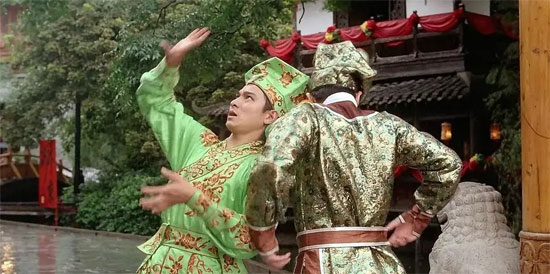
The Buddha Palm battles the Heavenly Crippled Kick, trading blows with laser effects. Hong Kong cops make a cameo, and cartoon characters fill out the scene as the film nears its end. The defeated Tian Can is deported back to the mainland, where the four heroes—including Andy Lau—bid him farewell. Here, hamburgers and cola make another soft-sell appearance, a relatively tasteful product placement. Personally, the funniest sequence is the kung fu commercial shoot—hilarious without being crude. Fans familiar with wirework techniques back then will find it especially delightful.

Thirty-five years ago, Hong Kong cinema experienced an explosive boom, producing numerous outstanding films. “Kung Fu VS Acrobatic” grossed over ten million at the box office yet ranked only 27th, a testament to the industry’s prosperity. Jacky Cheung’s box office appeal was consistently reliable, making him a safe investment with minimal risk of loss—hence his fictionalized experience of being forced into filming by the triads. The wheel of fortune turns. As economic focus shifted, Hong Kong cinema declined while mainland Chinese cinema rose unstoppably.
PS: Watching this as a kid, I laughed like a fool—no clue why it was so funny. Now it’s just nostalgia for that wide-grinning version of myself, a small consolation.
Please specify:Anime Phone Cases » Film Review: Nostalgia for Hong Kong Cinema 1990 “Kung Fu VS Acrobatic”