Film Name: 火烧红莲寺 / Burning Paradise / The Rape of the Red Temple / 火燒紅蓮寺
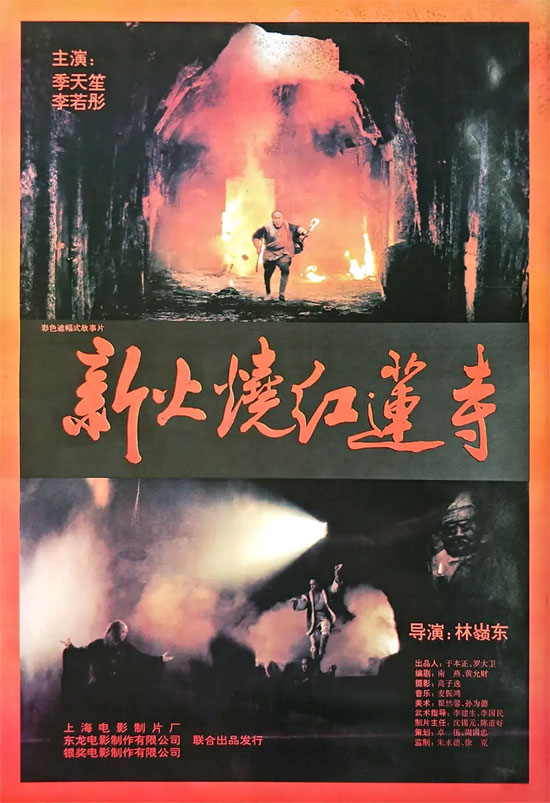
The 1994 version of The New Flaming Lotus Temple, produced by Tsui Hark, was something I watched as a child on VHS. Back then, I thought it was a horror film—it was bloody, I couldn’t read all the subtitles, and I barely grasped the plot, let alone understood what a New Wave martial arts film was. All I knew was that it featured Yuen Biao, and the fight scenes were pretty cool. Watching it again yesterday, I realized this film is incredibly interesting.
Those who roam the martial world value freedom and independence, unbound by constraints—a principle embraced by both Buddhist and Taoist disciples alike. Thus, whenever someone seeks to unify the martial realm, issue commands, or become the supreme leader, it often heralds a bloody storm. While The New Flaming Lotus Temple doesn’t follow this exact narrative, at its core, it’s a story of resistance against enslavement and violence. Undoubtedly, the film brims with the chaos of turbulent times and the essence of the martial world. The opening scene depicts the destruction of Shaolin Temple, where its disciples are forced to kneel before the gates while Qing soldiers burn scriptures with frenzied abandon. When the camera shifts to Red Lotus Temple, it reveals a cave-like monastery standing starkly in the barren desert, its crimson stone gates resembling a gaping maw. Outside, corpses litter the ground, piles of skulls dot the landscape, and the living buried alive have their hands raised to the sky. The grotesque Buddha statues all foreshadow this place as a hell on earth, reminding me of concentration camps. Perhaps the director also drew upon the element of Nazi concentration camps from World War II to amplify the terror and cruelty of the tyrannical ruler, the Divine Lord. Fong Sai-yuk was imprisoned in the heavily guarded underground dungeon of the Red Lotus Temple (though I still think concentration camp is a more fitting description), while the prostitute Dou Dou was offered to the Divine Lord as a concubine by his henchman, the Blood-Dripping Son. The most successful character in the film isn’t Fong Sai-yuk or Hung Hsi-kuan, but the demonic Shen Gong. When the rebellious Shaolin disciple battles the female henchwoman Cui He on the Life-and-Death Platform, Shen Gong makes his first appearance. Seated in an armchair surrounded by attendants, puffing on a tobacco pipe, he almost seems benevolent. This seemingly refined figure amuses himself by sketching ghostly symbols in his spare time, shrouding him in enigma. Witness his expression when the rebel falls into a trap, plummeting into a fiery pit to burn alive, and you grasp his utter cold-bloodedness. Fang Shiyu charges in to save the fallen, confronting Cuihe in combat. After defeating her and preparing to strike the Divine Lord, he is intercepted by the infiltrator Hong Xiguan. Ultimately, the wounded Fang Shiyu is cast into a pit of corpses—a place teeming with writhing maggots, scurrying rats, and scattered skulls. This scene has always struck me as straight out of a horror film.
The Divine Lord set his sights on Doudou. After being cleansed, she was brought into the bedchamber—a place inscribed as a paradise on earth. Of course, this applied only to the Divine Lord. In this hellish realm, he was a god, transcending all existence. This reminded me of a saying—Hu Si once remarked that the ultimate unwritten rule is “might makes right.” Dou Dou was terrified, yet the Divine Lord treated her with excessive tenderness. Unable to endure such sickening intimacy, she adopted the wanton demeanor of a prostitute. This enraged the Divine Lord, who flew into a rage, berating Dou Dou for disregarding chastity—how ironic! He claimed he was once the emperor’s loyal General of the Guard, dutiful and unwavering in his service. When he noticed his hair turning white, he realized everything would be lost with death. Understanding that life demands hedonism, he transferred to this lawless place to become his own little emperor—a ruler above all laws, with no one daring to defy his will. (The hedonistic worldview of an absolute ruler) A maid happened to enter the bedchamber and was instantly decapitated by the enraged Divine Lord. Blood spattered grotesquely onto the demonic talismans he had painted, filling Doudou with terror. Yet it was precisely her helpless, pitiful state that heightened the Divine Lord’s sadistic pleasure…
Honglian Temple was ultimately burned to the ground by Fang Shiyu and Hong Xiguan. Perhaps only fire could extinguish all the evil within its walls.
“Honglian Temple is as treacherous as the martial world itself. Where there are factions, there is strife. The victor becomes king, the vanquished becomes bandit—this is an ironclad truth… Only by abandoning your factions will Honglian Temple cease to exist, returning to the principle of ‘a new emperor, new ministers.’ If you remain stubbornly obstinate, you will only bring about your own destruction!” These were the words Shen Gong spoke to Fang Shiyu. Even if Fang Shiyu and Hong Xiguan had yielded, I believe this tyrannical, violent ruler would have sought out a second, a third Fang Shiyu and Hong Xiguan, forcing them to submit once more. If we liken the Red Lotus Temple to a nation, it is no different—like Cambodia’s Khmer Rouge regime in the 60s and 70s. Totalitarian tyranny may well revel in the thrill of violence and enslavement! This explains why the Divine Lord arrogantly scrawled “The Buddha Rejoices in Hell” upon the wall! The Buddha cares not whether you dwell in hell or heaven, for the tyrant and oppressor has crowned himself Buddha. Thus, every savior is yourself. Through resistance and awakening, you may save yourself—and thereby become Buddha.
Please specify:Anime Phone Cases » Burning Paradise 1994 Film Review: The totalitarian tyranny and perverse aesthetics of martial arts fiction.