Film Name: 锦绣前程 / Long and Winding Road / 錦繡前程
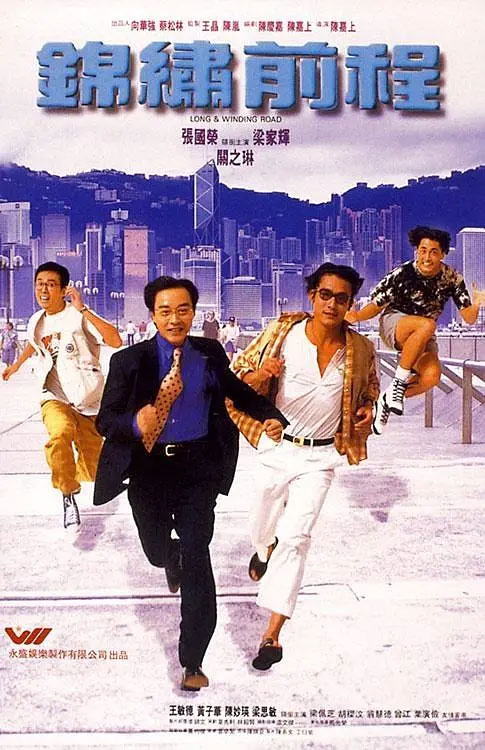
Everyone dreams of a bright future, especially men from the lower strata of society.
After watching Leslie Cheung’s “Long and Winding Road,” I felt a quiet joy. This is the purest Hong Kong cinema in my heart—a quintessential urban light comedy (a genre long extinct in Hong Kong today). The film’s tone is down-to-earth, streetwise, vulgar, daring, vibrant, and brimming with hope. It perfectly captures my youthful understanding of Hong Kong.
Leslie Cheung’s character, Lam Chiu-wing, is a complete scoundrel: an insurance broker swindling the elderly, cheating at mahjong with buddies when broke, always turning to Elaine (Yuen Siu-sing’s sister) penniless after being dumped by girlfriends, running a shady pirated goods business that gets his shop shut down, and then gambling away Yuen Siu-sing’s entire fortune in a desperate attempt to turn his luck around—only to lose everything.
Even in this state, he still pretends to be classy at fancy restaurants, where he and his companion secretly eat egg rolls while sharing a pot of tea. He approaches his goddess, Rosamund Kwan, without a hint of embarrassment. When he accidentally enters her company, he instantly hits it off with her cunning boss—two birds of a feather, conspiring in disgrace. In business, he showed no moral integrity whatsoever, even selling off Yuen Sze-sang’s nursing home. Always eyeing the next pot while eating from the current one, he immediately pestered the goddess-cum-money-goddess Rosamund Kwan relentlessly, dumping Elaine for the fifth time. Truly the ultimate toxic friend.
Tony Leung’s character, Yuen Sai-sang, represents another archetype of Hong Kong men. He’s not clever, timid, and avoids trouble, yet fiercely loyal to friends—though equally full of tricks. He lusts after Rosamund Kwan’s beauty but lacks the courage to act, while ignoring the affection of the shy Xiao Xian who adores him. Too scared to gamble himself, he gets swindled 362 times by Lam Chiu-wing yet still clings to luck, eventually gambling away his entire savings of HK$30,000 at the casino.
Then there’s Wong Tsz-wah’s homebody and Wong Man-tak’s SWAT officer who’s henpecked by his wife. Together, these four men form an urban male tragicomedy. But the most cunning of them all is the boss Bosco, played by Tsang Kong. “Any business that makes money is fair game”—greedy, ruthless, and shameless. Yet Tsang Kong’s portrayal is far from a stereotypical, formulaic villain or a hypocrite. He is a true villain who believes, “Emotions are emotions, business is business. Behind every deal lies a touching story, so tears flow freely while the money is collected.”
The male characters are all well-rounded, while the female roles fall far short—there’s little to say about them, as they’re mostly dutiful wives and mothers who follow their husbands’ lead. Even after enduring countless abuses, I treat you like my first love.
This is a standard Hong Kong industrialized film—a light comedy with a simple, smooth plot that’s clear and crisp. It avoids pretentious depth without being shallow, effectively capturing the social landscape of Hong Kong’s golden era in the 80s and 90s—the relentless pursuit of money and the fervent desire for success among ordinary people. Yet it also maintains a subtle warmth toward friends and family, portraying this aspect with remarkable nuance.
Take Lam Chiu-wing, for instance. Though cunning, he still remembers to give Yuen Sai-sang 200 bucks after winning at cards. When Yuen Siu-sang gets stood up by Rosamund Kwan, he still finds a way to help his friend fulfill his dream. It’s precisely this unshaken sense of decency that sustains their friendship—and of course, the three million dollars. Without that money, it would have been a tragedy. This is the film’s charm: offering hope amidst mundane, trivial lives, bringing a touch of joy when dreams come true.
Leslie Cheung and Tony Leung truly are exceptional actors. Tony’s portrayal of Lam Chiu-wing—with his slick hair, powdered face, and smooth-talking ways—executed evil deeds with such natural ease. It was a groundbreaking performance for Leslie. Without flashy looks or a larger-than-life persona, this role outshone even his iconic characters like Ashes to Ashes’ Ouyang Feng and The Story of Qiu Ju’s Cheng Dieyi. Why? Because he wasn’t some legendary figure—just a relatable, everyday “loser” we might encounter anywhere.
Tony Leung needs no introduction—he is unquestionably Hong Kong cinema’s finest actor, period. Whether playing heroes, comedians, period figures, modern characters, cops, gangsters, thugs, scholars, or knights—there’s scarcely a role he can’t master. He embodies every part he takes on. It’s hard to imagine characters like Yuen Sze-sang, Chow Wai-on, and Chow Chiu-sin converging in one man. His acting prowess is so extraordinary that you won’t find a second like him in Hong Kong, or even all of China.
“Long and Winding Road” is lighthearted, humorous, and brimming with the rich flavor of everyday life. It stands in stark contrast to Stephen Chow’s style of “over-the-top, pure madness” absurd comedies. Sadly, this kind of Hong Kong-style urban light comedy has vanished. Even after Stephen Chow’s absurd “madness” peaked, it left a mess in its wake. Hong Kong cinema, beyond its gimmicky, vulgar, and exaggerated antics, seems to have forgotten how to make comedy. The entire Hong Kong film industry has been in decline ever since. Films like “Mobfix Patrol” and “The Midnight After,” with their stale, decaying, and absurd black humor, have become the dominant tone of contemporary Hong Kong cinema—truly a cause for sighing and lamentation. The once dazzling, affluent, vibrant Pearl of the Orient has gradually faded, its once-promising future now a distant memory.
Please specify:Anime Phone Cases » Long and Winding Road 1994 Film Review: A promising future in one’s youth